The linkage gap behind foreign investment figures
In 2025, Singapore led in foreign direct investment (FDI) in Viet Nam with 6.98 billion USD, followed by China with 5.19 billion USD and the Republic of Korea with 4.20 billion USD. In the first eight months of 2026, major investment partners continued to include Singapore, the Republic of Korea, Hong Kong (China), Malaysia, China, and Japan.
These figures reflect Viet Nam's appeal amid shifts in investment flows and the restructuring of supply chains. However, behind the results in attracting FDI lies the question of how external capital can be connected with domestic production capacity: To what extent are Vietnamese businesses participating, and which stages of the supply chain can they undertake?
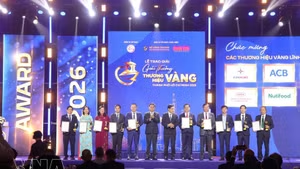
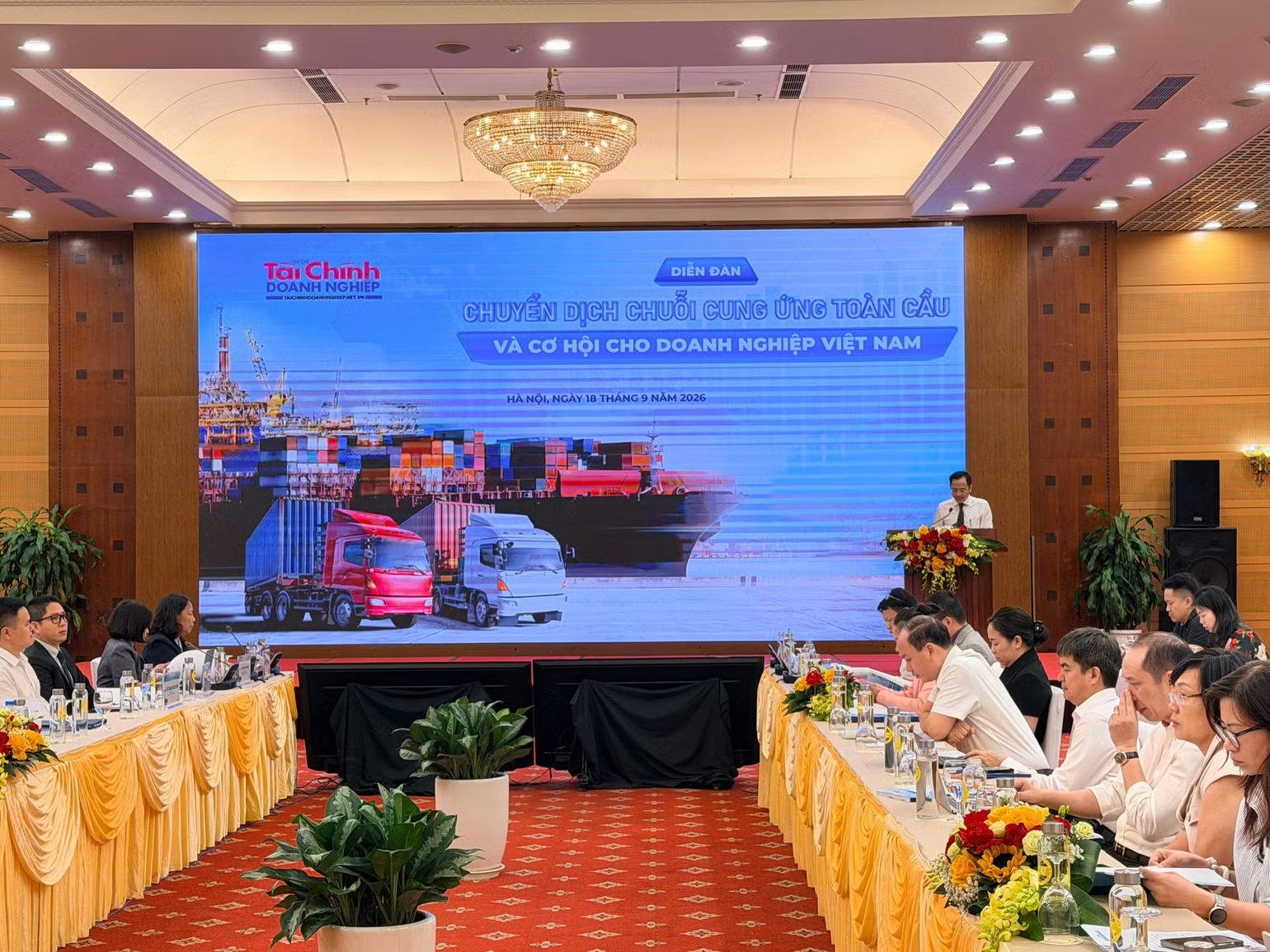
This was one of the issues raised at a forum discussing global supply chain shifts and opportunities for Vietnamese businesses recently held in Ha Noi.
Analysing supply chain shift trends, Dr Nguyen Anh Duong of the Institute for Policy and Strategy said that Viet Nam has continued to achieve positive results in attracting FDI, with China gradually becoming one of the country’s leading sources of investment.
FDI inflow, particularly from East Asia and the Pacific, has helped Viet Nam promote growth and exports, improve economic linkages, and more effectively implement free trade agreements.
The continued presence of many of the region’s major economies among Viet Nam’s key investment partners also creates opportunities for the country to participate more deeply in international production and trade networks.
However, opportunities do not automatically translate into greater capacity among domestic businesses. According to Nguyen Anh Duong, one of the challenges Viet Nam is facing is the lack of linkages between FDI enterprises and domestic businesses.
This linkage gap directly affects the ability of Vietnamese businesses to become suppliers to the foreign-invested sector, increase localisation rates, and participate in higher value-added stages of production.
Therefore, the effectiveness of investment attraction should be assessed not only on the basis of the scale of capital flow but also in terms of their spillover effects and the ability to develop domestic production linkages.
In addition to domestic limitations, the international trade environment is creating new requirements. Duong noted that Viet Nam is facing challenges arising from US import tariff policies since 2025 and technical criteria relating to inputs from a third economy.
These requirements make the origin of goods and sources of inputs increasingly important. Businesses participating in supply chains need to exercise greater control over raw materials, production processes, and related technical requirements if they are to maintain market access.
Viet Nam must also take into account the risk of a race to the bottom in ASEAN. As countries compete to attract shifting investment flows, competition based primarily on incentives may fail to create the necessary foundations to strengthen domestic production capacity.
In light of these challenges, Duong recommended shifting from a quantity-based approach to FDI attraction towards selective investment attraction, prioritising high-tech and innovation projects with linkages to domestic businesses.
Alongside project selection, Viet Nam needs to develop supporting industries and strengthen logistics, digital infrastructure and energy capacity, while enhancing the management of risks related to rules of origin and trade remedies.
These are essential conditions for building a resilient production ecosystem, diversifying markets, and strengthening Viet Nam’s economic autonomy.
Policies must incentivise stronger domestic capacity
If the selection of investment flows determines the quality of the inputs into the investment attraction process, the capacity of domestic businesses determines the extent to which opportunities arising from supply chain shifts can be harnessed.
Regarding tax policy, Le Thi Duyen Hai, Vice President and Secretary-General of the Viet Nam Tax Consultants Association, said the focus should shift from attracting investment into Viet Nam to upgrading the capacity of Vietnamese businesses to become high-value links in global supply chains.
This shift requires tax policy to be viewed beyond the goal of reducing immediate costs. According to Hai, tax policy should not merely aim to reduce tax liabilities, but, more importantly, create incentives for Vietnamese businesses to transform their growth models.
The chain of outcomes highlighted by Hai comprises technology, research and development, human resources, supply chains, and global markets. Technology, research and development activities, and the quality of human resources provide the foundation for businesses to improve their production capacity, thereby enabling them to participate more deeply in supply chains and access international markets.
This approach also demonstrates that support policies need to focus on businesses’ long-term upgrading capacity. If efforts stop at attracting more projects while domestic businesses lack the capacity to become suppliers, then improving the degree of linkages and the value retained in the economy will be difficult.
At the forum, delegates said that policies and the business environment play an important role in supporting businesses in adapting to supply chain shifts. Alongside tax policies and support measures, Viet Nam needs to develop supporting industries, enhance competitiveness, and strengthen linkages between domestic businesses and the FDI sector.
The goal is to increase localisation rates and establish high value-added production linkages. This requires Vietnamese businesses to proactively strengthen their capabilities, while policies need to create conditions for businesses to access orders, expand markets, and participate more deeply in regional and global supply chains.
Supply chain shifts offer opportunities to attract investment flows and expand markets, but they also highlight weaknesses in supporting industries, logistics, and production linkages.
Therefore, the issue is no longer simply about bringing more FDI into Viet Nam, but about selecting suitable investment flows and creating conditions for domestic businesses to gradually become high-value links in supply chains.