According to the Foreign Investment Agency (Ministry of Finance), to boost the investment environment’s appeal and attract next-generation FDI, it is essential to synchronously implement four groups of solutions — covering institutions, infrastructure, human resources, and support policies — thereby maximising the FDI sector's contribution to the economy.
Refining the investment environment to boost FDI attraction
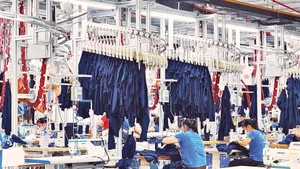
In recent times, FDI has played a vital role in economic growth, supplementing investment resources, boosting exports, creating jobs, and facilitating technology transfer.
However, the landscape for attracting international investment is shifting; competition among ASEAN nations is intensifying, while the implementation of the global minimum tax is fundamentally altering traditional investment incentive tools.
This necessitates that Vietnam continue to refine its investment environment, shifting the focus from competing via tax incentives to enhancing the quality of the investment climate and business support capabilities.
According to the Ministry of Finance, the first group of solutions involves reviewing, amending, and perfecting the legal framework for investment to ensure consistency, transparency, stability, and predictability.
Notably, in light of the global minimum tax implementation, the Ministry of Finance advocates a strong shift from tax incentive policies to investment support mechanisms based on actual costs.
Support policies will focus on infrastructure development, human resource training, research and development (R&D), innovation, and measures that help enterprises reduce investment costs and improve operational efficiency.
This approach reflects a trend adopted by many nations to maintain competitiveness in attracting high-quality FDI projects. Alongside policy refinement, administrative procedure reform remains a key priority.
Procedures concerning investment, land, construction, and the environment need to be reviewed to streamline processes and reduce processing times, thereby enabling the early implementation of projects.
The Ministry of Finance places particular emphasis on shortening procedural timelines for projects in high-tech sectors, the semiconductor industry, energy, and data centres — areas currently attracting interest from major global corporations.
Furthermore, procedures regarding work permits and visas for foreign experts require continued review and simplification to meet the demands of large-scale, high-tech FDI projects.
Facilitating the entry and work of international experts, engineers, and managers will help accelerate project progress while enhancing the absorption of technology and modern management expertise.
To ensure consistent policy implementation, the Ministry of Finance also proposes strengthening coordination mechanisms among ministries, sectors, and localities regarding investor management and support. This aims to ensure uniformity in policy execution and minimise regulatory overlaps or inconsistencies in application.
In addition to institutional refinement, infrastructure development is identified as a prerequisite for enhancing national competitiveness in attracting FDI.
According to the Ministry of Finance, priority must continue to be given to strategic infrastructure, particularly transport, energy, and logistics systems linked to key economic and industrial corridors.
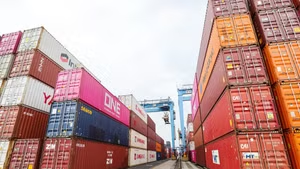
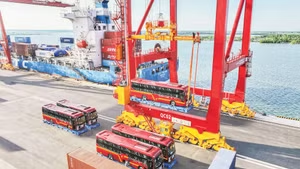
The focus lies on accelerating the development of inter-regional expressways, deep-water seaports, airports, and transshipment logistics systems to reduce transport costs, improve supply chain connectivity, and facilitate business production and operations.
Furthermore, the establishment and development of integrated industrial, urban, and logistics clusters — particularly in the key economic regions of the North, Central, and South — will create additional capacity to attract large-scale, concentrated FDI projects.
Regarding energy infrastructure, the Ministry of Finance emphasises the need to ensure a stable, long-term power supply for high-tech sectors, data centres, and the semiconductor industry.
At the same time, it is essential to accelerate the development of renewable energy in alignment with the green transition requirements of multinational corporations and broader sustainable investment trends.
Enhancing FDI quality through human resources and business linkages
Alongside institutional refinement and infrastructure development, the Ministry of Finance identifies human resources as a decisive factor in improving the quality of FDI attraction in the new era.
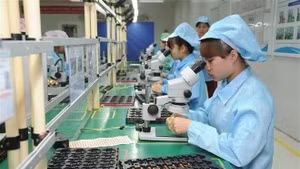
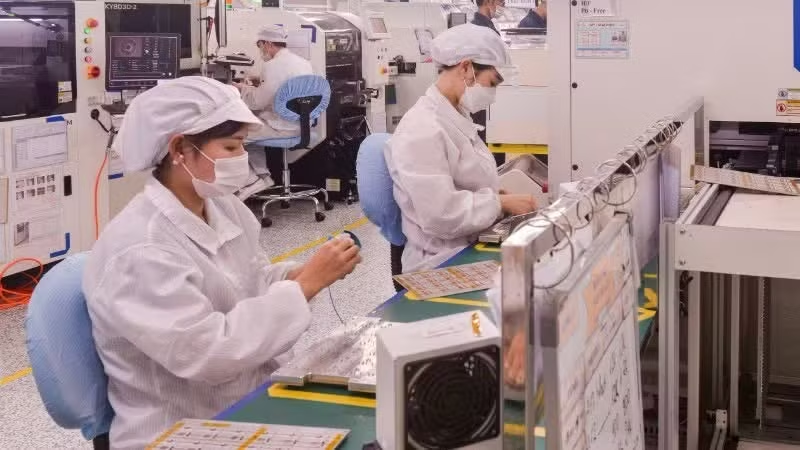
As investment attraction shifts strongly toward high-tech sectors — such as semiconductors, electronics, artificial intelligence, and data centres — the demand for a workforce with specialised expertise and technical skills is rising.
According to the Ministry of Finance, a shortage of highly skilled labour is directly affecting the implementation progress of numerous FDI projects.
To address this, it is essential to strengthen ties between training institutions and FDI enterprises, gradually establishing mechanisms for demand-driven training tailored to specific industries and companies.
The focus lies on sectors such as semiconductors, information technology, electronics, and artificial intelligence — industries that are expected to drive new economic growth in the near future.
In addition to training new personnel, the retraining and upskilling of the existing workforce must be accelerated to meet the demands of the shift toward high-tech manufacturing models.
This approach not only addresses immediate labour shortages but also enhances the overall quality of the workforce, improves the capacity to adopt new technologies, and meets the requirements of international investors.
Another solution emphasised by the Ministry of Finance is the refinement of mechanisms for attracting and utilising foreign experts. Accordingly, procedures for issuing work permits and visas need to be further simplified to facilitate the arrival of international experts, engineers, and managers to work in Viet Nam.
Attracting high-quality foreign talent is expected to boost technology absorption capabilities and management expertise, while helping domestic enterprises gradually integrate more deeply into global value chains.
In addition to human resource measures, the Ministry of Finance has proposed further reforming investment promotion activities to ensure a more targeted approach, specifically focusing on major technology corporations and high-value-added projects capable of technology diffusion and driving development across domestic economic sectors.
Another key priority is fostering linkages between the FDI sector and domestic enterprises. This strategy aims to increase localisation rates and enable Vietnamese businesses to integrate more deeply into global value chains, thereby maximising the spillover effects of the FDI sector on the broader economy.
Economists assess that the synchronised implementation of these four sets of measures — covering institutions, infrastructure, human resources, and support policies — will enhance the quality of FDI attraction in the new context.
Beyond merely attracting higher volumes of foreign capital, these measures aim to select projects that feature high technology content, are environmentally friendly, and possess the capacity to link with domestic enterprises and generate strong economic spillover effects.
This approach also lays the groundwork for the FDI sector to effectively drive innovation, boost labour productivity, enhance the competitiveness of Vietnamese enterprises, and contribute significantly to achieving the goal of double-digit economic growth.