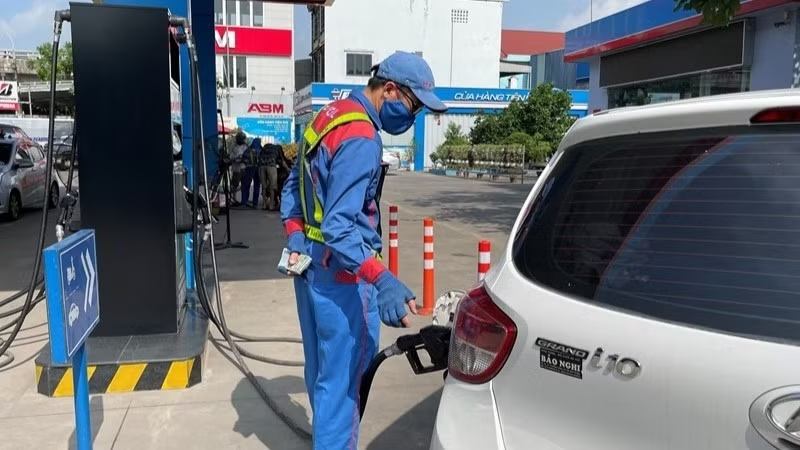
Easing cost pressures amid fuel price volatility
As the fourth quarter begins, management of the fuel market requires measures to limit the impact of fuel prices on production and people's livelihoods. Tax support policies were in place until September 30, 2026, while the global energy market continued to face risks. If the policies expired, tax costs could add to pressure on domestic retail fuel prices.
In a submission to the Government, the Ministry of Finance said the continued provision of time-limited tax support was necessary to prevent additional costs, help control inflation, stabilise production and business activities, and ensure energy supplies. The proposal takes into account oil price developments, the conflict in the Middle East and macroeconomic indicators.
According to information from the Ministry of Foreign Affairs cited in the submission, the conflict in the Middle East is likely to remain complex, with no clear end in sight. Even if the conflict ends soon, restoring oil production capacity and petroleum infrastructure in the region will take time. As a result, global oil prices are unlikely to fall rapidly and could remain high for an extended period.
Market movements in September showed that these pressures had not eased. The submission cited market developments on September 11, 2026, when Brent crude closed at around 104.61 USD per barrel, down 2.81% from the previous session, while WTI stood at 100.05 USD per barrel, down 2.37%. However, over the week as a whole, Brent rose about 8.65% and WTI increased by around 9.37%.
A decline in a single session while prices continued to rise sharply over the week highlights the need for caution when assessing the prospect of market cooling. According to the Ministry of Finance, risks of disruptions to transportation and supply continue to put pressure on oil prices, directly affecting fuel import, production and business costs and domestic retail fuel prices.
At the September 10, 2026 price-setting period, average global prices of RON92 and RON95 petrol products used to blend E5RON92 and E10RON95-III increased by around 9.28% and 9.21%, respectively, from the previous period. The price of 0.05S diesel rose by about 4.09%. The Ministry of Finance used these figures to assess the impact of international market developments on domestic prices.
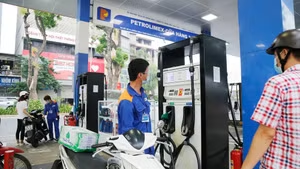
Following that price-setting period, the maximum retail prices were 23,744 VND per litre for E5RON92 petrol, 24,239 VND per litre for E10RON95-III and 28,485 VND per litre for 0.05S diesel. With average consumer prices rising 4.45% in the first eight months of the year, limiting fuel-related pressure remains an important task for economic management.
The issue is to avoid additional pressure from taxation while global prices remain volatile. The submission states that if the support policies expire without being extended, tax rates on fuel products will return to those stipulated under current regulations, raising retail prices compared with a scenario in which tax support remains in place.
The Ministry of Finance also considered the impact on transport and logistics costs and production and business activities. Extending the policies is intended to limit the impact on the consumer price index in the fourth quarter and reduce pressure on businesses and consumers. This is the policy's support objective and does not mean that fuel prices will fall in every price-setting period.
Maintaining support and diversifying supply sources
Alongside the need to control costs, the submission stresses the importance of continuing to facilitate the diversification of fuel supplies and raw materials for fuel production. Preferential import tariffs are being considered to give businesses more choices of markets and reduce the risk of dependence on traditional import sources.
According to the Ministry of Finance, extending the policies will enable businesses to import from a wider range of markets beyond ASEAN and the Republic of Korea, contributing to energy security. The objective links tax support with the need to secure supplies proactively amid continued instability in international markets.
The proposal also takes into account a recommendation from the Ministry of Industry and Trade. In Official Letter No. 7345/BCT-TTTN dated September 14, 2026, the ministry provided information on the implementation of Resolution No. 34/2026/NQ-CP and proposed that the authorities consider extending the measures through December 31, 2026.
During the drafting process, the Ministry of Finance sought opinions from seven ministries and the Viet Nam Petroleum Association. According to the submission, all agencies and organisations consulted had submitted their written opinions by the time of reporting and basically agreed with the draft. Their comments were considered and incorporated into the final dossier submitted to the Government.
Based on the Ministry of Finance's proposal, the Government on September 30, 2026 issued Resolution No. 43/2026/NQ-CP extending the preferential import tax, environmental protection tax and value-added tax policies applicable to petrol, oil, raw materials for petrol and oil production, and aviation fuel.
The resolution takes effect from October 1, 2026 through December 31, 2026. The new period immediately follows the previous policy period, ensuring continuous support throughout the fourth quarter. This also addresses the Ministry of Finance's requirement to avoid a legal gap in implementing the measures.
For preferential import tariffs, the Government extended the application of Resolution No. 25/2026/NQ-CP dated April 30, 2026 and Decree No. 72/2026/ND-CP dated March 9, 2026 through December 31, 2026. Article 1 covers petrol, oil and raw materials used to produce petrol and oil.
For environmental protection tax and value-added tax, the resolution extends through December 31, 2026 the application of the provisions in Articles 1 and 2 of National Assembly Resolution No. 19/2026/QH16 dated April 12, 2026. This is stipulated separately in Article 2 of Resolution No. 43/2026/NQ-CP.
The scope of this extension should be distinguished from special consumption tax. The resolution stipulates that special consumption tax on petrol will be implemented in accordance with Law No. 66/2025/QH15 on Special Consumption Tax and its implementing regulations. Therefore, the latest extension does not include an extension of the policy reducing special consumption tax on petrol.
The Government has also established a mechanism for adjusting the period of validity when necessary. To meet socio-economic development requirements, ensure energy security and stabilise the fuel market, the Ministry of Industry and Trade may submit proposals to the Ministry of Finance for consideration and submission to the Government to shorten or extend the application period.
With the measures now set to remain in effect through the end of the year, the policy will continue to ease cost pressures and facilitate broader supply options in the fourth quarter. The adjustment mechanism allows continued support to be reviewed in line with actual developments, while taking into account market stability and macroeconomic requirements.