Ready to adapt to new safety thresholds
Le Viet Anh, Secretary General of the Viet Nam Pepper and Spice Association, said that changes in the maximum residue limits (MRLs) for pesticides in many markets are affecting the spice sector. Specifically, regarding the active ingredient Chlorothalonil, Japan has proposed reducing the MRL for ginger from 0.05 mg/kg to 0.01 mg/kg, an 80% reduction. For Boscalid, Japan has proposed reducing the MRL for spices from 50 mg/kg to 40 mg/kg; for ginger alone, the limit would be cut sharply from 2 mg/kg to just 0.05 mg/kg, equivalent to a 97.5% reduction.
“Businesses exporting spices to Japan need to proactively review the list of pesticides used in raw-material growing areas, while consulting testing laboratories on appropriate limits of quantification (LOQs) for active ingredients with very low MRLs. Notably, with the proposed Chlorothalonil MRL for ginger at 0.01 mg/kg and the Boscalid MRL for ginger at just 0.05 mg/kg, residue control needs to be carried out from the growing areas rather than relying solely on testing finished products before export,” Le Viet Anh stressed.
In the European Union (EU) market, the European Commission made an announcement in July for detailed regulations on the import of animals, germinal products, and products of animal origin, which took effect on August 12, 2026. The important adjustments include updated requirements for dairy, meat, eggs, and composite products, as well as revisions to the list of aquatic species susceptible to disease and the identification of intermediate hosts. This shows that EU market management is increasingly focusing on product composition and the origin of each component.
Vietnamese businesses are expanding exports of deeply processed and convenience products to the EU. Therefore, a proper understanding of the regulations will help businesses standardise technical dossiers, prepare the correct import documents, and reduce the risk of being asked to provide additional documentation at EU border crossings.
According to Tran Hoang Luan, Sales Director of An Hai Seafood Company Limited, the US and Europe are the company's two main export markets, accounting for around 42% and 20-25% of sales, respectively. However, increasingly stringent requirements in Europe have had a direct impact on export operations. Therefore, alongside adapting to these requirements, the company is expanding into markets in Russia and South America.
Creating an advantage through compliant supply sources
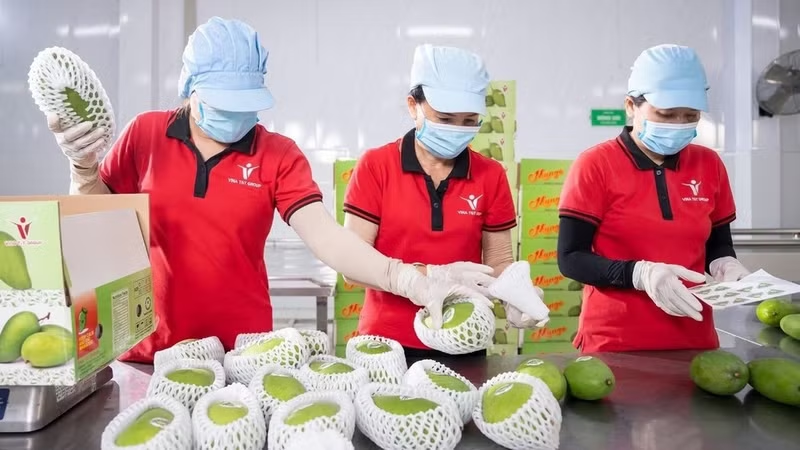
In response to increasingly stringent requirements for supply quality, Ngo Tuong Vy, General Director of Chanh Thu Fruit Import-Export Group Joint Stock Company, said that exporters need to change their mindset from “selling whatever is available” to identifying what the market needs and what businesses must do to meet those needs. In reality, it is very difficult to require individual farmers to independently meet all the strict standards imposed by import markets regarding pesticides, fertilisers, pre-harvest intervals, traceability, and growing-area codes. Therefore, businesses need to become more deeply involved in organising production, working with community-based agricultural extension services and local authorities, and investing in technical teams to work closely with farmers.
“However, businesses' proactive efforts need to be accompanied by practical support policies, particularly for small and medium-sized enterprises. Their limitations include a lack of resources for stages requiring substantial costs and long periods of time, such as market research, brand building, overseas intellectual property registration and protection, testing, certification, production-process conversion, traceability, and the development of international partner networks. Therefore, policy should shift its focus from supporting businesses after they receive orders to preparing their capacity before entering the market. Accordingly, state management agencies need to play an enabling role by providing market information, connecting businesses with overseas distribution systems, and introducing appropriate support programmes so that businesses can invest in standards, technology, and raw-material areas,” Vy proposed.
Taking a different approach, Minh Phu Seafood Group Joint Stock Company is focusing on improving production capacity and strengthening end-to-end control to meet the required supply volume and quality. According to General Director Le Van Quang, the company is considering investing in additional factories if demand from import markets continues to rise, while accelerating modernisation and automation amid the risk of labour shortages. The company aims to automate 70-80% of its production operations, with robots capable of performing a workload equivalent to around three workers and operating continuously across three shifts.
In addition, the company is testing fast-growing shrimp varieties to reduce farming costs, with the hope of soon limiting any disadvantages in terms of the production costs of Vietnamese shrimp. During the year-end peak trading period, these are essential conditions for retaining and expanding orders, reducing pressure on delivery schedules and costs, and meeting increasingly demanding market requirements.