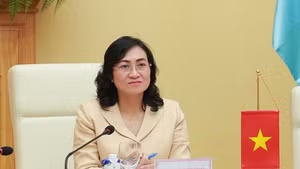
According to Nguyen Thi Bich Thuy, Deputy Head of the Division for Supporting Enterprises and Business Households, Department of Private Enterprise and Collective Economy Development under the Ministry of Finance, current support policies for small and medium-sized enterprises contain a number of provisions related to taxation and accounting aimed at reducing input burdens and simplifying the operations of enterprises, business households, and individuals.
These include abolishing the presumptive tax method and business licence fees; policies on value-added tax and personal income tax; and simplified accounting regimes for enterprises, micro-enterprises, business households, and individuals.
However, the issue of particular concern to the business community at present is the policy orientation for the development of small and medium-sized enterprises in the coming period, especially solutions to remove difficulties in accessing finance and credit.
After nearly 10 years of implementation, the 2017 Law on Support for Small and Medium-sized Enterprises has revealed a number of shortcomings, with access to credit being one of the notable limitations. In response to new requirements, the initial approach was to amend and supplement the existing law, which was later changed to the development of a replacement law.
One notable change is that the draft is oriented towards renaming the Law on Support for Small and Medium-sized Enterprises as the Law on the Development of Small and Medium-sized Enterprises. The Ministry of Finance is coordinating with agencies of the National Assembly and the Government, the State Bank of Viet Nam, ministries, sectors, and associations to finalise the draft, submit it to the Government and then, as planned, submit it to the National Assembly during its October 2026 sitting.
Creating conditions for enterprises to enhance their own capacity
According to Nguyen Thi Bich Thuy, the draft law is designed towards focused and targeted support, comprising two main groups of policies: general support policies, and key support policies for small and medium-sized enterprises.
The overarching view is to create conditions for enterprises to develop on their own, rather than focusing only on what enterprises will receive in terms of state support. State policies play the role of creating conditions for enterprises to enhance their capacity, expand their scale and gradually mature.

The goal is to support micro-enterprises in developing into small enterprises, small enterprises in growing into medium-sized enterprises, and medium-sized enterprises in becoming large enterprises. For business households and individuals, the policy aims to promote their transformation into enterprises.
Along with redefining the objectives, the draft law is approaching support through new methods. Instead of the state providing whatever content it has available, support could be delivered through mechanisms of commissioning, assigning tasks, or providing support vouchers to small and medium-sized enterprises.
The solutions are being developed to cover various aspects of business operations, from access to finance and credit to expanding domestic and international markets and promoting science and technology, innovation, participation in value chains, and the transition from business households to enterprises.
Among these, access to finance and credit is a key focus. The draft not only aims to diversify sources of capital supply but also proposes policies to help enterprises enhance their capacity, improve the transparency of their books, and standardise financial and credit information so that they can access capital more easily.
On the demand side of capital, the policy is expected to support small and medium-sized enterprises in making their books transparent and standardising financial and credit information, thereby improving their ability to access sources of capital. Alongside this are solutions to enhance production and business capacity, expand markets, apply science and technology, promote innovation, and participate in value chains.
As operational capacity improves and information becomes more transparent, enterprises’ demand for capital will also increase. This will give capital providers more favourable conditions to expand lending to the small and medium-sized enterprise sector.
According to a representative of the Ministry of Finance, the requirement is that once enacted, the law must address current bottlenecks and quickly take effect in practice. The Ministry of Finance is closely coordinating with the National Assembly’s Economic and Financial Committee, the State Bank of Viet Nam, VCCI, associations, and relevant ministries and sectors to continue reviewing and finalising the draft.
Financing based on business plans, data, and cash flows
One of the notable orientations of the draft law is to approach the issue of capital from both the supply and demand sides.
On the supply side, the state is expected to introduce policies to diversify and synchronise domestic and foreign sources of capital for small and medium-sized enterprises. Resources will not come only from credit but also from capital markets, investment funds, and domestic and international financial institutions.
Credit institutions and capital providers are encouraged to develop products and financing methods suited to the characteristics of each group of small and medium-sized enterprises.
Emphasising the need to innovate the basis for financing decisions, Nguyen Thi Bich Thuy said: “The question is how to enable capital providers to provide financing and capital based on production and business plans, repayment plans, revenue, data, cash flows, and other lawful information, rather than relying solely on collateral.”
Under the proposed orientation, capital providers may consider financing on the basis of enterprises’ production and business plans, repayment plans, revenue, data, cash flows, and other lawful information.
Along with innovating the basis for financing decisions, the draft aims to diversify forms of financing. In addition to conventional credit, small and medium-sized enterprises may access forms such as factoring, financial leasing, supply-chain, or value-chain financing.
Measures for securing loans are also being oriented towards expansion. Instead of relying solely on real estate, security may be associated with movable assets, assets to be formed in the future, intellectual property rights, receivables, or cash flows.
To promote financing based on data and cash flows, the state needs to build a database on enterprises. According to Nguyen Thi Bich Thuy, the database must provide substantive information that accurately reflects enterprises’ operations, helping capital providers have a more reliable basis on which to consider financing.
The draft law is also expected to include provisions on the development of credit rating organisations and credit scoring organisations for small and medium-sized enterprises. The establishment of these organisations aims to increase enterprises’ opportunities to access sources of capital.
Alongside credit, the draft is expected to provide for private venture capital funds for small and medium-sized enterprises. This is not an entirely new provision, as the 2017 Law on Support for Small and Medium-sized Enterprises already contains provisions on innovative start-up investment funds. The implementation of Resolution No. 57 has also introduced legal provisions related to the establishment of venture capital funds at national and local levels.
In this draft law, the scope is defined as private venture capital funds. This provision aims to establish an additional channel of capital supply for small and medium-sized enterprises, with a focus on innovative start-ups.
Another issue attracting the attention of enterprises is the proposal to raise the revenue threshold for applying the simplified tax calculation method. The Ministry of Finance is coordinating with the National Assembly’s Economic and Financial Committee, the Viet Nam Chamber of Commerce and Industry (VCCI), and relevant associations to study the inclusion of this provision in the draft law.
According to Nguyen Thi Bich Thuy, the option currently being finalised is expected to apply to enterprises with revenue of up to 10 billion VND from the 2026 tax year, if approved by the competent authorities.
The provisions currently being developed show that the draft Law on the Development of Small and Medium-sized Enterprises aims to bring about simultaneous changes in both support mechanisms and mechanisms for accessing capital. The focus is on creating conditions for enterprises to enhance their capacity, improve operational transparency, expand their scale, and access resources suited to their development process.