Key sectors record solid growth in the first five months
In the opening months of 2026, the tourism industry continued to show encouraging signs, with both domestic and international visitor numbers rising in many localities. Le Mong Thu, Deputy Director of Saigon–Con Dao Hotel, said the sharp increase in arrivals to Con Dao during the first months of the year had provided an optimistic outlook for tourism businesses.
“At our hotel, occupancy rates have remained high, with rooms frequently fully booked during weekends and public holidays,” she said.
In response to growing travel demand, businesses are stepping up workforce training, improving service quality and expanding promotional activities to capitalise on market growth opportunities.
The recovery of tourism enterprises reflects a broader rebound in the domestic services and consumer sectors. According to the National Statistics Office under the Ministry of Finance, Viet Nam welcomed nearly 11 million international visitors in the first five months of the year, up almost 15% year-on-year and the highest figure ever recorded.
This has not only provided a boost to the tourism industry but has also supported related sectors such as transport, accommodation, food services and retail. Total retail sales of goods and consumer service revenues rose by more than 11% during the period, indicating continued improvement in domestic demand.
Assessing current growth drivers, Do Thi Ngoc, Deputy Director of the National Statistics Office, said that alongside tourism’s strong performance, foreign investment inflows are also providing an important boost to the economy.
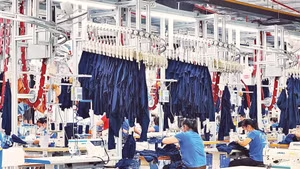
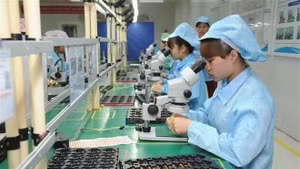
Beyond the services sector, manufacturing has also recorded encouraging results. The Index of Industrial Production (IIP) rose by 9.1% compared with the same period last year, marking the highest increase in four years. This suggests that manufacturing activity is recovering relatively evenly across industries, helping to strengthen business confidence.
Meanwhile, state budget-funded investment disbursement exceeded 254 trillion VND (9.6 billion USD), up 11.2% year-on-year. Improved public investment disbursement has not only generated jobs but has also stimulated demand in construction materials, building activities and related services.
Notably, foreign direct investment (FDI) continued to maintain strong growth momentum. Total registered FDI reached nearly 25 billion USD, an increase of almost 35% from a year earlier. Amid intensifying global competition for investment, this result demonstrates that Viet Nam remains an attractive destination for international investors.
Overall, traditional growth drivers – investment, consumption, and exports – are now being reinforced by new drivers from tourism, services and the ongoing global supply chain realignment. This provides an important foundation for maintaining economic growth during the remainder of the year.
Strengthening domestic capacity for sustainable growth
Despite these positive developments, the economy continues to face significant challenges.
According to Do Thi Ngoc, pressure on the 2026 growth target remains substantial, as all three key growth drivers – exports, investment and consumption – require stronger support against a backdrop of continued global economic uncertainty.
“Exports are growing strongly, but imports are increasing even faster. We need to absorb investment capital more effectively to support production while maintaining control over domestic prices to preserve macroeconomic stability,” she said.
According to Do Thi Ngoc, Deputy Director of the National Statistics Office: “International tourist arrivals have surpassed 10.6 million. Foreign investment inflows exceeded 24.8 billion USD, up more than 34%. Realised FDI reached 9.15 billion USD, the highest level in five years.”
In fact, imports are growing faster than exports, causing the trade balance to shift into deficit. At the same time, fluctuations in energy prices and input costs continue to place pressure on production and business activities.
Experts believe that, as opportunities to expand exports are increasingly affected by uncertainties in global trade, the domestic market should be regarded as an even more important pillar of growth.
Dr Can Van Luc argued that, with a population of more than 100 million, domestic consumption still offers substantial untapped potential.
“We need to maintain price stability, continue implementing demand-stimulation programmes, and ensure employment and income growth for citizens. At the same time, consumer finance and consumer lending could be expanded in a prudent manner,” he suggested.
From an international perspective, the World Bank (WB) believes Viet Nam possesses significant advantages to sustain growth over the medium and long term. According to Tehmina Khan, the World Bank’s Lead Economist for Viet Nam, Cambodia and Laos, the resilience of Viet Nam’s economy has improved markedly in recent years.
“Last year, Viet Nam’s economy grew by 8%, the highest rate in ASEAN despite uncertainties in global trade,” Khan noted.
However, the World Bank also highlighted several bottlenecks that need to be addressed. The gap between the FDI sector and domestic enterprises remains considerable; small and medium-sized enterprises continue to face capacity constraints; and dependence on external demand remains relatively high.
According to Tehmina Khan, the priority now is not only to identify the right reform agenda but also to improve implementation effectiveness. Public investment programmes should be delivered on schedule and concentrated in areas capable of generating significant spillover effects across the economy.
The World Bank forecasts that Viet Nam’s economic growth will remain between 7 and 8% in the coming years, among the highest rates in the region. Regarding the goal of achieving double-digit growth during the 2026–2030 period, the organisation believes Viet Nam has the potential to realise this ambition if it continues pursuing reforms and effectively harnessing its growth drivers.
However, as Tehmina Khan cautioned, growth speed is not the sole objective: “More important is the quality of growth, the ability to create better jobs, improve labour productivity and strengthen the economy’s resilience to future shocks.”
The results achieved during the first five months of the year suggest that Viet Nam has solid grounds for optimism about economic performance in 2026. Nevertheless, turning current growth drivers into a foundation for long-term development will require continued efforts to strengthen domestic capacity, improve investment efficiency, support local enterprises and maintain macroeconomic stability.