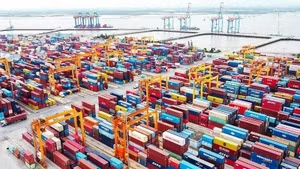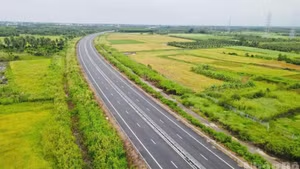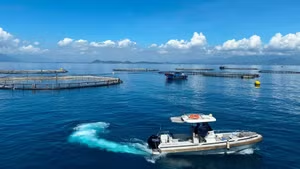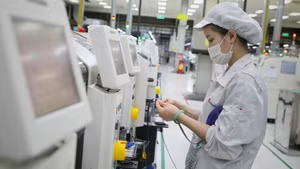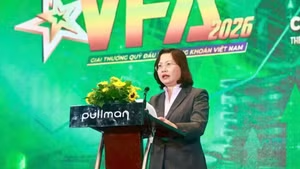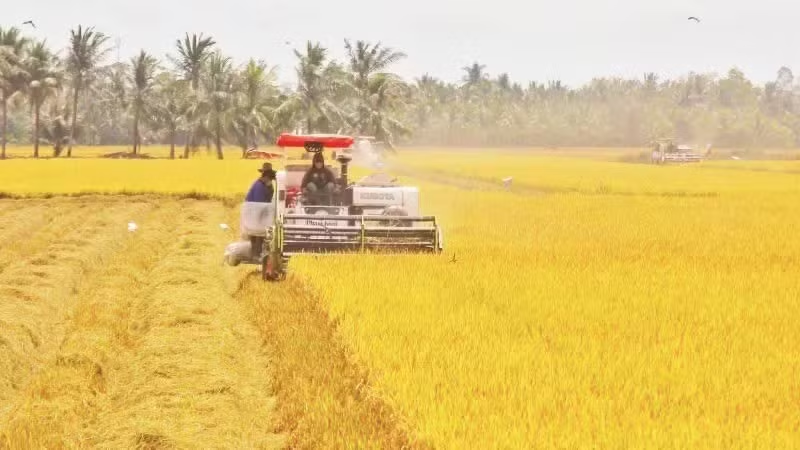
In an ambitious yet challenging macroeconomic picture, the agricultural sector is expected not only to maintain its role as a “pillar” of the economy amid volatility, but also to transform and generate breakthrough added value. The whole sector has set this year’s GDP growth target at 3.7–4%, with total export turnover of agricultural, forestry, and aquatic products expected to reach 73–74 billion USD.
Luong Quoc Doan, Chairman of the Viet Nam Farmers’ Union, said: To contribute to the double-digit growth target in preparation for the 100th anniversaries of the founding of the Party and the country, the agricultural sector must strive to achieve growth of 4–5%. This is a task that requires dedication and a complete change in thinking and action in the union’s work and the farmers’ movement nationwide.
However, in reality, shifts in production mindsets amond some farmers remain sluggish. The lack of cohesion in sustainable value chains leaves Vietnamese agricultural products, despite being diverse and abundant, frequently vulnerable to market fluctuations and climate change. The capacity of some grassroots-level union officials still falls short of the strict requirements and standards of modern agriculture.
To contribute to the double-digit growth target in preparation for the 100th anniversaries of the founding of the Party and the country, the agricultural sector must strive to achieve growth of 4–5%. This is a task that requires dedication and a complete change in thinking and action in the union’s work and the farmers’ movement nationwide.
Luong Quoc Doan, Chairman of the Viet Nam Farmers’ Union
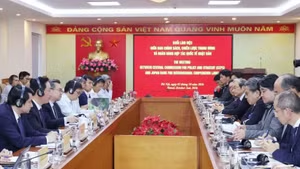
Facing these challenges, as a core socio-political organisation and a trusted companion of the peasantry, the Viet Nam Farmers’ Union has identified and vigorously implemented comprehensive breakthrough solutions. Notably, it has proactively engaged in the formulation of mechanisms and policies on agriculture, farmers, and rural areas. The presence of union chapters at all levels is built on staying close to the grassroots and listening fully and substantively to the thoughts, aspirations, and difficulties of farmer members.
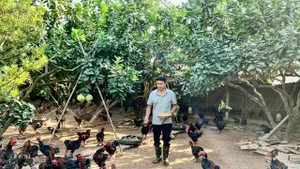
Alongside mechanisms and policies, the Viet Nam Farmers’ Union regards changing production methods as a decisive solution, focusing resources to support members in shifting strongly towards collective economic development and ending isolated production. The union has strongly urged the Government and relevant ministries to issue practical preferential policies to attract and encourage major enterprises to invest deeply in the preservation and processing of agricultural products.
This is the key to increasing value content and shaping the brand of Vietnamese agricultural products, rather than allowing farmers to toil on their homeland only to export raw products at values incommensurate with their efforts. Farmers in the new era cannot rely only on instinct or experience, but must be systematically trained to master high-tech techniques and be ready to meet the demands of global digital transformation.
Farmers’ Unions at all levels need to step up efforts to diversify forms of scientific and technical transfer to bring knowledge to fields and gardens. They must attract more young intellectuals, especially those with experience, capacity, innovative thinking, and the aspiration to develop agriculture and renew the face of rural areas.
To address farmers’ thirst for capital, union chapters at all levels obstacles through unsecured lending and make effective use of 200 trillion VND in entrusted outstanding loans through the union’s channels to support farmers in production and business.
The year 2026 is entering the final stretch. Double-digit growth is a demanding target, but it is entirely achievable if bottlenecks are cleared, and sufficient resources and determination are mobilised. With the orientation, close partnership, and practical decisions of the Viet Nam Farmers’ Union, this is not merely about completing a short-term economic target. More deeply, it is a process of affirming farmers’ position as masters on their homeland, turning agriculture from a quiet “pillar” into a dynamic driver, contributing to the country’s rapid and sustainable development in the nation’s new era.