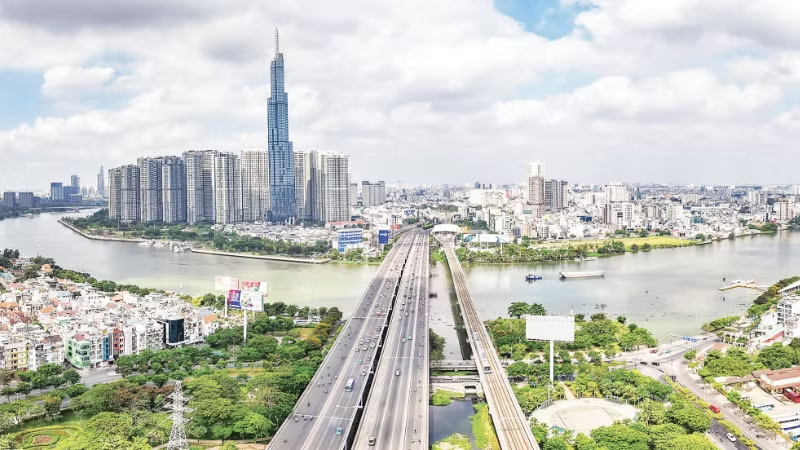
As Viet Nam enters a new era of development, the city drives pioneering innovation, aspiring to become a smart, modern global city with the competitiveness and stature of the world's leading metropolitan areas.
A mark of pioneering spirit and innovation
In the early 1990s, when Viet Nam was initiating the Doi Moi (Renewal) process, the South Saigon area remained a vast marshland with poor transport links. Few could have imagined that it would one day become one of the country's model urban developments.
However, with a strategic vision, an innovative mindset, and the determination to overcome institutional and policy barriers, Ho Chi Minh City launched the Phu My Hung Urban Area project. Its partnership with a foreign investor to develop the country's first modern urban area not only marked a breakthrough in urban planning but also introduced a new approach to market-oriented development and the mobilisation of social resources.
Scientist and architect Ngo Viet Nam Son recalled: "When I surveyed South Saigon before the project began, I had to travel by boat. It was a wetland, and few believed a modern urban area could emerge there." According to him, the city’s willingness to think boldly, act decisively, and embrace advanced global development models that transformed what once seemed impossible into reality. It also marked the first public-private partnership with a foreign investor in urban development in Viet Nam, creating valuable experience that was later replicated nationwide and contributed to the development of many new urban areas.
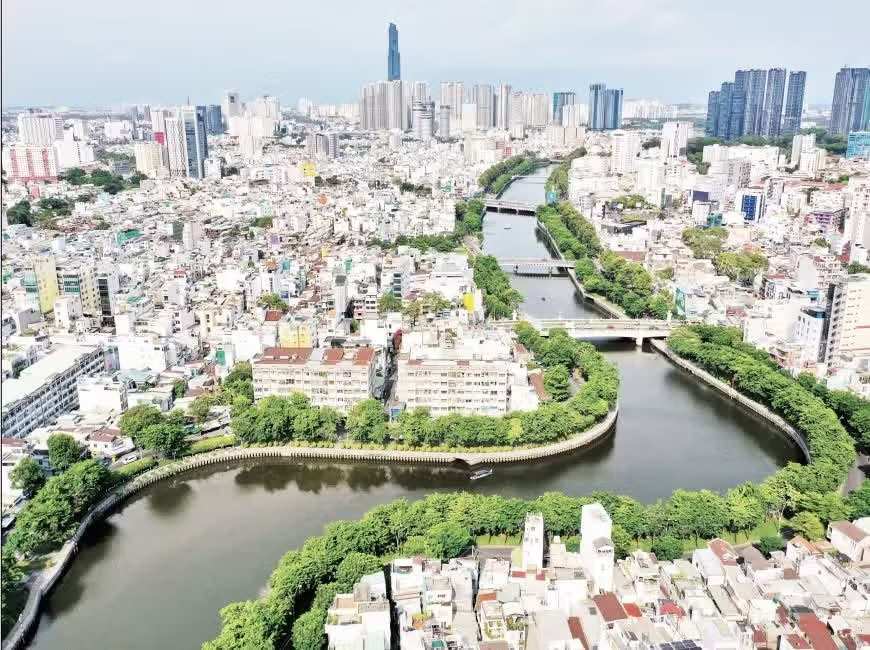
Phu My Hung was not an isolated success. Rather, it reflected a defining characteristic that has been cultivated throughout Ho Chi Minh City's development journey.
Pham Chanh Truc, former Deputy Head of the Party Central Committee's Economic Commission and former Permanent Deputy Secretary of the Ho Chi Minh City Party Committee, said the city's achievements over the past five decades demonstrate this spirit. Ho Chi Minh City has consistently been the country's pioneer in reform, piloting unprecedented policies to generate breakthrough development models, not only driving the city's own growth but also serving as practical experience later institutionalised and replicated nationwide.
Prominent examples include the Tan Thuan Export Processing Zone, Viet Nam's first export processing zone, which pioneered the country's foreign direct investment (FDI) attraction mechanism; Quang Trung Software City, an early model for software industry development and digital transformation; and the establishment of the Ho Chi Minh Stock Exchange (HOSE), which laid the foundation for Viet Nam's modern capital market and created a long-term financing channel for economic development.
According to Dr Tran Du Lich, former Director of the Ho Chi Minh City Institute of Economics, many of Viet Nam's major market-oriented economic policies originated from the city’s practical initiatives. Since the early 2000s, the Politburo has issued a series of resolutions on Ho Chi Minh City's development, progressively expanding decentralisation and delegation of authority to enable the city to pilot new policy mechanisms and fully leverage its dynamism and creativity in mobilising development resources.
Building on these policies, the National Assembly has also adopted several resolutions granting the city special mechanisms and policies, creating greater institutional space for continued innovation — from Resolution No. 54/2017/QH14 to Resolution No. 98/2023/QH15 and Resolution No. 260/2025/QH15.
Centre for innovation and driving growth
From a city devastated by war, Ho Chi Minh City has grown into Viet Nam's largest economic centre, serving as the country's principal growth engine and a strategic development pole. Following the expansion of its development space on July 1, 2025, the city now possesses exceptional advantages, with an economy estimated at approximately 3 quadrillion VND (around 115 billion USD), providing about 23.5% of the nation's gross domestic product (GDP) and nearly one-third of total state budget revenue.
Beyond its expanding economic scale, the city is profoundly transforming toward a development model driven by science and technology, innovation, and the digital economy. These emerging growth drivers are laying the foundation for higher productivity, stronger competitiveness, and more sustainable economic growth.
In its long-term vision, Ho Chi Minh City aims to sustain double-digit economic growth over many consecutive years, aiming to achieve a per capita gross regional domestic product (GRDP) of at least 100,000 USD by 2075. In the longer term, it aspires to become a global city — a dynamic symbol of Viet Nam's development in the 21st century, a hub for innovation, international competitiveness, and national aspirations. At the same time, the city aims to maintain its pioneering role in institutional reform, governance excellence, and national growth leadership.
According to Dr Huynh The Du from the Fulbright School of Public Policy and Management, in this new stage of development, Ho Chi Minh City should evolve beyond the country's economic engine to become a centre that creates new value, builds interconnected development networks, removes institutional bottlenecks, and generates momentum for the entire southern region and the nation as a whole.
To realise this ambition, alongside leveraging its own internal strengths, the city receives strong support from the central Government through policies to improve institutions and address long-standing development constraints. The proposed Law on Special Urban Administration, currently under preparation, is expected to establish a breakthrough institutional framework that will unlock new opportunities for the city's future development.
Nguyen Van Duoc, Member of the Party Central Committee and Chairman of the Ho Chi Minh City People's Committee, affirmed that the city recognises its position, role, and responsibility in the country's development and remains committed to the principle of acting "for the nation and together with the nation" in every major policy decision.
Half a century after being named after President Ho Chi Minh, the city has become a symbol of pioneering spirit and innovation. With the forthcoming Law on Special Urban Administration, which is widely regarded as a "breakthrough of breakthrough" in institutional reform, Ho Chi Minh City should gain greater autonomy to unlock its potential, mobilise resources more effectively, and realise its aspiration of becoming a modern, globally connected, and highly liveable city.

![[Infographic] GRDP growth scenarios for 34 provinces and cities in fourth quarter of 2026](https://en-cdn.nhandan.vn/images/nyM650OGFWrOVWc-xajqN-rTZ68Rlmc1fiGJOhBRYHFSa4DhrHNDxEFdnz313Vk5dNJuxdkHglPA3rLeaPeiaUheNuCI723k2lNssd-YLJuKR58epWq7s21lV5WjM-HR2-Qpbi4MwAzqt9wRjL4WjGkfEz7RO9qhcwg8o8LQFK8/grdp-growth-scenarios-for-34-provinces-and-cities-in-q42026-anh-dai-dien.jpg.avif)