Gradually mastering next-generation breeding technologies
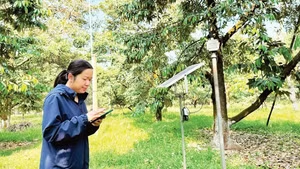
Standing amid vast plantations of tissue-cultured bananas, Duong Minh Toan, Director of An Thinh Khang-Farm Joint Stock Company in Gia Lai Province, explained that variety selection accounts for 70–80% of productivity in commercial banana production. "When bananas are propagated using traditional suckers, plantations tend to develop unevenly, affecting fruit quality and harvest schedules. Tissue-cultured plants, by contrast, offer clear advantages. They are disease-free and vigorous, produce larger bunches and consistently meet high commercial standards. Thanks to this, the facility can apply fertilisation, crop management and harvesting uniformly.
The consistency in both fruit quality and yield has enabled the company to access demanding export markets. The company currently cultivates 16 hectares of bananas, producing more than 640 tonnes of commercial bananas annually, all of which are exported to Japan, the Republic of Korea and the Middle East.
According to the Department of Crop Production and Plant Protection under the Ministry of Agriculture and Environment, crop varieties constitute the strategic starting point of agricultural production. In practice, the adoption of new varieties has increased yields by 8–15%, depending on the crop, while improving economic returns, enhancing farmers' livelihoods and transforming the crop production sector.
Son La Province provides a notable example of the benefits of introducing improved crop varieties. In 2016, the province cultivated only 12 major fruit crops, most of which consisted of older varieties with relatively low productivity and quality. By 2025, the number of fruit crop varieties had doubled to 24.
The province has successfully commercialised numerous high-value specialty varieties, including Anh Vang 205 longan, SR1 custard apple, Thai Bao yellow passion fruit, Booth avocado and green-skin pomelo. This transformation has played a significant role in establishing standardised production areas, making Son La the largest fruit-growing region in northern Viet Nam and one of the country's leading agricultural export hubs.
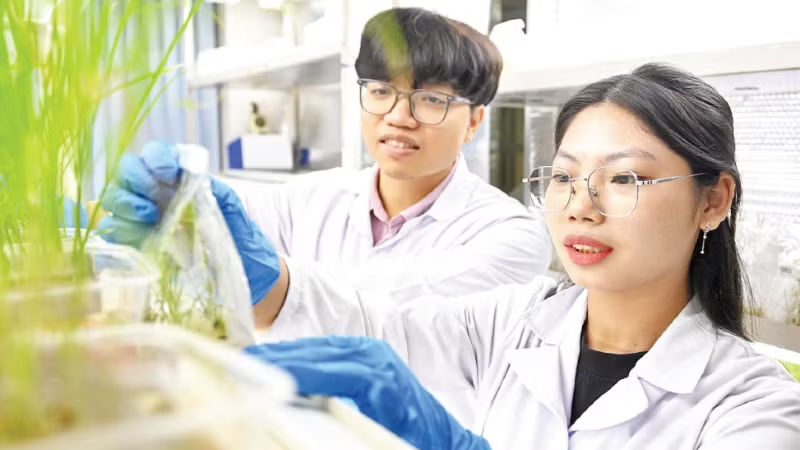
Viet Nam has achieved significant progress in crop breeding in recent years. The widespread application of modern technologies, including molecular biology, tissue culture and DNA sequencing, has substantially shortened breeding cycles, leading to the development of new varieties with higher yields, better quality and greater resilience.
According to Nguyen Quoc Manh, Deputy Director of the Plant Production and Protection Department under the Ministry of Agriculture and Environment, Viet Nam has achieved significant progress in crop breeding in recent years. The widespread application of modern technologies, including molecular biology, tissue culture and DNA sequencing, has substantially shortened breeding cycles, leading to the development of new varieties with higher yields, better quality and greater resilience. Many high-quality rice varieties, including ST24, ST25 and OM18, along with hybrid maize, soybean, coffee and fruit tree varieties, have delivered considerable economic value and gained widespread adoption.
Notably, Viet Nam is gradually mastering next-generation breeding technologies, particularly gene-editing technology, laying an important foundation for developing crop varieties that are better adapted to adverse conditions and capable of meeting increasingly demanding market requirements.
Expanding public–private partnerships
Despite these encouraging achievements, crop breeding and variety development in Viet Nam continue to face numerous challenges, particularly regarding policy frameworks and investment resources.
According to Tran Xuan Dinh, Vice Chairman and Secretary General of the Viet Nam Seed Trade Association, current procedures for variety testing and commercial approval of major crops remain cumbersome, resulting in significant time and financial costs. Several Vietnamese Standards, especially those governing Value for Cultivation and Use (VCU) testing, have become outdated. Some evaluation criteria are no longer appropriate, while the requirement for extensive multi-location trials places a heavy financial burden on enterprises, discouraging investment.
In addition, the legal framework has not kept pace with technological advances or production realities. Regulatory documents are often issued slowly and lack detailed implementation guidelines. While many countries have rapidly commercialised emerging technologies such as gene editing, related research projects in Viet Nam have had to remain on hold for years pending regulatory approval.
Investment in science and technology also remains fragmented, with insufficient focus on priority areas, while cumbersome financial settlement procedures continue to constrain research activities.
Meanwhile, current incentive mechanisms have yet to provide adequate motivation for scientists engaged in crop breeding. Weak enforcement of intellectual property rights and insufficient penalties for counterfeit and substandard seed trading also remain persistent concerns.
Tran Manh Bao, Chairman of ThaiBinh Seed Group, called on relevant authorities to strengthen intellectual property protection to safeguard the legitimate rights of plant breeders while expanding preferential policies on taxation, credit, science and technology funds, and support for research and development (R&D).
He also urged the Government to facilitate enterprises' access to land, testing facilities and research infrastructure, while promoting public–private partnership models in crop breeding.
Accordingly, the public sector would focus on investing in basic research, genetic resources and shared infrastructure, whereas private enterprises would take the lead in applied research and commercialisation.
The objective is not merely to increase the number of enterprises involved, but more importantly to develop strong domestic seed companies capable of innovation, technological self-reliance and international competitiveness.
Enterprises are the driving force behind innovation and the commercialisation of crop breeding research. Therefore, agricultural sector will continue improving policies to create a more favourable environment for long-term private investment in breeding programmes. It will also strengthen support for advanced research, high-quality human resource development, legal reform, intellectual property protection and public–private cooperation to accelerate the transfer of research outcomes into commercial production.
According to Huynh Tan Dat, Director of the Plant Production and Protection Department, enterprises are the driving force behind innovation and the commercialisation of crop breeding research.
Therefore, agricultural sector will continue improving policies to create a more favourable environment for long-term private investment in breeding programmes. It will also strengthen support for advanced research, high-quality human resource development, legal reform, intellectual property protection and public–private cooperation to accelerate the transfer of research outcomes into commercial production.
Relevant agencies will continue developing high-yield and high-quality crop varieties with improved resistance to pests and diseases, greater resilience to climate change and suitability for green and low-emission agricultural development.
It is crucial to expand the application of next-generation breeding technologies, including genome editing, artificial intelligence, big data and digital transformation. At the same time, Viet Nam will build a national genetic resources database, establish a digital gene bank and develop a digital seed management system to strengthen both public administration and research capacity.



![[Video] Resolution No. 10 repositions FDI in Viet Nam's new development strategy](https://en-cdn.nhandan.vn/images/5992a12dd6e78b9bfb434962ff1830731c3ef6c1538d722fbb2593b0fa31ecfea73ea406e335bb4f889623e75863a3fa5de1ba084f5b1db0b5788c84a44f1d4c/anh-dai-dien.jpg.avif)