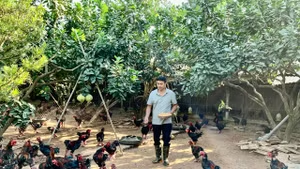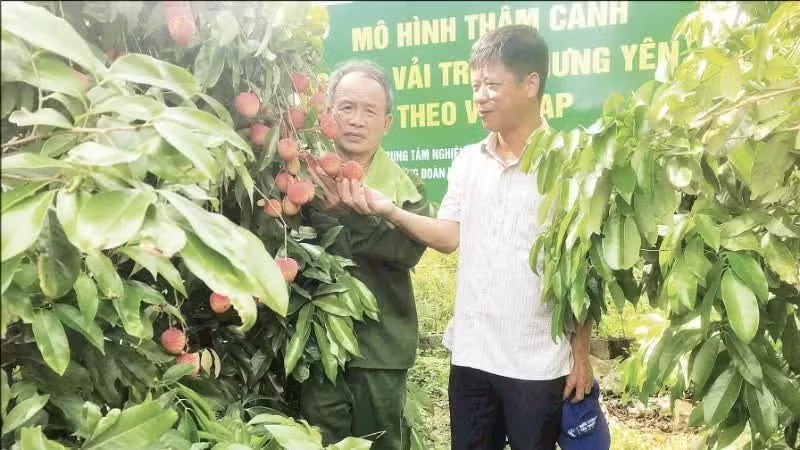
While this year’s lychee crop has suffered poor yields and reduced productivity in many areas, the VietGAP-oriented intensive cultivation model adopted by Le Ngoc Thuong’s family in Doan Dao Commune, Hung Yen Province, in 2025 has continued to generate substantial economic benefits.
Thuong said: “My family has been growing vai trung lychee, an egg-shaped local lychee variety, for six years. During the first few years, income from our orchard was modest because pests and diseases affected production, resulting in inconsistent fruit quality. Since joining the VietGAP model, we have followed the prescribed technical cultivation procedures. In the very first season, both yield and fruit quality improved significantly. In subsequent seasons, the fruit has become increasingly attractive and uniform. This year, lychees from my orchard are selling for around 220,000–250,000 VND/kg (8.4–9.5 USD/kg), nearly double the price achieved in the previous season.”
Nguyen The Bien, Chairman of the Board of Directors of the Doan Dao Lychee Cooperative, said: “The cooperative currently has more than 50 hectares of lychee cultivation, including 10 hectares farmed by 36 households participating in the VietGAP-oriented intensive cultivation model supported by the National Agricultural Extension Centre under the Ministry of Agriculture and Environment. Thanks to the application of comprehensive cultivation techniques, pest and disease management measures, and biological fertilisers, lychee orchards within the model have developed well. In favourable seasons, yields can exceed 10 tonnes per hectare, generating substantial profits for farmers.”
In Ninh Binh Province, Yen Cuong and Dong Thai communes are implementing a project to produce new peanut seed varieties, L32 and L33, to support the development of raw material production zones in northern Viet Nam. The project covers 20 hectares and involves 120 households.
On the Hu Field in Yen Cuong Commune, farmers are optimistic as the L32 peanut fields are only days away from harvest. Preliminary assessments indicate that the peanut plants have grown well, with uniform emergence, low pest and disease incidence, abundant pods and concentrated ripening.
Nguyen Thi Lien from Tam Binh Village said: “This winter-spring crop, my family joined the model and planted 1,800m2 of peanuts. Harvest time is approaching. Agricultural extension officers have regularly provided technical guidance on production processes and supported 50% of the costs of seeds and nitrogen fertiliser. Initial inspections show that the new peanut variety produces attractive pods and uniform kernels, with the potential to achieve significantly higher yields than rice cultivation.”
According to Nguyen Van Du, Chairman of the Board of Directors of the Nam Cuong Agricultural Production, Business and Services Cooperative in Yen Cuong Commune, local residents have cultivated peanuts for many years, producing around 1,000 tonnes annually.
To improve farmers’ incomes, the cooperative has consistently introduced new high-yield, high-quality varieties into production. During this winter-spring crop, the National Agricultural Extension Centre supplied the new L32 peanut variety for cultivation. In practice, the crop has performed well, producing numerous pods and an estimated yield of 4.4–4.5 tonnes per hectare, more than three times higher than that of rice cultivation.
The National Agricultural Extension Centre plans to implement 48 projects in the crop production and forestry sectors in 2026, comprising 148 demonstration models across 31 localities nationwide. The projects are intended to translate into practice the Ministry of Agriculture and Environment’s policies and orientations on developing a multi-value ecological agriculture sector, promoting green growth, reducing emissions, adapting to climate change, advancing organic agriculture and fostering a circular economy.
Relevant agencies are encouraging the development of sustainable, efficient and scalable agricultural production models that can enhance productivity, improve product quality and increase farmers’ incomes.
Le Quoc Thanh, Director of the National Agricultural Extension Centre, assessed that both the egg-shaped lychee model and the new peanut seed production project have achieved encouraging initial results. New varieties and advanced cultivation practices have helped improve agricultural productivity and product quality while contributing to higher incomes for local people.
However, for wider adoption, localities need to promote concentrated production on a larger scale to reduce costs and facilitate contractual linkages with enterprises for product purchasing, thereby ensuring stable market outlets for farmers.