In recent times, the National Agricultural Extension Centre under the Ministry of Agriculture and Environment has intensified its activities in transferring advanced technologies, focusing on ecological, circular, organic, low-emission agriculture, and value chain linkages. Training and workshops have been reformed to be practical, flexible, and closely linked to the practical needs of farmers.
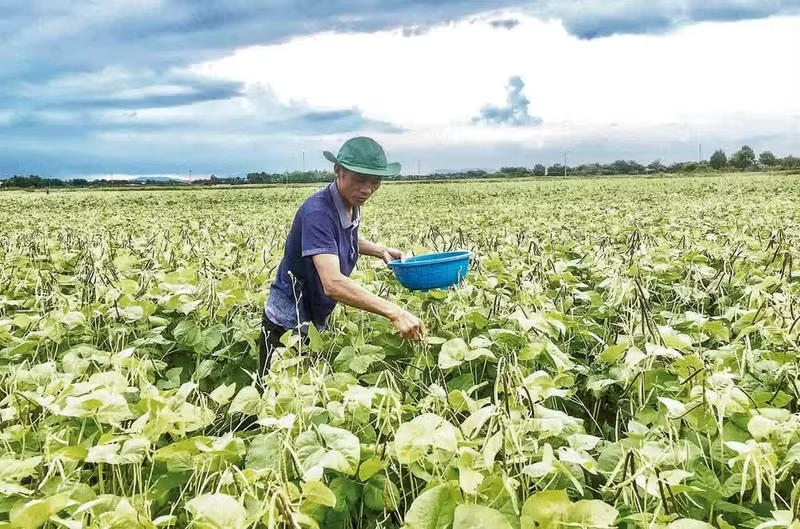
In the fields of crop cultivation and forestry, by 2025, the agricultural extension system implemented 197 models, covering nearly 3,000 hectares with nearly 6,000 farmer households participating directly. Many of these models have shown clear effectiveness, contributing to improved productivity, quality, and economic efficiency.
According to Nguyen Huu Ngoc, Director of the Ha Tinh Provincial Agricultural Extension Centre, in the 2023-2025 period, the centre developed and replicated 13 models for transferring scientific and technical knowledge in production according to VietGAP, organic, circular, and product consumption linkage processes.
A typical example is the model of raising yellowfin snapper according to VietGAP standards with product consumption linkage, covering an area of 1.5 hectares. The results show that the fish are suitable for local farming conditions, with a survival rate of 65 to 75%, an average yield of 10 tons/ha/season, and an average profit of 190 million VND/ha.
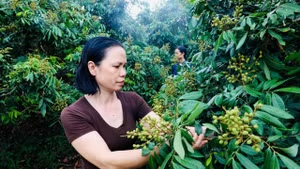
The intensive cultivation model of Phuc Trach pomelo, meeting organic standards on a scale of 0.4 hectares in Phuc Trach Commune, is growing and developing well, yielding comparable productivity to conventional farming but with a selling price 5 to 10% higher, resulting in a 10 to 15% increase in economic efficiency. Through this model, farmers are encouraged to shift towards clean production, ensuring food safety, and increasing profits.
During the 2020-2025 period, agricultural extension programmes in Phu Tho Province were implemented effectively, with high applicability, helping to increase productivity, product quality, and income for the people.
According to Dang Ngoc Nga, Deputy Director of the Phu Tho Provincial Agricultural Extension Centre, a highlight of this period is the support for production according to VietGAP standards, which covers an area of 6,760 hectares, helping crops such as pumpkins, chili peppers, potatoes, and other vegetables achieve high economic efficiency. Vegetables and fruits produced according to VietGAP standards yielded an average profit of 80 to 300 million VND/ha, 13 to 19% higher than conventional production.
In addition, the programme supporting the use of microbial preparations to treat rice straw on rice plants was implemented on a scale of 17,000 hectares, yielding good results. The straw was treated. Higher-than-average treatment helps limit organic poisoning in crops, reduces yellowing of leaves, promotes faster rice growth and development, and increases economic efficiency by 9.14% compared to areas outside the model.
According to Le Quoc Thanh, Director of the National Agricultural Extension Centre, given the increasing demand for green, circular, and low-emission agricultural production, agricultural extension activities need to shift their focus from individual technology transfer to leading production organisation, linking markets, and placing farmers and cooperatives at the centre, with businesses as the driving force for development.
Given this reality, the agricultural extension system needs to replicate models applying science, technology, and digital transformation, linked with the management of planting and farming area codes and traceability in production.
It is necessary to strengthen cooperation with domestic and foreign businesses and organisations to mobilise resources and transfer digital technology in agricultural extension activities.
At the same time, it is important to encourage the development of agricultural extension models linked to emission reduction, efficient resource use, environmental protection, and climate change adaptation.