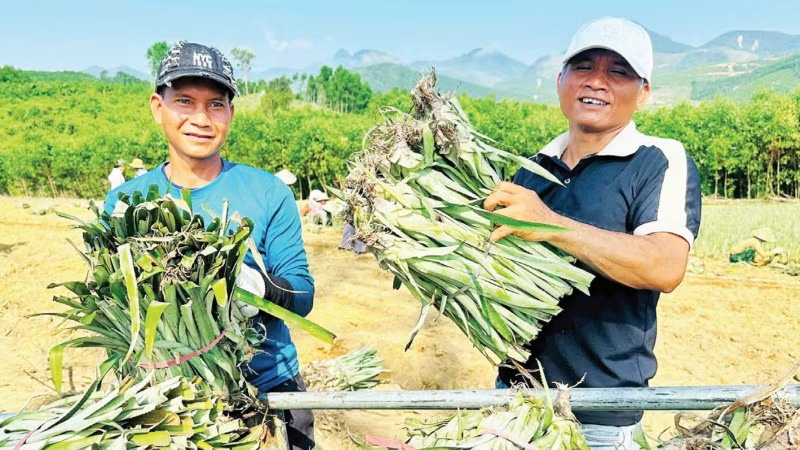
Following administrative restructuring, many mountainous localities in Quang Ngai have swiftly rolled out action programmes and solutions for economic development. Highland communes have taken the initiative to forge partnerships with enterprises, while maintaining close ties with local communities to promote agricultural growth.
Tripartite linkage in production
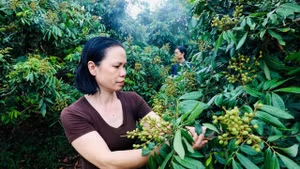
After four months of cultivation, nearly 10 hectares of tobacco in the hilly areas of Dak Tung and Chung Nang Hamlets in Dak Pek Commune have entered their first harvest season. Lush green tobacco fields now cover land that had long been barren.
Each day, more than 50 local workers, together with technical teams from Tay Nguyen Renewal Energy Development and Construction Investment Joint Stock Company, take part in the harvest. The first crop yielded over 20 tonnes of fresh leaves; after drying, about 4 tonnes were produced for supply to processing factories.
Dak Pek, a highland commune, holds strong potential for developing specialised agricultural zones, particularly on hillside land requiring crop restructuring to enhance land-use efficiency. Building on a tobacco cultivation model previously implemented in Dak Glei District, the commune has mobilised 30 households to participate, creating jobs for more than 100 workers throughout the season. The enterprise provides seeds, technical support, and product off-take guarantees.
Each hectare generates an income of between 40 million VND and 60 million VND, offering promising prospects for improving the livelihoods of the Gie Trieng and Xo Dang ethnic communities.
Nguyen Thi Thuong, Chairwoman of the Dak Pek Commune People’s Committee, said the local authority is working to replicate suitable crop models aligned with soil conditions. Tobacco has proven compatible with local farming practices and holds potential for expansion into a raw material zone, thereby boosting household incomes.
For generations, residents of Duc Nong Commune have lived along the Po Ko River, relying primarily on upland farming with unstable incomes. Identifying livelihood improvement as a key priority, early in 2026 the commune’s leadership proactively sought investors and proposed cooperation to develop pineapple and passion fruit raw material areas. Following surveys, in 2026 cooperatives and residents across 24 hamlets, in partnership with Sao Mai Agro-Processing Joint Stock Company, began cultivating between 5 and 10 hectares of pineapple.
Tran Cao Bao Viet, Chairman of the Duc Nong Commune People’s Committee, said: “Local Party committees and authorities play a guiding role, while commune officials act as the core force, taking the lead in supporting both residents and enterprises. With production linkages and guaranteed product off-take, people feel more confident to invest and gradually develop their household economies. Rather than waiting, localities proactively identify practical needs to choose appropriate development pathways.”
In the context of reforming local governance, restructuring the economy, and deepening integration, the proactive engagement of mountainous communes in linking with enterprises and residents to implement economic models is of particular significance. It is a fundamental solution to effectively harness potential, narrow development gaps, and move towards sustainability.
Providing momentum for highland development
Quang Ngai Province currently has 96 communes and wards, including 65 in ethnic minority and mountainous areas, with 561 especially disadvantaged hamlets. In remote areas, living conditions remain challenging, with high rates of poor and near-poor households, placing urgent demands on grassroots authorities.
Under the proactive spirit of “localities decide, act, and take responsibility”, Party committees and authorities in highland and border communes are gradually translating resolutions into concrete action programmes. When empowered and encouraged to act proactively, many localities have developed appropriate economic models such as high-tech agriculture and community-based tourism, helping to create grassroots growth poles and lay the foundation for sustainable development.
With abundant land and natural resources, many highland communes in Quang Ngai are promoting agricultural linkages as a key driver to strengthen socio-economic foundations. In localities such as Sa Loong, Tu Mo Rong, Mang Ri, Dak Long, and Son Tay Thuong, grassroots authorities have actively partnered with enterprises to introduce suitable crop models, encouraging farmers to shift production practices.
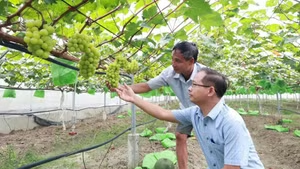
At present, 25 highland communes and wards in Quang Ngai have implemented nearly 40 production linkage models, expanding raw material zones for passion fruit, pineapple, medicinal plants, temperate coffee, and high-value fruit crops, thereby laying the groundwork for deep agricultural processing.
With total investment exceeding 500 billion VND, Sao Mai Agro-Processing Joint Stock Company has built a processing plant for agricultural products and medicinal herbs, while partnering with 11 highland and border communes to develop more than 1,000 hectares of passion fruit and pineapple cultivation areas.
The company’s General Director, Tran Phuong Anh, noted that highland communes possess advantages in land and soil conditions, enabling the development of stable raw material zones and expansion of production scale. Support from local authorities has helped enterprises connect with residents, forming integrated value chains from cultivation and procurement to processing and product distribution.
In addition, localities have effectively mobilised resources from national target programmes on socio-economic development in ethnic minority and mountainous areas, sustainable poverty reduction, and new-style rural development.
According to Pham Hong Khuyen, Chairman of the Son Tay Thuong Commune People’s Committee, depending on the characteristics of each production area, local authorities proactively collaborate with multiple enterprises to establish raw material zones and promote deep processing. The commune is currently engaging investors both within and outside the province to identify suitable production and processing models that can enhance the added value of agricultural products.
Nguyen Hoang Giang, Member of the Party Central Committee and Chairman of the Quang Ngai Provincial People’s Committee, emphasised that under new conditions, grassroots authorities must proactively strengthen regional linkages and cooperation. Localities with similar potential and advantages should work closely with enterprises and residents to implement appropriate economic models. This, he noted, is the key to advancing sustainable poverty reduction, narrowing development gaps between mountainous and lowland areas, and fostering a more robust mountain economy.