Gradually building a digital, modern, and professional customs sector
Implementing the Party and State’s policy on accelerating administrative reform, building a modern and professional administration, and promoting national digital transformation, the customs sector is actively deploying many comprehensive solutions to renew customs state management methods.
According to the Customs Department, since 2014, customs procedures for exported and imported goods have mainly been carried out on the VNACCS/VCIS system at 100% of Customs Departments and Customs Sub-departments under the centralised model at the General Department of Customs, now the Customs Department. More than 99.65% of import-export enterprises currently participate in the system, which processes around 99% of import-export declarations with stable, secure, safe, and effective 24/7 operations.
The deployment of the VNACCS/VCIS system has been considered a prerequisite and an important driving force helping the customs sector achieve its administrative reform goals, continue improving the business environment, and enhance national competitiveness in recent years.
In addition to supporting electronic customs procedures, the VNACCS/VCIS system has also created a widespread impact on the entire state management process for imported-exported goods and means of transport entering and leaving the country at all stages and administrative procedures. This has also required ministries and sectors to accelerate the implementation of the National Single Window, connect with the ASEAN Single Window, promote administrative reform, and reduce specialised inspection time for imported-exported goods.
At present, electronic customs procedures for imported-exported goods are implemented uniformly on the VNACCS system and its satellite systems. Accordingly, the Customs Department sets risk management criteria and establishes them on the VCIS system to automatically classify declarations once customs declarants submit complete dossiers through the system. For green-channel declarations, the system automatically grants customs clearance; for yellow and red channels, customs authorities conduct dossier inspections and physical inspections of goods.
These tasks are currently carried out within one customs unit through five steps, including receiving, inspecting, registering, and classifying declarations; inspecting customs dossiers; physically inspecting goods; verifying the completion of tax, fee, and charge obligations; and finalising dossiers.
According to the Customs Department, the deployment of the VNACCS/VCIS system over recent years has brought many benefits to the business community. Dossiers and documents related to customs procedures and ministries and sectors have been significantly simplified, while the time required to complete procedures for imported-exported goods and means of transport entering and leaving the country has been clearly reduced.
However, in the context of increasingly deep globalisation and international economic integration, import-export activities continue to increase in both scale and complexity. At the same time, the completion of organisational restructuring under Resolution No. 18-NQ/TW has also created increasingly higher requirements for reform, reducing administrative procedures, digitalisation, and moving towards paperless customs procedures.
The Customs Department said that these requirements closely follow the spirit of the Politburo’s Resolution No. 57-NQ/TW dated December 22, 2024, on breakthroughs in science and technology development, innovation, and national digital transformation; the Politburo’s Resolution No. 66-NQ/TW dated April 30, 2025, on reforming law-making and law enforcement to meet national development requirements in the new era; and are consistent with the customs development strategy towards 2030 under Decision No. 628/QD-TTg dated May 20, 2022, by the Prime Minister.
Based on international experience, the Customs Department noted that the centralised customs clearance model has already been implemented in the European Union. Under the model, enterprises can submit customs declarations in one EU member nation while goods are presented for inspection at customs authorities in another member nation.
In line with modern management requirements and international practices, from September 2025, the Customs Department began developing the centralised customs clearance project. After completing the project and assessing legal grounds and implementation conditions, the Customs Department reported to the Ministry of Finance and issued a pilot implementation plan for customs procedures for imported-exported goods under the centralised customs clearance model at Customs Sub-department Region III from June 1, 2026.
Towards paperless procedures, reducing direct contact, and improving management efficiency
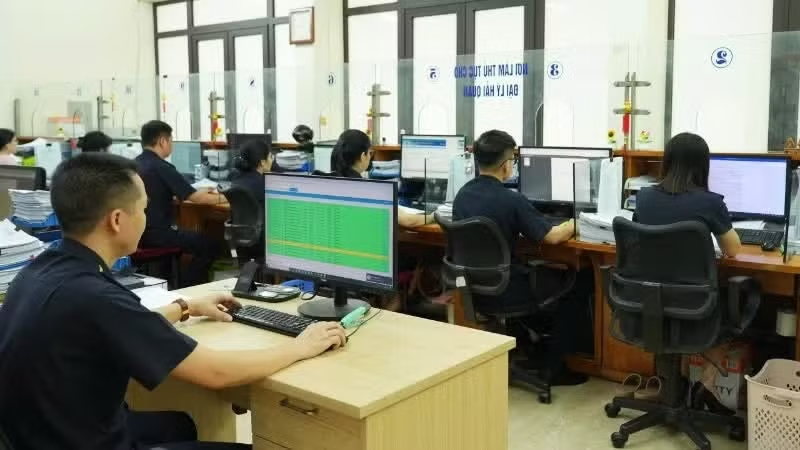
According to the Customs Department, under the centralised customs clearance model, customs procedures, instead of being handled at many border-gate and non-border-gate customs units as at present, will be centralised at one focal point, namely the Customs Clearance Team. The receipt and inspection of customs dossiers will be conducted centrally to ensure specialisation and align with the trend of staff streamlining.
Customs procedures under the new model are implemented according to a “one-way flow” principle, meaning that procedures are completed at the unit where processing ends, and that unit handles any arising procedures. At the same time, the model aims to implement paperless procedures without direct contact between enterprises and customs officers, thereby limiting negative practices, inconvenience, and harassment, while strongly shifting from inspections during customs clearance to post-clearance inspections.
The Customs Department assessed that the pilot implementation of the centralised customs clearance model demonstrates the customs sector’s strong determination in the process of comprehensive reform, modernisation, and digital transformation. The model is expected not only to improve the effectiveness of state management but also to facilitate import-export activities, enhance national competitiveness, and improve the investment and business environment.
To ensure the smooth operation of the model, the Customs Department has issued an implementation plan and assigned specific responsibilities to specialised units. The Customs Supervision and Management Board is responsible for issuing customs procedure processes for imported-exported goods for the pilot implementation; coordinating the development of systems for supervision and management operations; monitoring implementation; and consolidating and handling arising difficulties during the implementation process.
The Risk Management Board has been assigned to strengthen the application of professional technical measures for risk management, focus on information collection, risk analysis, and assessment, identify key subjects, establish declaration classification criteria, and build risk profiles, locality profiles, and key enterprise profiles to promptly handle risks arising from import-export activities at Customs Sub-department Region III.
The Customs Tax Board is tasked to coordinate to establish treasury account codes for the Customs Clearance Team and develop guidelines on import-export tax procedures under the customs process to implement the new pilot model.
Meanwhile, the Information Technology and Customs Statistics Board has been assigned to adjust and configure information technology systems to ensure the pilot implementation proceeds smoothly without disrupting customs clearance procedures for goods.
At the same time, the Post-Customs Clearance Inspection Sub-department and the Anti-Smuggling Investigation Sub-department have been assigned to strengthen technical and professional measures; focus on collecting information, analysing, and assessing risks, identifying key subjects, locality profiles, and enterprise profiles; and apply professional measures to promptly handle cases showing signs of violations in export and import activities within the jurisdiction of Customs Sub-department Region III during the pilot implementation, ensuring the effectiveness of customs management.
The Customs Department has also issued amended decisions related to organisational structure, functions, and tasks to ensure the operation of the centralised Customs Clearance Team under Customs Sub-department Region III. Accordingly, the Customs Clearance Team is a unit directly under Customs Sub-department Region III, responsible for directly carrying out customs procedures for exported and imported goods, transshipment, means of transport entering, leaving, and transiting the country, and implementing tax laws and other revenue collection regulations for imported-exported goods in accordance with regulations.
The pilot implementation of the centralised customs clearance model at Customs Sub-department Region III is considered the following step in the customs modernisation roadmap towards building a more digital, centralised, specialised, and transparent customs administration. In addition to facilitating import-export activities, the model is also expected to promote administrative reform, reduce direct contact, improve risk management efficiency, and align with national digital transformation requirements as well as international customs practices.