Expanding access to land, capital and technology
At the Ministry of Finance’s regular press conference for the first quarter of 2026, Trinh Thi Huong, Deputy Head of the Agency for Private Enterprise and Collective Economy Development, said that a key task over the past period had been to swiftly translate the major orientations set out in Resolution No. 68-NQ/TW into specific regulations that could be immediately applied in practice. On that basis, the National Assembly has adopted relevant resolutions, while the government has formulated and issued implementing decrees to bring business support policies into effect as soon as possible.
According to the Ministry of Finance’s report, one of the major priorities following the issuance of Resolution No. 68-NQ/TW has been to remove obstacles related to access to land, business premises, credit, science and technology, and digital transformation.
To institutionalise these orientations, the National Assembly adopted Resolution No. 198/2025/QH15 on a number of special mechanisms and policies for private sector development. The resolution focuses on policy measures aimed at reducing input costs; improving access to land, credit, and science and technology; promoting digital transformation; and enhancing corporate governance capacity.
In the field of land management, the government has issued Decree No. 20/2026/ND-CP detailing and guiding the implementation of a number of provisions of Resolution No. 198/2025/QH15. Under the decree, local authorities are permitted to use budget resources to support part of the infrastructure investment costs for industrial parks, industrial clusters, and technology incubators.
Support items include site clearance, compensation, resettlement, transport infrastructure, electricity and water systems, wastewater treatment, and telecommunications infrastructure. Based on the infrastructure supported by the state, project developers are required to allocate part of the serviced land area to private-sector high-tech enterprises, small and medium-sized enterprises (SMEs), and innovative start-ups for lease or sublease, with a minimum 30% reduction in land sublease fees during the first five years.
According to Trinh Thi Huong, localities are actively implementing support policies in line with Resolution No. 68-NQ/TW. Under the regulations already issued, part of the land area in industrial parks, industrial clusters, and incubators is reserved for lease or sublease to innovative start-ups, high-tech enterprises, and SMEs. At the same time, mechanisms to reduce land rental costs are being applied to ease input cost pressures and create favourable conditions for businesses to stabilise production and expand operations.
Notably, each industrial park or industrial cluster is required to allocate at least 20 hectares or 5% of its industrial land area to enterprises in these categories.
At the same time, the Government has focused on addressing bottlenecks in the implementation of the Land Law. The National Assembly adopted Resolution No. 254/2025/QH15 on a number of mechanisms and policies to remove difficulties and obstacles in the implementation of the Land Law nationwide.
Alongside institutional reforms, the Ministry of Agriculture and Environment has largely completed the national land database in accordance with the principles of being “accurate, sufficient, clean, and live”, facilitating lawful access to, retrieval of and utilisation of land information by enterprises and business households.
Regarding capital resources, the State Bank of Viet Nam has developed an action plan for the banking sector to prioritise credit for private enterprises, encourage lending based on value chains and supply chains, promote cash-flow-based lending, and expand the acceptance of intangible assets and future assets as collateral.
As a result of these measures, outstanding credit loans to SMEs exceeded 3.65 quadrillion VND by the end of 2025, up 21.73% compared with the end of 2024.
Another notable policy under Resolution No. 198/2025/QH15 provides that private enterprises, business households and individual business operators are entitled to state support covering 2% per year of borrowing costs when taking out loans for green projects, circular economy projects, or projects applying ESG standards.
The Government is currently considering the issuance of implementing decrees to put this policy into practice. According to the report, the mechanism is expected to help reduce capital costs, improve credit absorption capacity, and encourage businesses to expand investment in projects that contribute to green economic development.
Under Resolution No. 198/2025/QH15, the SME Development Fund is tasked with providing loans, start-up financing, seed funding for innovative start-up projects, and investment in investment funds to increase capital supply for SMEs. The Ministry of Finance is currently finalising a draft decree governing the fund’s operations for submission to the Government.
In addition to support relating to land and capital, the Government is also focusing on improving the quality of human resources for the private sector. The Prime Minister issued a programme for training 10,000 chief executive officers by 2030 under Decision No. 525/QD-TTg, dated March 31, 2026.
The programme aims to develop a generation of business leaders equipped with modern management capabilities, strategic thinking, business ethics, respect for the rule of law and the ability to lead digital transformation, green transition, and sustainable development.
Trinh Thi Huong said that, alongside policy improvements, several large-scale support programmes have been approved by the Prime Minister to translate the objectives of Resolution No. 68-NQ/TW into action. These include the programme for training 10,000 CEOs, the programme for developing 1,000 pioneer enterprises, and the programme supporting the expansion of enterprises into international markets. The Ministry of Finance is currently expediting the preparation of implementing documents to bring these programmes into practice as soon as possible.
In addition, support programmes for SMEs under Decree No. 80/2021/ND-CP continue to be implemented, focusing on strengthening governance capacity, promoting innovation, ensuring legal compliance, and enabling deeper participation in value chains.
Creating foundation for businesses to expand into regional and global markets
Alongside unlocking traditional resources, a notable highlight in the implementation of Resolution No. 68-NQ/TW has been the promotion of digital transformation, support for business households, and the creation of favourable conditions for enterprises to scale up their operations.
According to the Ministry of Finance, support for business households has been implemented in a more practical and substantive manner. The tax sector has established on-site support teams, developed assistance programmes tailored to different groups of business households, organised guidance activities in streets and marketplaces, and launched intensive campaigns to support business household transformation.
At the same time, tax authorities have stepped up the provision of free electronic tax services through the Public Service Portal and the eTax Mobile application, enabling business households to register, declare, and pay taxes electronically.

By December 2025, more than 1.04 million business households nationwide were using eTax Mobile out of nearly 1.14 million stable tax-paying business households, accounting for over 91.5%. The rate of business households filing and paying taxes electronically reached 99%.
Digital transformation results continued to expand in 2026. As of May 2, 2026, more than 2.48 million business households nationwide were using eTax Mobile out of the more than 3.07 million actively operating business households registered for tax purposes, equivalent to approximately 81%.
Compared with the period before Resolution No. 68-NQ/TW was issued, the number of business households using eTax Mobile increased by about 1.952 million. The nationwide rate of electronic tax filing by business households reached 98.6%, while the proportion of tax declarations submitted on time following the first-quarter 2026 declaration period reached 99.8%.
In parallel with policies supporting access to capital and land, ministries and sectors are also coordinating the implementation of digital transformation support programmes for small and medium-sized enterprises. According to Trinh Thi Huong, promoting the application of digital technologies not only helps enhance management capacity but also strengthens the adaptability of enterprises in the context of the rapidly developing digital economy.
At the same time, the rollout of e-invoices generated from cash registers has continued to be strongly promoted. In 2025, more than 252,730 business establishments registered to use this form of invoicing, 4.8 times higher than the figure recorded for the whole of 2024.
As of April 30, 2026, the cumulative number of business households registered to use e-invoices generated from cash registers exceeded 303,000, representing an increase of around 50% compared with the end of 2025.
These results demonstrate the growing readiness of business households to adopt new tax administration methods, while also creating an important foundation for the roadmap to abolish the presumptive tax regime.
In addition to supporting small enterprises and business households, the Government is gradually creating conditions for private enterprises to participate more deeply in large-scale projects of national significance.
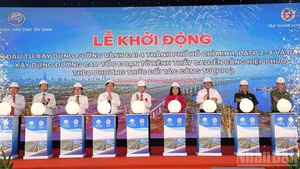
According to the Ministry of Finance’s report, following three nationwide rounds of project groundbreakings and inaugurations in 2025, a total of 564 works and projects were launched or completed across the country, with total investment of approximately 5.2 quadrillion VND. Of this amount, private capital accounted for nearly 75%.
To continue supporting enterprises with the potential to grow on a larger scale, the Prime Minister has approved the Programme for developing 1,000 pioneer enterprises for the 2026–2030 period and the Programme for expanding into international markets for the 2026–2030 period.
These programmes are aimed at identifying, supporting, and developing a cohort of private enterprises with the capacity to play a leading role and participate more deeply in regional and global value chains.
Assessing the implementation of Resolution No. 68-NQ/TW, Trinh Thi Huong noted that the large volume of work, limited implementation time, and constrained resources have posed significant challenges. Nevertheless, thanks to the coordinated efforts of ministries and sectors, together with the proactive engagement of the business community, many important policies have been issued and have gradually begun to deliver positive results.
In the coming period, the Ministry of Finance will continue coordinating with relevant agencies to refine the programmes and policies already introduced, while conducting a one-year review of the implementation of Resolution No. 68-NQ/TW in order to further assess and supplement measures that are better aligned with the practical development needs of businesses.