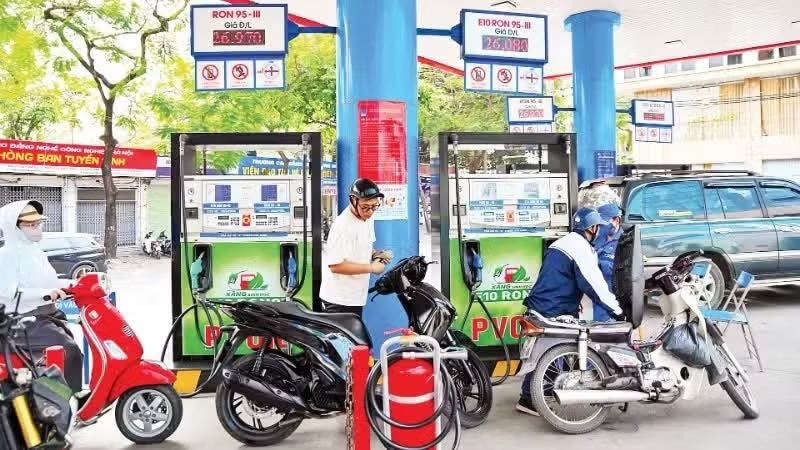
Amid concerns that the use of E10 biofuel petrol (comprising 10% ethanol and 90% mineral petrol) could affect car and motorbike engines, regulatory agencies and businesses have confirmed that they have not received any negative feedback regarding this fuel, while studies and trials have concluded that E10 petrol is suitable for most vehicles currently in circulation.
The use of E10 petrol not only helps to reduce emissions but also cuts dependence on imported fossil fuels, promotes the consumption of domestic bio-based feedstock, creates outlets for agricultural production, and enhances the nation’s energy self-sufficiency.
Ensuring vehicle engine safety
Under the Government’s roadmap, E10 petrol will officially be sold nationwide from June 1. However, the issue attracting particular public attention is the extent to which this fuel is safe for vehicle engines. On this matter, Dao Duy Anh, Deputy Head of the Agency for Innovation, Green Transition and Industry Promotion under the Ministry of Industry and Trade, affirmed that during the development of the biofuel roadmap, the ministry conducted surveys and assessments of the potential impact of E5 and E10 biofuel petrol on engine performance and durability.
Assessment results by scientists from Ha Noi University of Science and Technology and the University of Transport and Communications showed that E5 and E10 petrol have no negative impact on the operating performance or durability of petrol engine components. Viet Nam has used E5 petrol nationwide since 2018, while E10 petrol has been piloted since August 2025.
To date, neither distributors nor the Ministry of Industry and Trade have received any feedback indicating that E5 or E10 petrol adversely affects vehicle engine performance or durability.
Dao Duy Anh added that international experience also shows biofuels have been used for a long time, with the US and Brazil using E10 petrol since the 1980s. Southeast Asian countries such as Thailand and the Philippines have already adopted E15 petrol and are even moving towards E20, without recording any negative impact on vehicle engines.
E10 petrol has been researched, tested, and assessed as suitable for most vehicles currently in circulation.
Nguyen Sinh Nhat Tan, Deputy Minister of Industry and Trade
Nguyen Sinh Nhat Tan, Deputy Minister of Industry and Trade, affirmed: “E10 petrol has been researched, tested, and assessed as suitable for most vehicles currently in circulation.” The roadmap for transitioning from mineral petrol to biofuel petrol has been designed to proceed step by step, with thorough impact assessments rather than abrupt implementation. During the rollout process, the ministry will continue coordinating with ministries, sectors, and enterprises to ensure stable supply, fuel quality, and transparent information so that people can confidently use the fuel.
According to a representative of the Viet Nam Automobile Manufacturers’ Association, materials used in vehicles currently sold on the market have already been researched and selected for alcohol resistance, meaning there will be no corrosion or accelerated ageing of rubber seals if consumers use E10 petrol meeting prescribed standards.
However, the association’s representative also advised customers not to leave vehicles unused for prolonged periods, especially when the fuel tank contains only a small amount of petrol. Ethanol has moisture-absorbing properties, which may lead to water condensation inside the fuel tank. Users should make sure to comply with manufacturers’ recommendations on replacing fuel filters to ensure the fuel system remains clean.
Ready to meet demand
Do Van Tuan, Chairman of the Viet Nam Biofuels Association, added that most motorbike models manufactured since 2000 are compatible with E10 petrol. Circular No. 50/2025/TT-BCT issued by the Ministry of Industry and Trade stipulates the mandatory roadmap for blending biofuels with conventional fuels in Viet Nam.
The Viet Nam Association of Motorcycle Manufacturers also affirmed that motorbikes can safely use E10 petrol. For very old models, some components such as rubber seals or fuel pipes may age more quickly, but this only affects rubber materials after prolonged use and does not directly impact engines.
Replacing these components is very simple and inexpensive. Concerns that E10 petrol could damage engines, corrode machine parts, or reduce vehicle durability are entirely unsupported by scientific evidence and practical verification.
Concerns that E10 petrol could damage engines, corrode machine parts, or reduce vehicle durability are entirely unsupported by scientific evidence and practical verification.
Globally, an important common factor among countries that have successfully developed biofuels is the availability of abundant and stable feedstock sources. This is the key factor determining the ability to produce on a large scale. Viet Nam still relies heavily on imported fuels.
In the coming period, to accelerate the use of biofuels, Viet Nam needs to develop synchronised and stable policies, including price support mechanisms and incentives for producers and distributors. It is also necessary to develop sustainable feedstock areas linked with domestic agriculture to proactively secure ethanol supply, while investing in distribution infrastructure to help people better understand and trust the use of biofuels.
Nguyen Quang Dung, Deputy General Director of Viet Nam National Petroleum Group (Petrolimex), affirmed that across the entire system, petrol sales currently total around 400,000-500,000 cubic metres per month. All supply plans and procurement contracts have been synchronously prepared by Petrolimex to meet consumption demand and match the company’s blending capacity. In practice, since 2018, Petrolimex’s E5 and E10 petrol products have been operated under strict control procedures and no incidents related to biofuel quality have been recorded.
Similarly, Binh Son Refining and Petrochemical Corporation (BSR), a member unit of Viet Nam National Industry-Energy Group (Petrovietnam), recently delivered its first 12,000 cubic metres shipment of E10 petrol by sea to a business customer.
In May and the coming months, BSR will produce and sell around 80,000-100,000 cu.m of E10 petrol each month. The implementation of two sales and delivery methods will help enterprises increase supply flexibility, expand distribution coverage, and improve their ability to meet nationwide consumption demand.