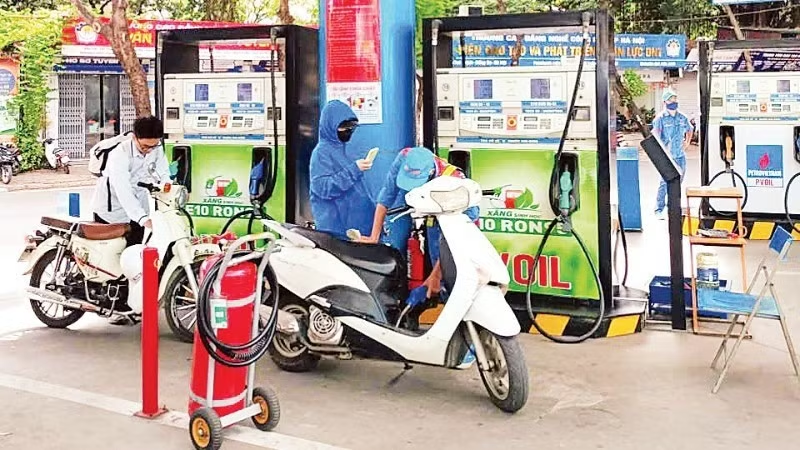
The early resumption of ethanol plant operations is considered a key solution, not only to supplement fuel supply and ease pressure on the market but also to demonstrate proactive efforts in safeguarding national energy security.
Proactively securing fuel supply
Nguyen Viet Thang, General Director of Binh Son Refining and Petrochemical Joint Stock Company (BSR – the operator of the Dung Quat Oil Refinery), said that by the end of this month, the company will receive 60,000 tonnes of ethanol (E100) from the Central Biofuels Plant to blend E10 petrol. This will help increase domestic fuel output and ease pressure on the market amid restricted imports due to export limitations imposed by some countries.
In addition, proactive sourcing — both domestically and through imports — has helped stabilise the company’s crude oil supply, ensuring that the Dung Quat Oil Refinery operates continuously and efficiently at an average capacity exceeding 121%, while supplying petrol and oil to partners and customers as planned.
“The company has also reported to and received direction from the Viet Nam National Industry–Energy Group (Petrovietnam) to implement solutions ensuring crude oil reserves, stable production output, and a steady supply of fuel to the market. Furthermore, risk management mechanisms and systems have been activated, and task forces established to research and propose policies aimed at maintaining stable operations at the Dung Quat Oil Refinery and ensuring national energy security,” Thang said.
According to Pham Van Vuong, Director of the Central Biofuels Plant, following trial operations, the company delivered its first batch of 210 cubic metres of ethanol on February 12 to Binh Son Refining and Petrochemical Joint Stock Company for blending E10 RON 95 biofuel.
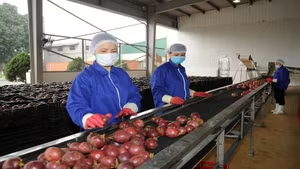
From March 20 onwards, the plant will operate at optimal capacity, producing around 60,000 tonnes of ethanol annually, equivalent to approximately 5,000 tonnes per month. The primary input material for ethanol production is dried cassava chips, supplied by partners under long-term contracts.
Vuong added that, in the short term, the plant will mainly supply ethanol to Binh Son Refining and Petrochemical Joint Stock Company via a pipeline system directly connected to the storage tanks of the Dung Quat Oil Refinery. At the same time, the company is investing in road transport systems to ready itself to supply other partners and customers as market demand arises.
“In the context of a projected sharp increase in demand for biofuel, the early restart of ethanol plants is seen as a crucial solution to supplement fuel supply, ease market pressure, and demonstrate proactive efforts in ensuring national energy security. With its modern blending infrastructure, storage systems, and direct pipeline connections to the Central Biofuels Plant, the Dung Quat Oil Refinery will play a key role in blending and supplying E10 RON 95 petrol to the market,” Vuong emphasised.
Developing along the value chain
Alongside efforts to proactively secure supply and meet rising fuel demand across the system, Viet Nam National Petroleum Group (Petrolimex) is implementing various solutions to upgrade technical infrastructure and expand ethanol supply sources.
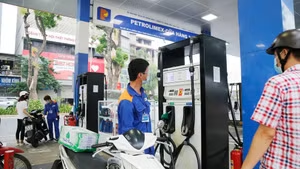
With seven storage facilities ready for E10 blending and more than 5,000 petrol retail outlets nationwide, Petrolimex is expediting infrastructure upgrades, aiming to accelerate progress and roll out E10 petrol simultaneously across the market in the near future.
Petrolimex leaders noted that current domestic ethanol production stands at only around 20,000 cubic metres per month, while the group’s demand is approximately 45,000–50,000 cubic metres per month. The shortfall must be covered by imports, and the company has negotiated and signed contracts with partners in countries such as the US and the Republic of Korea to ensure stable supply for E10 blending and to maintain energy security.
The company has also sent delegations to countries including the US and Thailand to study business models, logistics, and quality assurance practices for E10 petrol before supplying it to the market.
Statistics from the Ministry of Industry and Trade show that total petrol consumption in 2025 reached approximately 11.37 million cubic metres. With nationwide adoption of E10 petrol (from June 1), around 1.1 million cubic metres of E100 will be required annually.
Viet Nam currently has six ethanol production plants, but only three are operational and none are running at full capacity. If all plants operate at maximum capacity, ethanol output could exceed 500,000 cubic metres, equivalent to about 40% of domestic demand, with the remaining 60% needing to be imported.
On this matter, a representative of the Ministry of Industry and Trade affirmed that Viet Nam could import ethanol directly from the US and Brazil, which together account for more than 80% of global ethanol production. Each year, these countries produce a surplus of around 30–40 million cubic metres beyond their domestic demand, meaning they are fully capable of meeting additional demand in the Vietnamese market.
Ethanol can also be imported via regional distribution hubs such as Singapore and the Republic of Korea. Therefore, in the short term, ethanol supply for Viet Nam is expected to be minimally affected by geopolitical fluctuations in the Middle East.
At the same time, the Ministry of Industry and Trade is coordinating with other ministries, sectors, and local authorities to implement solutions to restore and enhance the efficiency of ethanol plants, while also developing raw material zones to ensure stable production and gradually increase domestic self-sufficiency.
Do Van Tuan, Chairman of the Viet Nam Biofuels Association, stated that the development of biofuels not only reduces dependence on fossil fuels but also opens opportunities for agriculture and processing industries.
When ethanol plants operate stably, farmers will not only supply raw materials but can become integral links in the value chain. This will improve agricultural efficiency and provide a foundation for the sustainable development of the ethanol industry.
As the world enters a phase of strong energy transition, energy security is no longer based solely on the exploitation or import of fossil fuels. Countries are increasingly focusing on diversifying supply sources and developing sustainable fuels.
With a structured and well-defined roadmap for biofuel development — supported by policy frameworks, business preparedness, and agricultural potential — E10 petrol is expected to be rolled out widely across the market soon. This will help reduce pressure on fuel supply and lay the groundwork for Viet Nam to gradually strengthen its energy security amid uncertainties in the global energy market.