If the “golden population window” is not effectively utilised within the next one to two decades, the risk of “growing old before becoming rich” could entirely become a reality.
Existing pressures
For many years, Viet Nam has often referred to its “golden population” as a natural advantage. Around 70% of the population is of working age, most under 40 years old, with the ability to quickly access science, technology and the digital economy. However, a favourable population structure only truly has meaning when the workforce is equipped with skills, health and the ability to adapt to the new labour market. Yet demographic advantages will not last forever. A large workforce does not necessarily mean high productivity, especially when the majority of workers are still employed in low value-added jobs.
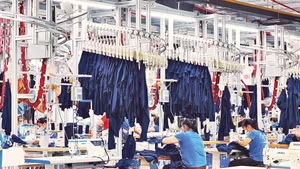
Current reality shows that many businesses are facing the paradox of “an excess of labour but a shortage of high-quality human resources”. In industrial parks, it is not difficult to encounter workers over the age of 35 beginning to struggle to maintain their jobs because of the pressure of high labour intensity, while their vocational skills are not sufficient for them to transition to other positions.
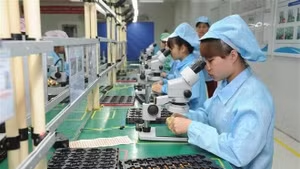
In several industrial localities such as Bac Ninh Province, Ho Chi Minh City and Dong Nai City, many electronics enterprises have had to open retraining programmes for middle-aged workers so they can shift from manual production lines to operating automated machinery or technical management. These changes show that demographic pressure has already begun to directly affect the labour market.
According to economist Nguyen Tri Hieu, population ageing is an inevitable global trend, but what is worrying for Viet Nam is that this process is taking place in the context of still-limited economic resources. As the number of elderly people increases rapidly, pressure on pension funds, health insurance and the social security system will become increasingly heavy. He believes that Viet Nam has been somewhat slow in preparing for this demographic transition period, leading to shortages in both infrastructure and specialised support services for the elderly.
In Ho Chi Minh City, the locality with the fastest population ageing rate in the country, there are currently more than 1.3 million people aged 60 and above, accounting for around 12.5% of the population. Forecasts suggest that by 2030, this proportion could reach 20%. Changes in population structure are creating a series of pressures on the healthcare system, housing, transport and social care. Many top-level hospitals are now witnessing a sharp rise in elderly patients suffering from multiple diseases.
According to Doctor Hoang Tu Anh, Director of the Centre for Creative Initiatives in Health and Population (CCIHP), Viet Nam currently has around 16.1 million elderly people, equivalent to 16% of the population. On average, each person over 60 suffers from three to four chronic illnesses, while those over 80 may suffer from more than six illnesses simultaneously.
Meanwhile, the geriatric healthcare system remains very limited. The whole country currently has only one central-level geriatric hospital; many localities still do not have separate geriatric departments. The ratio of geriatric doctors is currently only around 0.8 doctors per 100,000 elderly people, much lower than international recommendations. The traditional family model is also changing rapidly. The migration of young people to urban areas means that increasing numbers of elderly people are living alone in rural areas, or only elderly couples are relying on one another.
In many rural areas of the Red River Delta or the Mekong Delta, the image of “elderly villages” is no longer uncommon. During the daytime, most young people work far away, leaving mainly elderly people and children in the villages. This creates major gaps in healthcare, emotional support and community life for older people.
Utilising development resources
However, population ageing does not entirely mean a burden. With an appropriate strategy, it could become a driving force for a new market and economic model: the “silver economy”. Tran Bich Thuy, Country Director of HelpAge International in Viet Nam, believes that elderly people in Viet Nam today are very different from before. They live longer, are healthier, more proactive in consumption and wish to continue participating in social activities.
Demand for healthcare, rehabilitation, housing and resort services for the elderly is creating a new market with enormous potential. In Viet Nam, several initial models have already demonstrated the great potential of the “silver economy”.
In Ha Noi, many businesses have launched home care services for elderly people with teams of nurses, physiotherapy technicians and online consulting doctors. Instead of having to stay in hospital for long periods, elderly people can have their blood pressure, diabetes and mobility rehabilitation monitored at home through digitally connected devices. Several urban areas in Hung Yen Province, Dong Nai City and Vung Tau Ward (Ho Chi Minh City) have also begun developing “senior living” models with step-free designs, emergency alarm systems, community activity areas and accompanying medical care.
In the technology sector, many Vietnamese start-ups have developed wearable devices for monitoring heart rates, warning of falls or applications connecting doctors with the families of elderly people. Demand for products supporting the health monitoring of the elderly has been increasing quite rapidly in recent years.
At present, many elderly people continue participating in the workforce in more flexible forms. In Da Nang City, Le Thi Thu Mai, aged 63, after retiring from the education sector, is currently involved in teaching communication skills and customer care at a tourism human resources training centre. Each week, she teaches several classes while also supporting students through online platforms. “Young people today are technologically quick, but many lack practical communication skills. I believe the experience of older people still has value if we know how to adapt. Returning to work helps me feel useful and maintain an active spirit,” Mai shared.
According to Nguyen Tri Hieu, in the context of the strong development of the digital economy and artificial intelligence, many jobs today no longer mainly depend on physical labour but on knowledge and experience. If provided with appropriate technological skills training, elderly people can entirely continue participating in socio-economic activities. For example, in Can Tho City, many wards have now opened smartphone training classes for elderly people. In small classes at community cultural houses, elderly men and women are guided on how to make video calls to their children and grandchildren, book medical appointments online or pay electricity and water bills via banking applications.
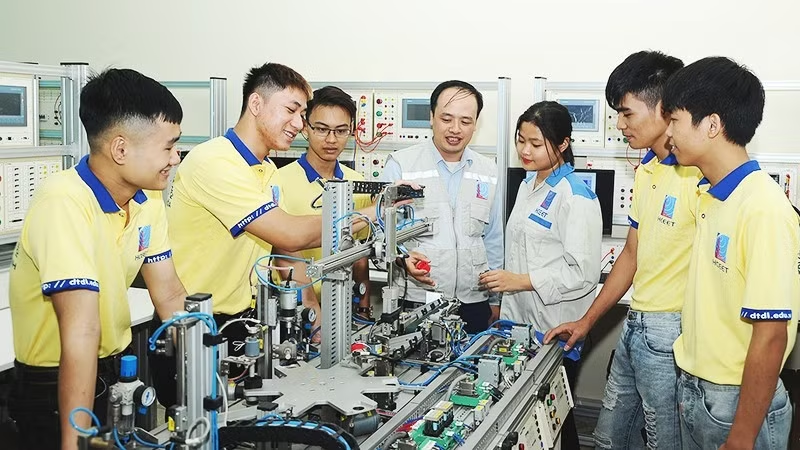
Nguyen Thanh Binh, Chairman of the Viet Nam Association of the Elderly, believes that in order for the country not to fall into the situation of “growing old before becoming rich”, it is necessary to make effective use of the remaining time of the golden population period. The top priority is improving the quality of human resources through strong investment in vocational education, digital skills and labour productivity. If within the next 10-15 years Viet Nam fails to build a workforce with high qualifications and strong adaptability, the economy will face many difficulties when the scale of the young labour force begins to shrink.
In addition, the healthcare system also needs to change its approach, shifting strongly from a treatment model to long-term healthcare and chronic disease management within the community. This is not only a solution to reduce overload at top-level hospitals but also helps reduce social costs in the context of a continuously growing elderly population.
Binh also emphasised that population ageing not only creates pressure but also opens opportunities for developing a new market known as the “silver economy”. According to him, elderly people should not simply be viewed as a group requiring assistance but also as a major consumer force and a valuable source of experience capital. Sectors such as technology, insurance, healthcare, real estate and tourism can all find enormous growth potential if they prepare early for this trend.
In addition, more flexible employment mechanisms for elderly people need to be developed. In the context where many jobs today rely more on knowledge and experience than manual labour, many people after retirement age still have the ability and desire to continue working. “Elderly people should be enabled to continue participating in socio-economic life instead of being viewed as a completely dependent group,” he said.