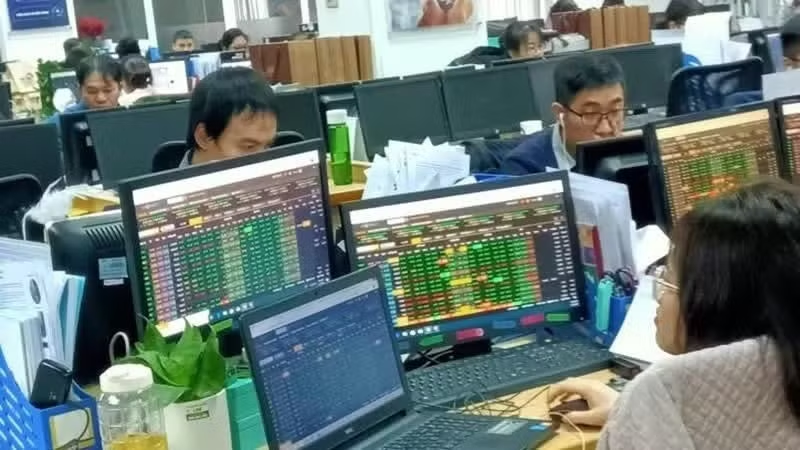
According to Bui Hoang Hai, Vice Chairman of the State Securities Commission (SSC), along with the positive results achieved in the first six months of 2026, the securities industry will focus on refining institutions, elevating market quality, cultivating new growth drivers, and bolstering transparency to effectively mobilise resources for national development.
The capital market affirms its stature as a capital channel for the economy.
The year 2026 signifies the beginning of the 2026–2030 socio-economic development period, simultaneously requiring the mobilisation of substantial resources to realise strategic infrastructure development goals, science and technology, innovation, national digital transformation, and private sector development.
According to Bui Hoang Hai, in this context, the securities industry has designated its core task as the comprehensive development of the financial market, transforming the capital market into a vital medium- and long-term capital channel for the economy alongside the banking credit system.
After nearly 30 years of formation and development, the Vietnamese stock market sustains its positive growth momentum. By June 30, 2026, the stock market capitalisation is projected to attain approximately 10.6 trillion VND, an increase of 6% compared to the end of 2025, equivalent to about 82.3% of the estimated GDP in 2025. The listed bond market size is anticipated to attain approximately 2.8 trillion VND, an increase of 6.1%, equivalent to 22.1% of GDP.
Along with this scale, market liquidity is anticipated to remain high, with average trading value on the stock market attaining approximately 29.3 trillion VND/session, a 0.3% increase compared to the 2025 average; the listed bond market is anticipated to attain approximately 16.3 trillion VND per session, a 9.9% increase. The range of listed securities has also expanded with 725 listed stocks and fund certificates, and 825 stocks registered for trading on UPCoM.
Notably, the market's ability to raise capital has been markedly bolstered. In the first six months of the year, the total value of capital raised through the stock and corporate bond markets attained approximately 325.3 trillion VND, an increase of 15.83% compared to the same period in 2025.
Bui Hoang Hai stated that this result corroborates the stock market as an vital medium- and long-term capital mobilisation channel, augmenting financial resources for the investment, production, and business activities of enterprises.
The capacity of intermediary organisations has also been strengthened. The total charter capital of securities companies exceeded 330 trillion VND, an increase of about 15% compared to the end of 2025; while their combined shareholders' equity surpassed 450 trillion VND. Meanwhile, the total value of assets under management of the fund management industry exceeded 834 trillion VND, and the total net asset value of investment funds exceeded 93 trillion VND. In just the first half of the year, the market witnessed the establishment of ten new investment funds and the licensing of seven funds for public offerings.
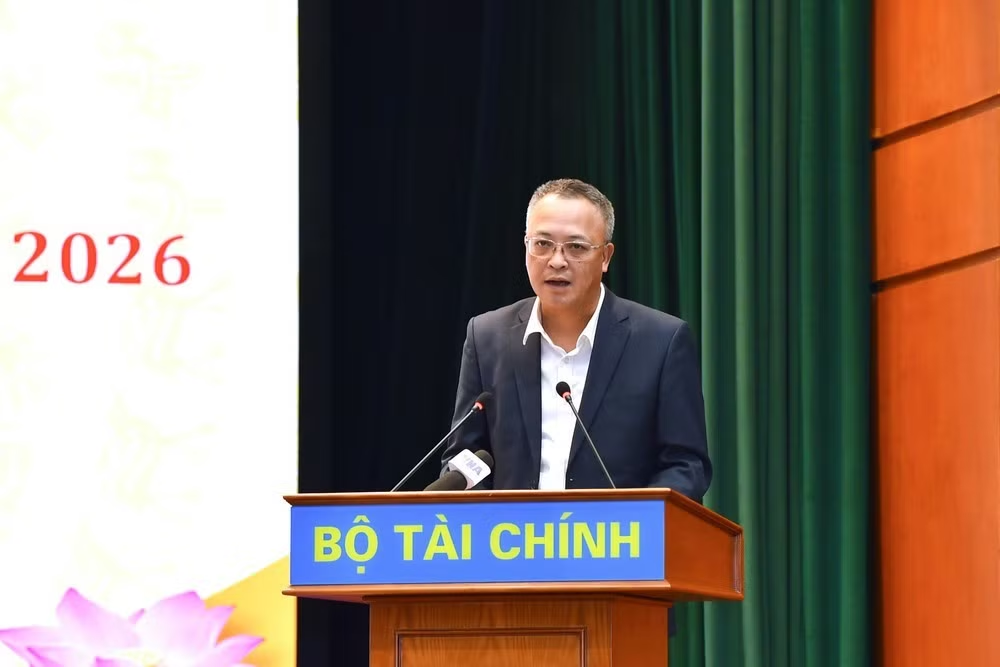
In addition, the trading infrastructure operated securely after running the new information technology system. According to the Vice Chairman of the State Securities Commission, trading, clearing, and settlement activities have been executed smoothly, with the total value of trading, clearing, and settlement transactions for listed and registered securities exceeding 7.1 quadrillion VND. In particular, the official launch of the domestic carbon exchange on June 29, 2026, is regarded as a crucial milestone in the development of the green financial market, aiming for the goal of net-zero emissions by 2050.
In the field of international integration, after a comprehensive reform process, FTSE Russell promoted the Vietnamese stock market to a secondary emerging market. The mid-term review report in April 2026 further corroborates that the upgrade will officially take effect from September 21, 2026, generating additional impetus to attract international investment capital.
Refining the institutional framework, forging a foundation for a new development phase
The positive results in the first two quarters of the year have corroborated the right direction and outstanding efforts of the entire securities industry. However, Bui Hoang Hai also frankly conceded that our capital market is entering a qualitative transformation phase, demanding deeper and more synchronised reforms to maintain sustainable growth in the face of global economic fluctuations.
Therefore, the State Securities Commission has designated key tasks in the coming period that go beyond simply expanding scale, focusing instead on forging breakthroughs in refining the legal framework, safety standards, simplifying administrative procedures, proactively anticipating the digitalisation trend, and catalysing capital attraction for the economy.
First, the State Securities Commission is accelerating amendments and supplements to several provisions of the 2019 Securities Law for submission to the National Assembly in 2026. The proposed revisions endeavour to reduce business conditions, simplify administrative procedures, and promote digital transformation. At the same time, it will effectively execute Decree No. 200/2026/ND-CP on the offering and trading of privately placed corporate bonds and issuance to the international market; and investigate regulations on bond offerings by PPP project enterprises, bond payment guarantee organisations, and a securities trading market for innovative startups.
Along with institutional improvements, the State Securities Commission will continue to execute solutions to elevate the market to international standards, focusing on operationalising the Central Counterparty Clearing (CCP) mechanism, removing barriers for foreign investors, refining corporate governance quality, information disclosure, and protecting investor rights. The regulatory body will also continue to maintain exchanges with MSCI and FTSE Russell, endeavouring for the Vietnamese stock market to be upgraded to emerging market status by MSCI before 2030.
Bui Hoang Hai stated that, along with finalising the legal framework, the regulatory body will proactively forge new growth drivers by preparing the conditions for operating the digital asset trading market, elevating the infrastructure for the stock market for innovative startups, and investigating solutions for market organisation such as extending trading hours and considering expanding appropriate price limits.
Towards sustainable development, the State Securities Commission will continue to restructure the supply of goods, champion the IPO mechanism associated with listing, incentivise large-scale private corporations and FDI enterprises to participate in the market; and cultivate investment fund products such as ETFs, REITs, and voluntary pension funds to generate long-term investment capital flows.
Along with that, inspection and supervision will continue to be fortified; acts of market manipulation and insider trading will be rigorously penalised. The State Securities Commission is also constructing a centralised data warehouse, applying artificial intelligence and big data to the early risk warning system to elevate management efficiency and better safeguard the legitimate rights and interests of investors.
According to the leaders of the State Securities Commission, the synchronised implementation of the above solutions will forge a foundation for the capital market to sustain its role as an vital medium- and long-term capital channel for the economy, contributing to the effective mobilisation of social resources, serving the goal of rapid and sustainable growth in the new development phase.