In this context, the stock market has clearly demonstrated its role as a medium- and long-term capital mobilisation channel with many advantages such as the ability to provide long-term capital sources, risk-sharing mechanisms, optimised capital structure, and attracting international capital flows.
Promoting the capital market for infrastructure investment
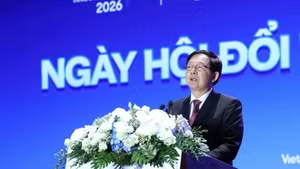
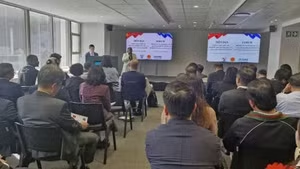
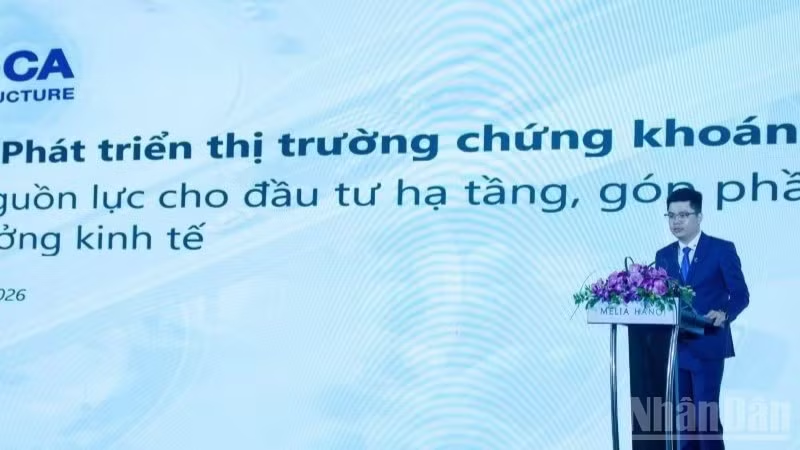
Speaking at the “Stock Market Development in 2026” conference recently organised by the State Securities Commission of Viet Nam, Ngo Truong Nam, General Director of Deo Ca Infrastructure Investment Joint Stock Company (HHV), stated that the stock market needs to become the main capital mobilisation channel for transportation infrastructure development. Currently, HHV has built fairly comprehensive capabilities in three core areas: investment, construction, and operation management of transportation projects.
HHV has remained committed to sustainable development, refusing to compromise long-term quality and efficiency for short-term rapid growth, while prioritising the harmonious interests of the company, shareholders, employees, and society.
The company also proposed improving the investment mechanism for public-private partnerships (PPP) towards a “public works - private management and operation” model, aiming to increase management flexibility and concretise the risk-sharing mechanism for projects with long payback periods, thereby enhancing the ability to attract resources from the capital market. In reality, bank credit, previously the main source of funding for PPP projects, is currently constrained by numerous issues regarding limits, terms, and risk management.
Meanwhile, the stock market is increasingly demonstrating its role as a medium- and long-term capital mobilisation channel with many advantages such as the ability to provide long-term capital, risk-sharing mechanisms, optimized capital structure, and attracting international capital flows.
In this context, HHV leaders proposed continuing to promote the upgrading of the Vietnamese stock market to attract more international capital flows.
In addition, they suggested improving regulations on issuance, capital raising, and capital mobilisation in the market by simplifying procedures and shortening processing times; and perfecting the legal framework for long-term capital mobilisation instruments such as project bonds, construction bonds, or infrastructure investment fund models.
HHV representatives stated that, to address the investment capital challenge, Deo Ca Group has proactively researched and implemented the PPP++ model as a step forward in its approach to resource mobilisation. The PPP++ model is the solution Deo Ca Group has proposed to mobilise capital for its projects.
By diversifying funding sources to increase mobilisation efficiency and minimise risks throughout the project implementation process, the capital structure of projects implemented under the PPP++ model is more diversified than the basic PPP model. In addition to budget funds, equity capital, and credit capital, the capital structure under the PPP++ model includes profits from construction work, bonds, stocks, BCC contracts, etc.
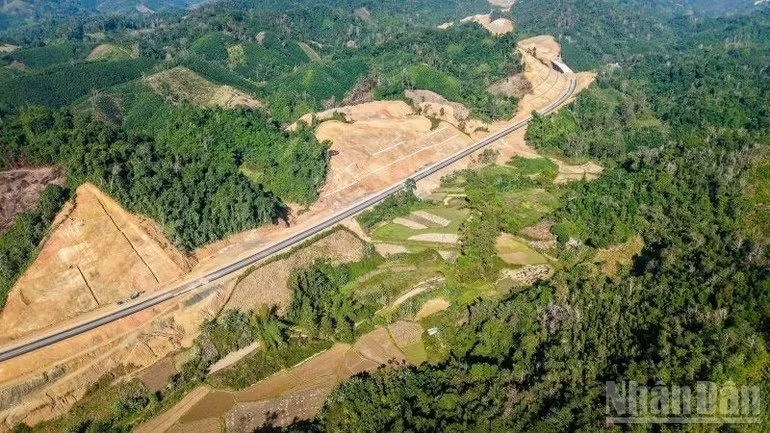
Beyond the combination of the State and enterprises, PPP++ expands the capital structure towards greater diversification, with the participation of the capital market through stocks, bonds, business cooperation contracts (BCCs), and profits from the project’s construction activities.
This model has been successfully applied to expressway projects such as Cam Lam-Vinh Hao, Huu Nghi-Chi Lang, Dong Dang-Tra Linh, etc., demonstrating its effectiveness in mobilising social resources for infrastructure development.
Ready to respond to market fluctuations
Recently, during an inspection of the Ho Chi Minh City-Trung Luong-My Thuan Expressway project, Minister of Construction Tran Hong Minh highly praised Deo Ca Group, as the leading investor consortium, for proactively coordinating with the Viet Nam Road Administration to decisively implement investment procedures, completing the project contract signing in December 2025, and successfully securing approximately 27 trillion in credit with a fixed interest rate of 10.45% per year throughout the contract term.
This approach not only helped improve the efficiency of capital mobilisation but also disperses risks throughout the project’s lifecycle, a particularly important factor for infrastructure projects with investment cycles lasting decades. At the same time, PPP++ also created conditions for businesses to enhance transparency, standardise governance, and be more proactive in the face of financial market fluctuations.
The Minister also assigned the Viet Nam Road Administration to coordinate with the proposed investor, Deo Ca Group, to study the expansion of the My Thuan-Can Tho expressway section using the PPP method. During the research process for the expansion plan, including land acquisition, resettlement, identifying material sources, and investing in integrated rest stops and related infrastructure, strong coordination and support from local authorities are necessary.
The application of a fixed interest rate mechanism aims to ensure a stable financial plan, meet construction capital requirements, accelerate progress, and guarantee project completion. Simultaneously, it provides practical benefits to the State by proactively “locking” interest costs throughout the project's lifespan, minimising risks from financial market fluctuations.
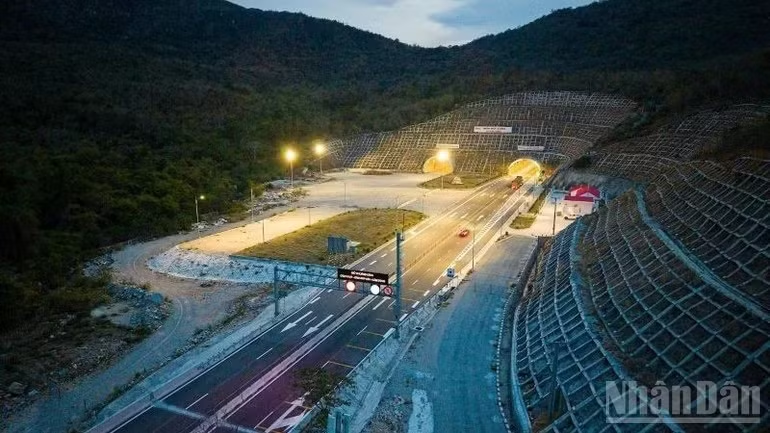
To date, HHV has invested in, constructed, and managed nearly 670km of expressways and national highways, along with over 40km of road tunnels, with a total investment of approximately 60 trillion VND in PPP projects. This is not only a foundation in terms of scale, but also a basis for the company to gradually affirm its capacity in implementing complex financial models such as PPP++.
From a market perspective, HHV’s leadership believed that, unlike many industries that can generate sudden short-term growth, transportation infrastructure assets have the characteristics of stable cash flow, long cycles, and are linked to the actual transportation needs of the economy. Therefore, the value of a business lies not in short-term fluctuations, but in its ability to maintain stable, transparent, and consistent growth across cycles.
In the context of a volatile global financial market due to geopolitical tensions, policy adjustments, and cautious international capital flows, infrastructure assets are increasingly seen as a “defensive” investment channel. For HHV, traffic flow on routes closely linked to domestic economic activity, less directly impacted by external fluctuations, provides a stable foundation for sustainable long-term cash flow.
At the macro level, infrastructure development continues to be one of Viet Nam’s strategic breakthroughs for the 2026-2030 period, creating a stable policy foundation for long-term investors. This is also why infrastructure stocks are increasingly attracting the attention of international institutional investors. With infrastructure businesses directly participating in the capital market, once the legal framework is perfected, policies are stable, and risk-sharing mechanisms are ensured, the capital market will become a crucial driving force in promoting infrastructure development and sustainable economic growth.