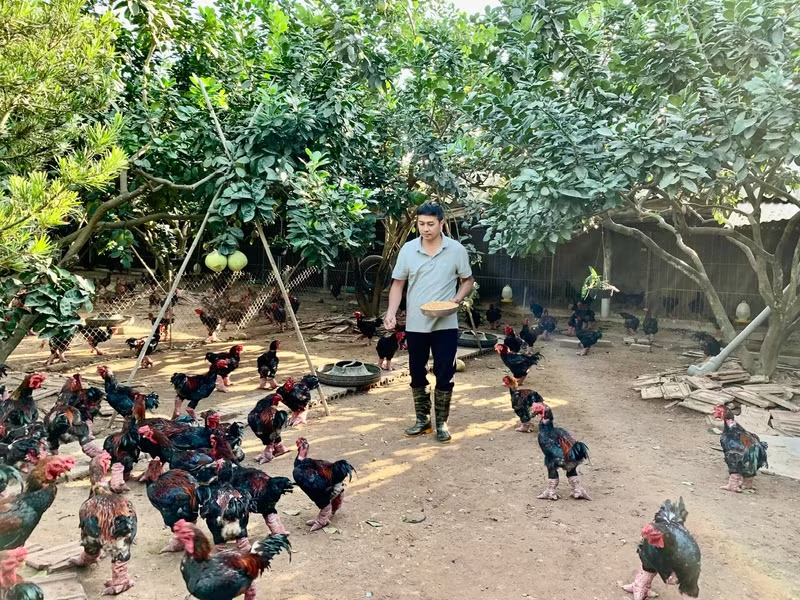
There are many biosafety and VietGAHP livestock production models in Hung Yen province that have effectively protected livestock and poultry herds from the threat of disease, helping develop livestock production and generating substantial incomes for farming households.
Nguyen Huu Tue, Director of Nguyen Gia Livestock Cooperative in Luong Bang commune, Hung Yen province, said that the cooperative has a flock of more than 70,000 laying hens, producing an average of around 30,000 eggs a day. The cooperative organises production through an integrated chain from livestock production to consumption, and therefore always attaches great importance to disease prevention and control, considering it a key factor in achieving efficiency and success in production.
Accordingly, Nguyen Gia Livestock Cooperative has implemented biosafety livestock production procedures, invested in modern technology and built a closed housing system, while using technology to control temperature and humidity, carry out vaccination and treat the environment. These measures have created favourable conditions for the chickens to grow well and maintain stable productivity and quality.
Hoan Long commune, Hung Yen province, is home to nearly 200 large- and medium-sized livestock and poultry farms and production establishments. To promote efficient livestock production, the commune has implemented various projects and models, including livestock production planning, a livestock breeding project, and models for developing biosafety and VietGAHP livestock production.
Through these projects and models, many livestock farmers have proactively applied scientific and technical advances, including closed housing technology, automatic feeding systems, biological products for waste treatment and biogas digesters. Models using microbial products have also been introduced to enhance animals’ resistance to disease, reduce the use of antibiotics and minimise unpleasant odours. The application of biosafety and VietGAHP livestock production practices has helped the commune’s livestock sector develop steadily, increasing production efficiency by 20%–30%.
Biosafety and VietGAHP livestock production have contributed to promoting the livestock sector in Hung Yen province towards modern, efficient and sustainable development. The structure of the livestock sector has initially shifted in a positive direction, with a lower proportion of household-based production and a higher proportion of concentrated, farm-based livestock production.
During the 2021–2025 period, Hung Yen’s livestock sector recorded average annual growth of 3.4%. Livestock households and farms supplied an estimated 297,220 tonnes of live pig meat, more than 16,496 tonnes of beef and buffalo meat, more than 122,000 tonnes of poultry meat and 865 million eggs to the market.
To promote sustainable livestock development and increase added value, the Hung Yen Provincial People’s Committee approved the “Project on developing biosafety livestock production and VietGAHP livestock production to ensure disease prevention, food safety and environmental protection for 2026–2030, with a vision to 2035”. The project will continue to support farm owners and farming households in implementing biosafety and VietGAHP livestock production, with the following tasks:
Encourage the development of farm-based livestock production on a scale that meets the requirements of the Law on Animal Husbandry, while ensuring biosafety, disease prevention and environmental protection.
Encourage the development of livestock production into a high-value-added economic sector with effective disease control and traceability, based on rapidly increasing the number and quality of productive, high-quality livestock and poultry, while prioritising indigenous breeds with distinctive regional characteristics.
Strengthen and improve the effectiveness of linkages in livestock production by encouraging the development of enterprises and the establishment of livestock cooperatives operating along commodity chains that ensure food safety and are associated with the One Commune One Product (OCOP) programme.
Promote the application of advanced livestock production techniques and high technology, particularly in breeding-stock production, and expand biosafety, VietGAHP and organic livestock production establishments. Improve livestock waste treatment in conjunction with the production of microbial organic fertilisers for clean agricultural production.
Effectively implement disease prevention and control measures and proactively control dangerous diseases; continue to improve the quality of establishing disease-free production establishments and gradually develop disease-free zones.
These measures will help the livestock sector develop sustainably along commodity chains linked to the OCOP programme and new-style rural development, while ensuring disease prevention, food safety and environmental protection. They will also reduce the proportion of household-based livestock production and increase the proportion of biosafety and VietGAHP livestock production and disease-free production.