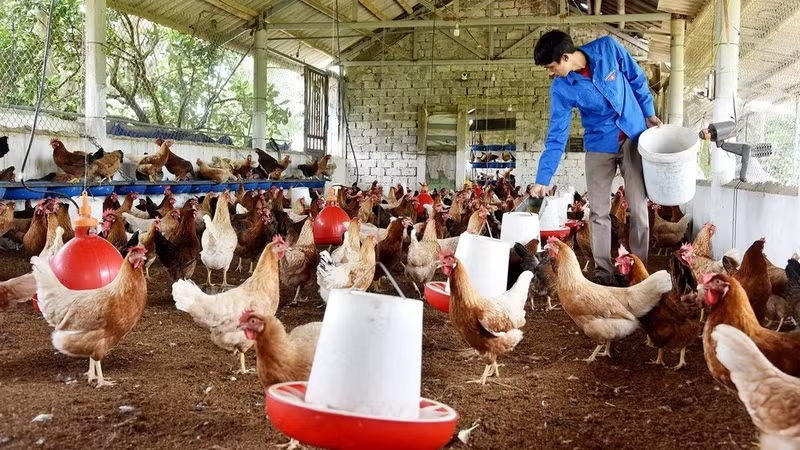
Nguyen Trong Tuyen, a representative of the Department of Livestock Production and Animal Health under the Ministry of Agriculture and Environment, said: “Over the past 15 years, the livestock sector has maintained annual growth of more than 4.5–6%, with meat production exceeding 8 million tonnes and egg production reaching 21.1 billion eggs, firmly ensuring food supplies to meet domestic demand. Vietnamese livestock products are now available in 65 countries and territories, with export value reaching 628 million USD in 2025.”
Livestock farming in Viet Nam is currently making substantial progress towards greater information transparency and traceability. Many large-scale farms have adopted electronic ear tags, smart collars, and high-frequency (HF) and ultra-high-frequency (UHF) RFID chips to identify individual animals.
Farm data management solutions supporting traceability across the value chain, such as Agri360, TE-FOOD, and iCheck, seamlessly connect data from breeding stock production, nutrition records, and veterinary quarantine procedures through to automated slaughtering and the packaging of finished products with transparent QR-code labels. In addition, the use of QR-code labels combined with blockchain technology in processing and distribution has also demonstrated outstanding effectiveness.
The livestock sector is required to produce safe, high-quality products with traceability to meet increasingly demanding market requirements. Traceability in livestock production is not limited to labels or QR codes; it also requires data covering the entire production process, including breeding stock, feed, veterinary medicines, vaccination, record-keeping, slaughtering, processing, and distribution. In recent years, the agricultural extension system nationwide has implemented a range of models focused on biosecurity, VietGAHP, quality control, traceability, and market linkages.
Le Quoc Thanh,
Director of the National Agricultural Extension Centre under the Ministry of Agriculture and Environment.
VietGAHP-compliant pig farming models incorporating traceability and market linkages have been implemented in localities including Hai Phong, Ninh Binh, Quang Ninh, Thanh Hoa, Nghe An, and Dong Nai, clearly demonstrating their effectiveness. Under these models, farmers receive direct guidance from agricultural extension officers on technical procedures, disease control, the use of feed and veterinary medicines, record-keeping, and food safety requirements. This creates a robust data foundation for traceability, secures market outlets for products, and results in selling prices that are 5–10% higher.
VietGAHP-oriented cattle farming models in localities including Ha Noi, Thai Nguyen, Bac Ninh, Phu Tho, and Khanh Hoa have significantly boosted economic efficiency by approximately 19.7–23.5% compared with conventional livestock farming.
Despite this progress, livestock production along value chains with traceability still faces formidable challenges. Establishing a standard high-tech livestock cooperative, for example, requires capital investment roughly seven times higher than under traditional methods. This serves as a major barrier, leaving most livestock cooperatives reliant on conventional production methods.
Furthermore, production organisation and value-chain linkages remain fragile; traceability and data management are not yet fully substantive; while animal diseases, fluctuations in input prices, and natural disasters pose major risks that can disrupt production and supply chains. At the same time, centralised slaughtering facilities, processing plants, cold storage, and logistics infrastructure remain poorly integrated in many localities, while the market has yet to provide sufficient incentives for quality products with traceability.
According to the Department of Livestock Production and Animal Health, to develop livestock production along value chains with traceability, production must be decisively restructured towards industrial-scale operations in the coming period, with priority given to closed-loop value-chain models. The effectiveness of value-chain linkage contracts should be monitored, while unlicensed and unsafe slaughterhouses must be resolutely eliminated. Greater emphasis should also be placed on developing circular and organic livestock production, VietGAHP-compliant farming, and green, low-emission livestock production.