A journey to restore forest cover
According to the Ministry of Agriculture and Environment, Viet Nam had about 14.3 million hectares of forest in 1943, with forest cover standing at 43%. By 1995, the figure had fallen to just over 9.3 million hectares, while forest cover dropped to 28%. The loss of 5 million hectares of forest over five decades posed serious risks to the environment, natural disaster resilience and people’s quality of life.
During years of economic hardship, timber exploitation for domestic use and economic development severely damaged primary forests and valuable timber forests. Forest clearing for shifting cultivation, natural disasters and unexploded ordnance left over from wartime also contributed to the rapid decline in forest area.
Following the launch of the Doi Moi (Renewal) process, a shift in management thinking and the approach to forests — from exploitation towards conservation and development — gradually halted the decline. Forests were no longer viewed simply as resources to be exploited but increasingly as strategic assets for socio-economic development, national defence and security, and environmental protection.
The loss of 5 million hectares of forest over five decades posed serious risks to the environment, natural disaster resilience and people’s quality of life.
In 1992, Decision No. 327-CT, issued by the Chairman of the Council of Ministers (now the Prime Minister) on September 15, laid the foundation for restoring forests and rehabilitating barren land, degraded hills, coastal alluvial areas and water surfaces.
Decision No. 661/QD-TTg, issued by the Prime Minister on July 29, 1998, on the objectives, tasks and implementation of the five-million-hectare forest restoration project, became the country’s largest forestry programme. It set out comprehensive goals, including restoring protective forests, rehabilitating and protecting special-use forests, developing production forests and creating jobs for local people.
These decisions also changed the way land and forest users viewed their responsibilities. Instead of exploiting forests, local people shifted towards planting, caring for and benefiting from forest protection and development activities, including payments from the State under the payment for forest environmental services (PFES) scheme. Meanwhile, businesses that affect or benefit from forests are required to pay forest environmental service fees.
For natural and primary forests, the Government introduced a logging ban and stepped up protection of remaining forest areas. Following Decision No. 1976/QD-TTg, issued by the Prime Minister on October 30, 2013, Viet Nam planned 167 special-use forest areas nationwide, including dozens of national parks and nature reserves for habitat protection, forestry and biological research. Special-use forests now cover nearly 2.4 million hectares.
More than three decades after the implementation of comprehensive and decisive measures, Viet Nam’s forest area has recovered to more than 14 million hectares. Of this, more than 1 million hectares comprise scattered trees and degraded forests not included in the forest-cover calculation, bringing overall forest cover to 42%.
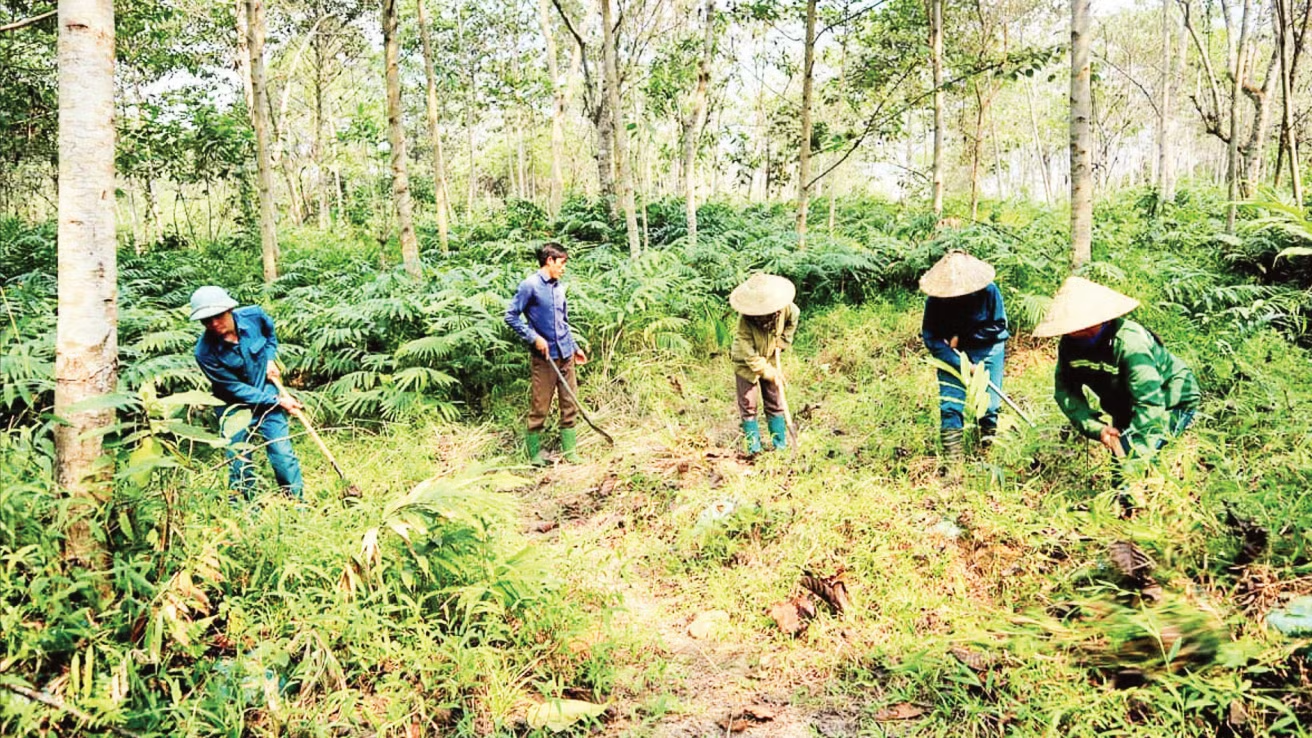
At the same time, the wood processing and export industry generates tens of billions of US dollars in annual revenue, while forest carbon credits are expected to provide a new source of income and resources for forest restoration and rehabilitation.
Towards a greener, more sustainable future
Despite these notable achievements, Viet Nam’s forest restoration journey still faces considerable challenges. According to the Department of Forestry and Forest Protection under the Ministry of Agriculture and Environment, primary forests account for only 0.25% of the country’s total forest area, while natural forests cover nearly 4 million hectares.
Notably, the quality of natural forests, measured by timber volume per hectare, is only about one-tenth that of primary forests and one-third of the level recorded in natural forests in the past.
These figures show that an increase in forest area does not necessarily mean a full recovery in forest quality. A large proportion of the additional forest area consists of production plantations, mainly acacia and eucalyptus, as well as shrubs and naturally regenerated trees.
This also highlights the difficulty of restoring primary forests and natural forests with high timber reserves. The Central Highlands, central Viet Nam and several northern mountainous localities continue to face pressure from forest loss and biodiversity decline. Climate change, natural disasters, forest fires and infrastructure development projects are creating further challenges for forest protection and quality improvement.
These figures show that an increase in forest area does not necessarily mean a full recovery in forest quality. A large proportion of the additional forest area consists of production plantations, mainly acacia and eucalyptus, as well as shrubs and naturally regenerated trees.
If the task for 1990–2025 was to preserve the country’s green cover, the focus for 2025–2045 will be on implementing stronger measures to improve forest quality. This is not only essential for environmental protection but will also increase the value of the country’s “green assets” through the forest carbon market.
According to Pham Hong Luong, Deputy Director of the Department of Forestry and Forest Protection, Viet Nam has significant potential for forest carbon absorption and storage services. This potential is the result of years of implementing policies on forest protection and development. Most recently, the Government’s Decree No. 180/2026/ND-CP, issued on May 21, 2026, concretised the Party and State’s policies on carbon credit development, creating an important resource for economic development and future forest protection and development.
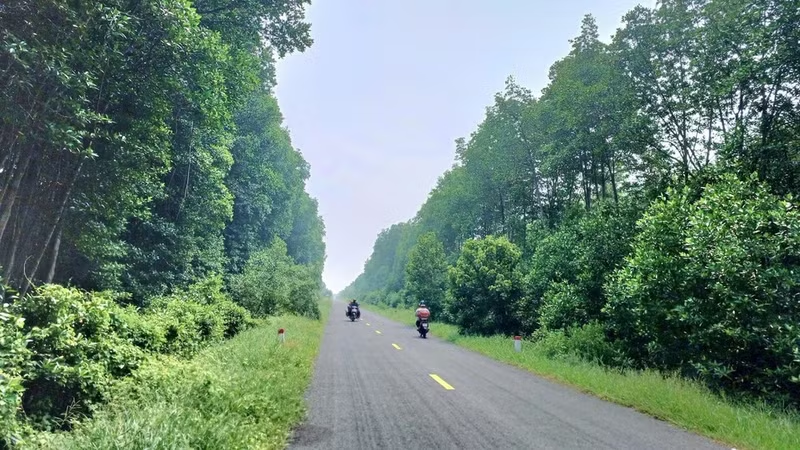
To put these policies into practice, the forestry sector is stepping up efforts to develop the carbon credit market and increase the economic value of forest environmental services. It is also implementing measures to strictly protect natural forests, develop large-timber forests, expand coastal and mangrove forests, and restore natural ecosystems, thereby strengthening forest resources and laying the foundations for a greener and more sustainable future.