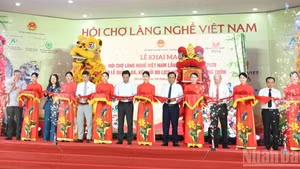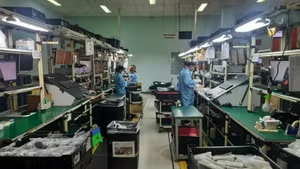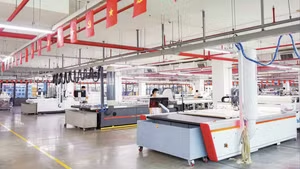
In early July, Suntory PepsiCo Viet Nam Beverage Company Limited inaugurated its factory in Huu Thanh Industrial Park, Duc Hoa commune, Tay Ninh province. This is the company’s sixth factory in Viet Nam.
A clear ripple effect
Many foreign corporations are continuing to expand their presence in Viet Nam. Dowooinsys Vina Company Limited (NP Group, the Republic of Korea) started construction of its second factory in Song Cong II Industrial Park (Thai Nguyen). Intel Products Viet Nam has increased its total investment in the Ho Chi Minh City High-Tech Park to 4.1 billion USD...
According to the General Statistics Office under the Ministry of Finance, as of June 30, the total registered FDI capital reached 34.65 billion USD, a 61% increase compared to the same period last year. Foreign direct investment (FDI) has truly created a ripple effect on industrial production, construction, and domestic supply chains.
Implemented FDI capital increased by 11.2% in the first six months of the year, with many projects completing the preparation phase and entering commercial production. The FDI sector also has the most positive production outlook for the third quarter of 2026.
For the construction and real estate sector, FDI combined with public investment has created additional momentum for the construction industry, contributing to job retention and market support.
The wave of investment in high-tech and electronics industries is also driving the formation and expansion of supply chains, creating opportunities for domestic businesses to participate more deeply in the production network.
Regarding prospects, Dr. Dang Thao Quyen from RMIT University Viet Nam believed that Viet Nam has maintained a very special position in the region thanks to its relatively high political stability.
Coupled with a consistent economic integration orientation and a wide network of free trade agreements, helps Viet Nam continue to be chosen as an “anchoring” point in the regional production system.
Viet Nam is also located in the heart of Southeast Asia and close to major Asian manufacturing centres, allowing us to act as an efficient transit link in the value chain.
With an increasingly expanding domestic market and a young workforce, Viet Nam has remained significantly attractive to investors seeking a balance between cost, scale, and scalability.
Redesigning the incentive policy system
With US-China tensions high and a clear trend of capital outflow from China, Viet Nam will have to compete more intensely for direct investment with economies like India, Indonesia, and Thailand.
Domestically, the most notable factor currently is the relatively extensive restructuring of the government apparatus and policy adjustments. This is a necessary step to improve governance efficiency and the business environment, but in the short term, it may create an “institutional lag.”
The impact of this factor could affect project approval timelines, disbursement capabilities, and investors’ perceptions of policy consistency.
According to Quyen, if domestic institutional reforms are effectively implemented and create a significant improvement in transparency and predictability of policies, Viet Nam could enter a new cycle of attracting FDI.
From a policy perspective, Dr. Tran Toan Thang, Head of the International and Integration Policy Department, Institute of Economic and Financial Strategy and Policy under the Ministry of Finance, argued that Viet Nam needs to shift from a cost-based competitive mindset to building a highly competitive investment ecosystem.
The new generation of FDI has focused more on the quality of human resources, innovation capacity, value chain connectivity, and the stability of the investment environment.
This is also the direction set forth in Resolution No. 10-NQ/TW of the Politburo on the development of the foreign-invested economy (shifting the focus from simply attracting capital to selectively attracting investment, prioritising high-tech projects, innovation, digital transformation, green transformation, etc.).
To realise this goal, Viet Nam needs to strengthen investment support policies beyond tax incentives, continue to simplify administrative procedures, increase policy transparency, ensure legal stability, and enhance intellectual property protection.
At the same time, investment incentives should be conditionally designed and linked to the goal of improving the quality and efficiency of FDI flows.
When the investment environment becomes more transparent, stable, and predictable, it will be a crucial competitive advantage for Viet Nam to attract a new generation of FDI, said Thang.
To realise this direction, the incentive policy system also needs to be redesigned. Instead of incentives primarily based on capital size or investment sector, policies should be linked to the results of investors' commitments, such as the level of localisation, technology transfer, use of domestic suppliers, human resource training, and support for Vietnamese businesses to participate in supply chains.
From the project selection stage, criteria regarding technology, innovation, linkages with domestic businesses, and the roadmap for fulfilling commitments should be added. Incentives should also be linked to the project implementation process, only applying when investors fully fulfill their commitments.
Along with reforming preferential policies for FDI, the State also needs programs to support domestic businesses in improving their technological capabilities, management, and product quality.
According to Professor Hoang Van Cuong, former member of the Finance and Budget Committee of the National Assembly, when both FDI and Vietnamese businesses have the motivation to cooperate, the goal of forming a production ecosystem and increasing the added value of the economy, as set out in Resolution No. 10-NQ/TW, can become a reality.