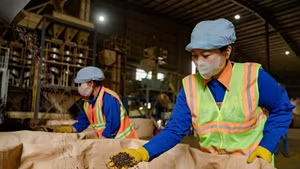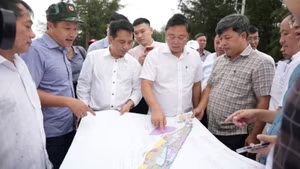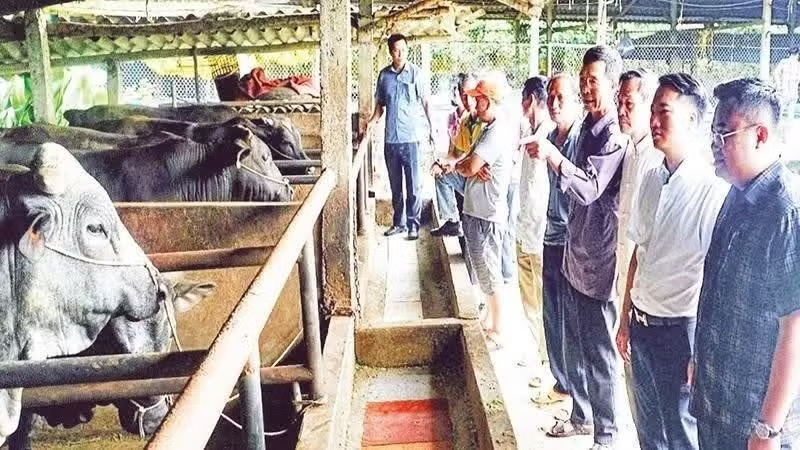
Chu Ba Trung, Director of the Thai Nguyen Centre for Agricultural Extension and Environment, said: “In recent years, agricultural extension work in livestock farming has closely followed the orientations of sustainable development and biosecurity, while being linked to value chains.
In 2025 and the first six months of 2026, the centre implemented 15 livestock farming projects and models focusing on key areas such as circular livestock farming and the application of high technology; quality standardisation towards VietGAP certification and linkage with product distribution; and the effective development of high-value indigenous breeds.”
These projects have demonstrated the practical effectiveness of new production approaches based on circular practices and VietGAP standards and aligned with market demand. Models such as VietGAP-certified pig farming, circular beef cattle fattening, and H’Mong chicken farming have helped improve disease prevention, reduce environmental pollution, and increase profits by 13% –17% compared with traditional livestock farming. Cooperatives participating in the projects organise production according to standardised processes, control quality, and gradually link production with product distribution, thereby increasing the value of their products.
During 2024–2026, the National Agricultural Extension Centre under the Ministry of Agriculture and Environment implemented a project to develop circular agricultural production models in Thai Nguyen and Bac Ninh, involving 950 beef cattle and 12 hectares of forage maize, with Thai Nguyen accounting for 510 cattle and six hectares of maize. The results showed that economic efficiency increased by around 13% compared with traditional livestock farming.
Hoang Thi Phuong, from Diem Thuy Commune, Thai Nguyen Province, said: “Previously, my family raised cattle using traditional methods, which were not very effective. Since joining the project, waste has been properly treated, reducing odours in the barns. Cow manure is used to feed earthworms, whose castings are then made into organic fertiliser for 10,000 square metres of forage maize. This provides tens of millions of Vietnamese dong in savings each year because we no longer have to buy inorganic fertiliser. We now raise 30 cattle using the new husbandry techniques. The cattle grow well, the fattening period is shorter, and both the weight and quality of the meat have improved. We also have a stable market through production linkages.”
In Dong Hy Commune, Thai Nguyen Province, 100% of the products under the H’Mong chicken farming development project for 2025–2027 are being developed under arrangements linking production with product distribution. This marks a shift from traditional chicken farming to the production of quality products with clear identification and established markets.
Nguyen Thi Binh, Director of Thien Phuc Agriculture and Medicinal Plants Cooperative, said: “The cooperative currently works with 45 farming households to raise 10,000 H’Mong chickens. Under the production linkage, households receive guidance on standardising the production process, from breeding stock and feed to husbandry techniques. The chickens are raised under a semi-free-range system, combined with regular vaccination and the use of biological preparations to improve flock health and protect the environment. The approach also helps secure feed supplies, improve product quality, and limit disease outbreaks. After 16 weeks, farmers can earn an average profit of 30,000 VND –50,000 VND per chicken.”
Chu Ba Trung, Director of the Thai Nguyen Centre for Agricultural Extension and Environment, said that in the coming period, the centre would continue to evaluate the models to identify those that deliver good results and are suited to local conditions for wider replication.
At the same time, it will encourage farmers to develop livestock production based on biosecurity, disease prevention, and circular practices to reduce costs and environmental impacts; step up the application of technical advances; and strengthen links between production and product distribution.