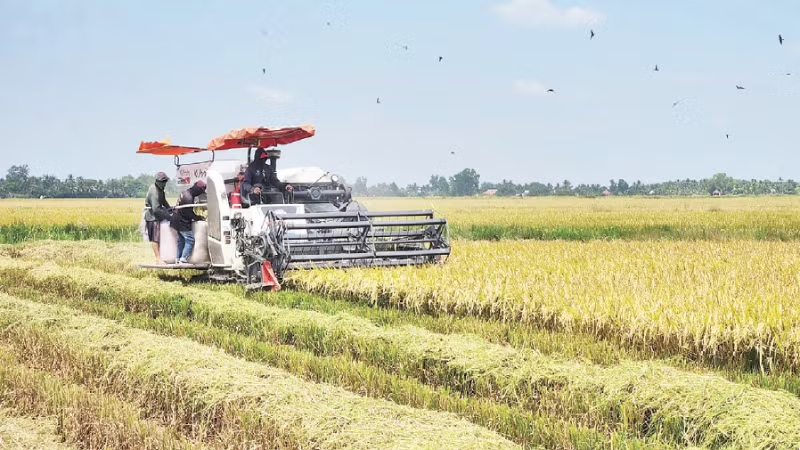
The collaboration between the agricultural extension system and businesses promises to create highly effective production models, reduce emissions, and increase farmers' income.
In the context of transitioning to high-tech and sustainable agriculture, the agricultural extension system is doing a good job of transferring technology, leading farmers to change their production mindset, connecting markets, and innovating…
In particular, the National Agricultural Extension Centre is promoting PPP cooperation to exploit direct investment capital from the private sector both domestically and internationally.
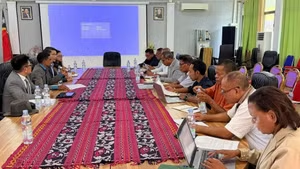
According to Director Le Quoc Thanh, PPP cooperation activities are implemented in a substantive manner, closely linked to the value chain and production needs. In this model, businesses play a central role in terms of market and technology, the agricultural extension sector acts as a technical bridge and implementer, and farmers are the main producers.
The cooperation content is closely integrated with training, technology transfer, model building, consumption linkages, and digital transformation.
In 2025, public-private partnerships continued to be identified as one of the important pillars in reforming the operational methods of the agricultural extension system.
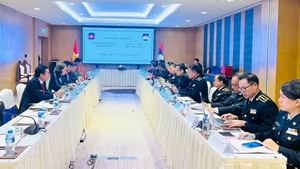
Through programmes and cooperation agreements with businesses, international organisations, and industry associations, the National Agricultural Extension Centre has effectively mobilised social resources for agricultural development.
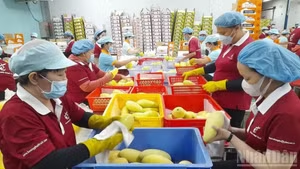
Simultaneously, it promotes the transfer of technical and digital advancements, smart agriculture, and green agriculture towards low emissions, contributing to increasing the value of the value chain, improving income and the production organisation capacity of farmers and cooperatives.
PPP cooperation activities are implemented in conjunction with major programs and projects such as: the Project for the sustainable development of 1 million hectares of high-quality, low-emission rice monoculture associated with green growth in the Mekong Delta by 2030; the National Strategy on Green Growth; Digital transformation programme for agriculture and agricultural extension...
Implementing the “one million hectares of low-emission rice” project, the National Centre for Agricultural Extension has collaborated with businesses, units, and localities to deploy seven pilot models in 2024 and 2025.
After three seasons of implementation, these models have helped reduce seed usage by 30-50%, fertilizer use by 30-70 kg/ha, irrigation water usage by 30-40%, and pesticide application by 1-4 times, thereby reducing production costs by 8.2 to 24.2%.
The models have resulted in increased yields by 2.4 to 7%, increased farmers’ income by 12 to 50% (equivalent to 4-7.6 million VND/ha), reduced greenhouse gas emissions by 2 to 12 tonnes of CO2/ha compared to traditional methods, and minimised the burning of rice straw after harvest, contributing to pollution reduction and environmental protection.
During the implementation of the 1 million hectare low-emission rice project, the agricultural extension system collaborated with organisations and businesses to build and form an “agricultural extension-business ecosystem.”
This included collaboration with companies such as Bayer Vietnam Co., Ltd., Binh Dien Fertilizer Joint Stock Company, and AHA Chemical and Agricultural Joint Stock Company to develop integrated models applying technological solutions and organic, low-emission rice farming models, thereby concretising the key tasks and solutions set out in the project.
Nguyen Truong Vuong, representative of Bayer Vietnam Co., Ltd., stated that, implementing the PPP (Public-Private Partnership) model for agricultural extension and enterprise cooperation in supporting the development of high-quality rice raw material areas for export in Viet Nam, the company has deployed the Bayer Forward Farming model.
This has helped ensure or increase productivity by 0.6 to 13.5%, reduce average production costs by 10 to 25%, increase profits by 13.1 to 74.16%, reduce seed sowing by 50 to 70%, and reduce nitrogen fertilizer use by 30 to 50%.
Le Quoc Thanh stated: “Currently, relevant agencies are actively expanding the export market for Vietnamese agricultural products. Therefore, cooperation between businesses and the agricultural extension sector is needed to help farmers produce according to the standards and criteria desired by the market.
However, when cooperating, the mindset of agricultural extension workers must also be innovative; they need to link their responsibilities with businesses, farmers, and cooperatives.”
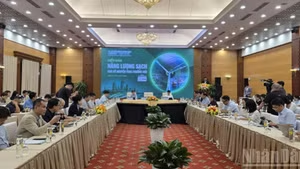
At the recent 2025 agricultural extension and business forum held in Ho Chi Minh City, many delegates suggested that in the future, a flexible financial mechanism should be enacted to encourage socialisation, public-private partnerships, and the mobilisation of resources from businesses, international organisations, and the community for agricultural extension activities.
Furthermore, there needs to be a close connection between state-run agricultural extension and business-run agricultural extension, with state-run extension playing a central role in guiding, mobilising, connecting, and coordinating resources; promoting the linkage of the “four stakeholders” (farmers, businesses, scientists, and the government). Develop public-private partnership programmes between state-run agricultural extension services and enterprise-run agricultural extension services.
At the same time, it is necessary to innovate the content and methods of agricultural extension activities towards professionalism and modernity, meeting the requirements of agricultural economic restructuring; proactively train a professional, highly qualified workforce capable of analysing, advising, organising production, and guiding the transfer of advanced technologies linked to market needs and product value chains; develop electronic, digital, and smart forms of agricultural extension to diversify forms and increase coverage…