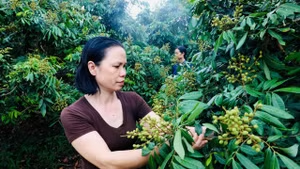
With many years of experience in agriculture, but only focusing on rice cultivation, the results were not very good. Then, a stroke of luck came to Bui Van Kha, currently the Director of the Dong Thap Flower Cooperative in Dan Phuong Commune (Ha Noi City), when he married a woman from Tay Tuu Flower Village. In 2000, he began bringing chrysanthemums, roses, and mimosa to the area to grow in rice fields.
Kha confided: “After 10 years of growing these flowers, I realised they weren’t suitable for the soil and didn’t yield high economic returns, so I switched to growing gerbera daisies. Seeing the effectiveness of growing gerbera daisies, I accumulated experience and linked up with other households to form a cooperative to support each other in production and sales.
Currently, with an area of about 27 hectares, many households grow flowers in greenhouses and net houses, resulting in more flowers with better quality and much higher economic returns compared to conventional methods.”
Recognising the increasing number of farmers abandoning their fields, the Thuy Huong Agricultural Production, Business and Service Cooperative (Hai Phong City) has recently leased land for large-scale production.
Nguyen Thi Ha, Director and Chairwoman of the Cooperative’s Board of Directors, shared: “To date, with over 300 hectares of land leased from the people, the cooperative is producing models such as high-quality rice and rice-fish farming, achieving an efficiency of 70 million VND/hectare/year, 3 to 5 times higher than conventional farming.
In addition, the cooperative collaborates with the people to cultivate rice-worm farming on 222 hectares using high-quality rice varieties following organic farming methods, she said, adding that in this model, straw and rice stalks are composted into microbial organic fertiliser, which is then used to fertilise the crops, reducing fertiliser costs by 15 to 20%, increasing soil fertility, and limiting pests and diseases.
"Currently, the cooperative's rice from rice-worm fields is available in stores and supermarkets in many localities nationwide. Every year, we supply approximately 200 tons of clean rice under the brand name of rice from rice-worm fields to the market," Ha noted.
Similarly, at the Dong Xuyen Integrated Livestock Cooperative (Hung Yen Province), members are producing according to the integrated VAC economic model, such as: rice-fish-sea duck farming, poultry farming, snail farming, black carp farming, etc.
Currently, the whole country has about 26 million hectares of agricultural land, but due to a variety of factors, the area is tending to shrink.
According to Director Ngo Van Duan to enhance production value, the cooperative has identified the application of science and technology as the key to success. The cooperative implements bio-secure duck farming using biodegradable bedding, which helps manage the environment, reduce odours in the barns, prevent diseases, and reduce veterinary medicine costs. Furthermore, utilising the abundant natural food sources in the tidal flats helps the ducks stay healthy, grow quickly, and produce flavourful meat and clean eggs.
Currently, sea duck meat and eggs are the two main 4-star OCOP products of the cooperative when sold on the market. In 2024, the cooperative had 12 members raising 80,000 meat ducks, earning a profit of 228 million VND per household, and 5,000 laying ducks, earning a profit of 150 million VND per household.
Currently, the whole country has approximately over 26 million hectares of agricultural land, but due to various reasons, this area is tending to shrink. Furthermore, the market demand for clean and safe products is increasing. Therefore, applying technology to production to enhance the value and income of farmers is an urgent need today.
According to statistics, the country currently has over 35,000 cooperatives with nearly 6 million members, of which approximately 4,700 cooperatives participate in value chain linkages and 2,600 apply high technology.
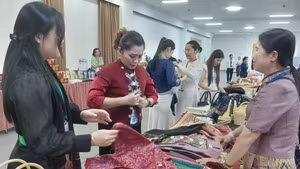
Cooperatives are recognised as playing a crucial role in organising the application of high technology in the production, processing, and consumption of agricultural products for farmers, as well as in promoting value chain linkages and improving management capacity to bring many benefits to cooperatives and participating members, thereby contributing to reducing intermediaries, costs, lowering product prices, and increasing income.
However, the percentage of cooperatives applying science and technology to production is still low; there are few cooperatives and businesses participating in value chain linkages; most cooperatives are small in scale, with limited management and production capacity, and do not yet meet the requirements of value chain linkages. There is a shortage of qualified and specialised personnel with in-depth knowledge of building and operating linkages between cooperatives and businesses.
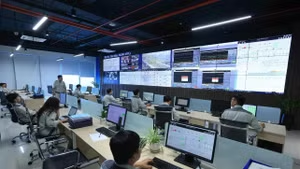
In the coming period, localities need to continue training and educating cooperatives and farmers; support cooperatives in applying technology and digital transformation in management, production, business operations, product promotion, and trade promotion for agricultural products; strengthen linkages between people, cooperatives, and businesses, ensuring a stable market for high-quality agricultural products.
In addition, cooperatives need to boldly innovate and apply digital technology in management and operation to truly play a bridging role, guiding farmers in production, promotion, trade promotion, and product consumption.