Engineers of global standing
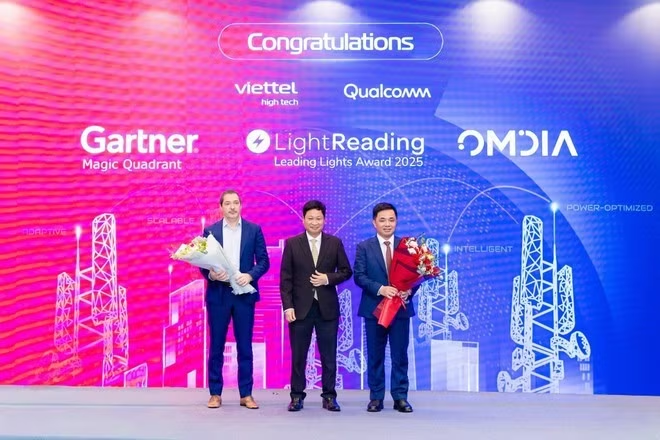
Viettel High Tech, a subsidiary of Viet Nam’s Viettel Group, earned significant recognition by being named a “Niche Player” in Gartner’s Magic Quadrant for CSP 5G RAN Infrastructure Solutions in 2025 — a historic milestone for Vietnamese technology in the global commercialisation of 5G. Viettel High Tech now stands alongside industry giants such as Samsung, Huawei, and Ericsson.
From a global perspective, where dozens of major corporations compete for every niche, this may not seem seismic. But for Viet Nam, it is a critical signal: the country has entered the arena of companies working at the deepest layers of technology, a field most emerging nations have only observed from the sidelines.
To be recognised in Gartner’s most prestigious report, businesses must demonstrate genuine market acceptance, provide evidence of real-world deployment, and undergo independent evaluation. Viettel High Tech is not credited merely for being a newcomer, but for reaching the level of the world’s foremost core technology experts.
The recognition confirms that Vietnamese engineers possess world-class calibre. This capability reflects the cumulative effort of generations of engineers who have long supported projects in telecommunications, electronics, and automation.
Behind this milestone lies the ability to absorb and master knowledge. As Qualcomm’s Deputy General Director Gerardo Giaretta notes, the technology underpinning the 5G ecosystem is highly complex, demanding immense effort and deep expertise.
The recognition confirms that Vietnamese engineers possess world-class calibre. This capability reflects the cumulative effort of generations of engineers who have long supported projects in telecommunications, electronics, and automation. Gartner’s acknowledgement is merely the visible tip of an iceberg that continues to grow.
That snapshot also prompts broader questions: if Vietnamese enterprises can master core telecommunications technology, why not semiconductors and electrical engineering?
Three pillars for advancement
Core technology forms the deepest layer of industrial infrastructure, determining a nation’s autonomy and competitive strength. To master core technology in the electrical field, Viet Nam must meet three conditions.
First, there must be pioneers who create genuine research demand. Without domestic companies daring to pose technological challenges and boldly investing in design and R&D, simply importing equipment will not produce engineers with deep expertise in chips, system architecture, or grid control.
Second, Viet Nam needs to build a consistent and long-term national strategy. Countries that master core technologies pursue decades-long research and development programmes. Viet Nam should therefore develop a comprehensive policy framework for the electrical industry.
The aim is not necessarily to manufacture everything domestically, but to master key stages: design, integration, control, and testing of power semiconductor chip systems, grid control systems, and smart transmission and distribution equipment.
Third, it is vital to nurture a knowledge ecosystem linking businesses, universities, and research institutes. No country has mastered chips or electrical technology without this connection.
If businesses fail to pose challenges, universities cannot train effectively. If research institutes do not generate new knowledge, businesses cannot ascend to higher value levels.
Such an ecosystem is still nascent in Viet Nam but requires more systematic investment in shared research infrastructure, co-funded programmes, data-sharing mechanisms, and networks connecting experts at home and abroad.
Globally, power semiconductors and new materials are dominated by corporations and nations that have invested billions over decades, securing supply chains, patents, and markets.
For Viet Nam, with limited research resources, supporting industries, and domestic demand, the most viable path is to select narrow strategic niches for deep investment.
When these factors converge, milestones such as appearing in Gartner’s Magic Quadrant will no longer be “rare coincidences” but part of Viet Nam’s natural technological trajectory.
According to Forbes, Gartner’s Magic Quadrant is regarded as the “gold standard” for assessing the market position of technology providers — from global giants to emerging startups. Gartner’s recognition extends beyond product quality, evaluating companies holistically, particularly their technological vision and execution capability.