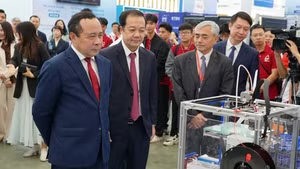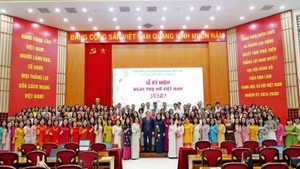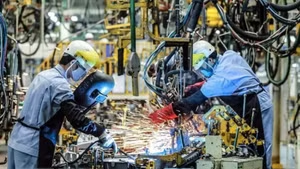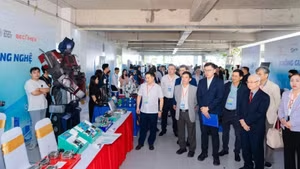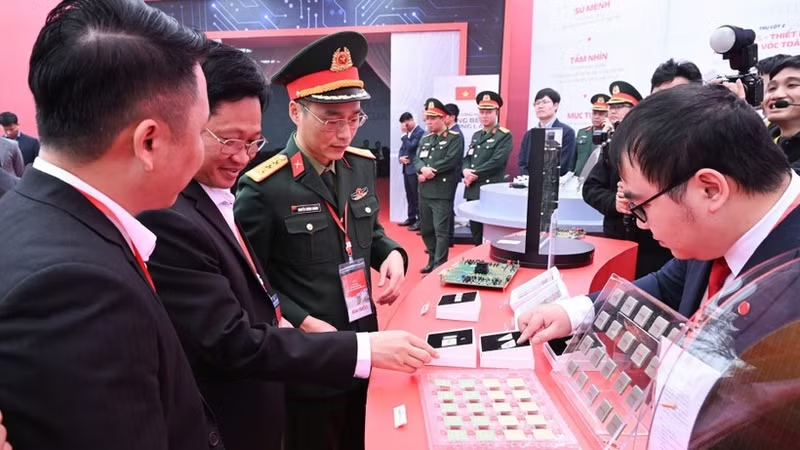
In the context that semiconductor technology is becoming increasingly linked to security and growth, this shows that the semiconductor development strategy is gradually being concretised with clear steps.
From design to manufacturing
Two highlights at the beginning of 2026 were Viettel’s groundbreaking of the first semiconductor chip manufacturing plant in Viet Nam and FPT’s announcement of the establishment of an advanced semiconductor chip testing and packaging plant. These milestones show a clear transition from strategic orientation to concrete action. After many years of participating in stages such as design, packaging, and testing, Viet Nam is for the first time moving closer to completing the most crucial link in the value chain: domestic chip manufacturing capacity.
According to the Authority of Information and Communication Technology Industry under the Ministry of Science and Technology, Viettel’s chip manufacturing plant project is a strategic step in line with the roadmap set out in the Semiconductor Industry Development Strategy. The plant focuses on research, design, and pilot production, creating a foundation for Viet Nam to gradually master technology from design to manufacturing. The target is to establish a small-scale chip manufacturing plant by 2030, then expand to two plants by 2040 and three by 2050.
The project is being implemented according to a roadmap during 2026-2030, from building the plant and acquiring technology to completing the process and improving operational efficiency. Bui Hoang Phuong, Deputy Minister of Science and Technology, emphasised that this marks the first time Viet Nam has formed domestic chip manufacturing capacity, which is not only symbolic but also contributes to gradually closing the chip production chain from design and manufacturing to packaging and testing.
Viettel’s chip manufacturing plant project is a strategic step in line with the roadmap set out in the Semiconductor Industry Development Strategy. The plant focuses on research, design, and pilot production, creating a foundation for Viet Nam to gradually master technology from design to manufacturing. The target is to establish a small-scale chip manufacturing plant by 2030, then expand to two plants by 2040 and three by 2050. The project is being implemented according to a roadmap during 2026-2030, from building the plant and acquiring technology to completing the process and improving operational efficiency.
In parallel with manufacturing, FPT’s investment in an advanced testing and packaging plant is considered a crucial piece in gradually completing the domestic semiconductor value chain. FPT Group Chairman Truong Gia Binh stated that this step aims to help realise the goal of mastering critical stages and enabling Vietnamese enterprises to participate more deeply in the global supply chain, as advanced packaging and testing increasingly play a vital role in improving chip performance and value. Mastering the packaging and testing stages helps optimise costs and reduce time requirements for product commercialisation, while also improving the technological capacity of domestic enterprises. This is a strategically significant step in completing the “Make in Viet Nam” semiconductor ecosystem in line with Resolution No. 57-NQ/TW of the Politburo.
The coordination between leading enterprises such as Viettel and FPT, and with an increasingly completed legal framework, is creating a favourable foundation to promote research, training, and commercialisation of domestic semiconductor products. Through this process, Viet Nam is gradually shifting from participation in the supply chain to mastering higher value-added stages.
Institutions pave the way, businesses lead the way
The semiconductor industry is becoming a foundation of the digital era. Therefore, the development of this industry is embedded in the broader strategy of improving growth quality and promoting the digital economy. Viet Nam aims to expand the scale of the digital economy in GDP and increase investment in science, technology, innovation, and digital transformation, thereby gradually improving competitiveness and position of innovation of the nation.
To realise this orientation, the government has issued a system of important guidelines and policies, from Resolution No. 57-NQ/TW to the Law on Science, Technology and Innovation, the Law on Digital Technology Industry, and the Semiconductor Industry Development Strategy of Viet Nam to 2030, with a vision to 2050.
In the context of the global semiconductor market becoming a geopolitical and national security issue, with an industry scale reaching trillions of USD, a country lacking chip capacity will be limited in strategic autonomy and development potential. Looking back, Viet Nam has formed significant foundations such as developing a workforce of engineers; emerging businesses involved in design; becoming an important destination in the packaging and testing stage; and attracting investment from many large technology corporations, thereby gradually strengthening its position in the global semiconductor value chain.
In the context of the global semiconductor market becoming a geopolitical and national security issue, with an industry scale reaching trillions of USD, a country lacking chip capacity will be limited in strategic autonomy and development potential. Looking back, Viet Nam has formed significant foundations such as developing a workforce of engineers; emerging businesses involved in design; becoming an important destination in the packaging and testing stage; and attracting investment from many large technology corporations, thereby gradually strengthening its position in the global semiconductor value chain.
However, the key bottleneck of the semiconductor industry is chip manufacturing capacity — the most complex and highest value-added stage in the value chain. The launch of a high-tech chip manufacturing plant not only fills this missing link but also marks an important shift from participation to gradual mastery, from assembly to innovation. More importantly, this will be a "real-world" environment for training high-quality human resources and attracting private and FDI enterprises to participate more deeply in high-tech supply chains.
To turn opportunity into sustainable capacity, the focus in the next phase will be on accelerating research and development (R&D), standardising, and expanding the mechanism of access to infrastructure. The Ministry of Science and Technology is prioritising resources for projects on chip design, research, and technology transfer with high application potential on new manufacturing infrastructure, while establishing mechanisms for institutes, universities, and start-up businesses to access pilot production capacity. Support models such as MPW (Multi-Project Wafer), together with the completion of technical standard and regulation system, are expected to shorten the path from laboratory to market and improve the competitiveness of “Make in Viet Nam” products.
At the local level, Ho Chi Minh City is building the “HCM+” model, aiming to become a growth pole for the semiconductor industry based on four pillars: human resource development, ecosystem improvement, promotion of core technology R&D, and institutional innovation. The city has proposed breakthrough policies on infrastructure investment, promotion of integrated circuit design, development of supporting industry, and the attraction and training of high-quality human resources, while implementing flexible pilot mechanisms to create space for new models to develop.
A notable highlight is Circular No. 30/2025/TT-BKHCN issued by the Ministry of Science and Technology, which allows the import of used production lines and equipment for chip manufacturing, packaging, testing, training, and R&D activities. This move aims to remove infrastructure bottlenecks and strongly shift towards post-inspection mechanisms while continuing to maintain strict technical requirements. Along with incentives from the Law on Digital Technology Industry and related policies, the institutional "runway" is gradually becoming more complete, enabling Viet Nam's semiconductor industry to attract investment, build endogenous capacity, and integrate more deeply into the global value chain.