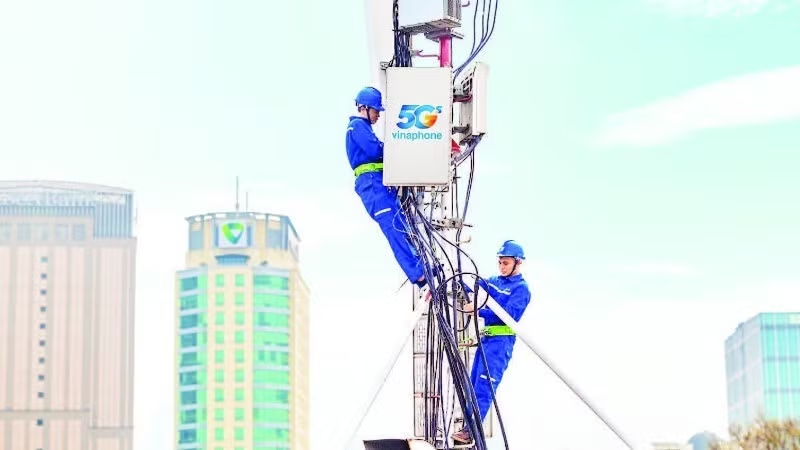
After one year of commercialisation, 5G mobile services (5G network) in Viet Nam have not only progressed faster than anticipated, but have also demonstrated a consistent approach: infrastructure first, development later, in line with the strategic orientation set by the Party and the State in the national digital transformation process.
The philosophy of “tracks before trains”
The Politburo’s Resolution No. 57-NQ/TW on breakthroughs in science and technology development, innovation, and national digital transformation clearly states that digital transformation is a key driving force for the country’s industrialisation and modernisation in the new period. In which, digital infrastructure must take the lead, playing a role as the foundation for the development of digital economy, digital society, and digital government. This is regarded as a strategic development orientation linked to the goal of improving productivity, growth quality, and national competitiveness.
In this context, the deployment of 5G network in Viet Nam is not only an investment activity of telecommunications enterprises, but part of a significant political-economic mission. In reality, just one year after official commercialisation, 5G network has been rolled out widely, quickly forming a new-generation connectivity infrastructure nationwide. This is a prerequisite for Viet Nam to keep pace with the global wave of digital transformation and to create room for digital economic models to develop in the coming years.
According to Nguyen Ha Thanh, Deputy General Director of Viettel Telecom, by the end of 2025 Viettel had deployed 30,000 5G stations, achieving 90% outdoor coverage and 70% indoor coverage. “We consider 5G investment as an investment in national digital infrastructure. When infrastructure goes first, applications and socio-economic value will follow,” she said.
Alongside Viettel, VNPT, and MobiFone have also gradually expanded coverage according to appropriate roadmaps, prioritising key economic areas such as major cities, industrial parks, seaports, and airports. This approach shows that from the outset, 5G has been positioned as one of the key foundations for digital economic development.
The fact shows that countries often face numerous challenges at the initial stage of deployment. However, the coverage of around 90% population usually takes at least two years and commonly around three years in many countries worldwide.
According to Nguyen Anh Cuong, Deputy Director General of the Telecommunications Authority under the Ministry of Science and Technology, by achieving approximately 90% population coverage within just 12 months, Viet Nam is among the fastest 5G deployers in the world. This achievement is not only technical in nature but also creates a relatively even digital infrastructure base, contributing to narrowing development gaps between regions, and between urban and rural areas. Viet Nam’s decision to deploy 5G “quickly and widely” comes from a consistent development philosophy aligned with international experience: “To deploy 5G quickly, infrastructure must be invested in first. Like a train, there must be tracks before it can run.”
At present, the Government is also proactively building specific mechanisms to encourage and support enterprises to accelerate 5G deployment. Among these is a policy to partially support investment capital for enterprises that soon complete 5G station rollout targets ahead of schedule, clearly demonstrating the State’s guiding and creating role in developing digital infrastructure.
This approach shows that 5G development is not considered as purely a commercial activity, but as a national-level infrastructure mission.
Creating the foundation for modern digital infrastructure
In practice, after one year of commercialisation, 5G network in Viet Nam has achieved clear infrastructure results: wide coverage, high connection quality, low latency, and readiness for next-generation applications. However, the issue of commercialisation and value-added exploitation remains challenging.
Nguyen Quoc Khanh, Deputy Head of Technology Department at VNPT Group, said that investment in 5G is a long-term investment process.
“The initial stage mainly improves individual user experience. Higher-value business models such as private networks or digital platforms require more time, synchronous ecosystem, and enterprise readiness,” he said.
The situation in Viet Nam reflects this trend. Currently, individual users remain the primary group of 5G subscribers, while enterprise and vertical-sector applications are still in the testing phase. Investment costs in 5G are several times higher than those of previous generations, and the inability to recover capital quickly had already been anticipated.
Nevertheless, telecommunications enterprises share a common view: the effectiveness of 5G cannot be measured by short-term profits, but must be assessed strategically through its broader impact on labour productivity, management efficiency, people’s quality of life, and the long-term competitiveness of the economy.
Viet Nam has issued the National Digital Infrastructure Architecture Framework, which identifies key infrastructure groups, including telecommunications and internet infrastructure (covering fixed networks, 5G, 4G, and other related components), as well as data infrastructure and data storage.
Overall, the first year of 5G commercialisation in Viet Nam can be regarded as a foundational phase, aiming at building a modern, synchronised digital infrastructure with a long-term vision. This foundation will determine the development capacity of digital economic and digital social models in the coming years, as applications deepen and integrate into urban governance, manufacturing, logistics, agriculture, and daily life of people.