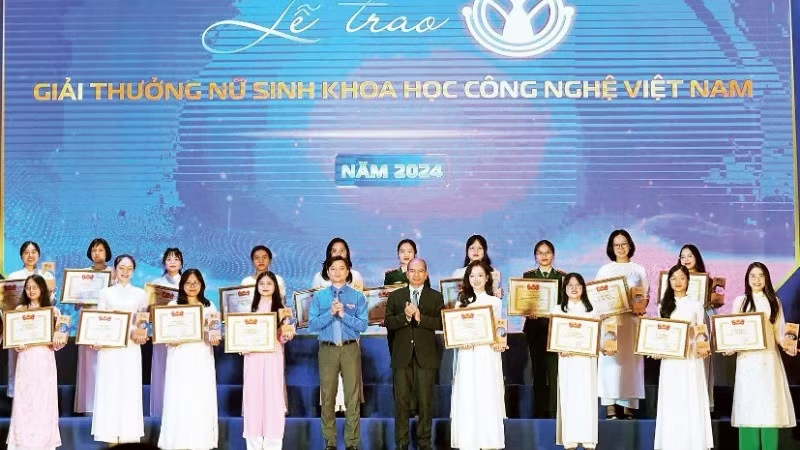
This requires specific, focused, and sufficiently strong changes to unleash the potential of female intellectuals.
Giving opportunities, unleashing potential
Giving opportunities is not just about creating conditions, but also about affirming trust. When women are trusted, supported, and empowered, their creative potential will be strongly unleashed, making practical contributions to the development of science, digital transformation, and the prosperous future of the country. So, what policies need to be prioritised for adjustment so that female intellectuals can participate more strongly in research, application, and innovation, contributing to the realisation of the breakthrough spirit of Resolution No. 57-NQ/TW?
Many experts, managers, and scientists, when asked, have emphasised policy groups that need immediate adjustment. Accordingly, the top priority is policies regarding age and research duration — a technical barrier but one that significantly impacts the career advancement opportunities of female scientists. A mechanism is needed to add 3–5 years to the eligibility criteria for national-level research project leadership, professorship, associate professorship, or young scientist awards for women; and to increase the number of female project leaders by 30%.
Funding mechanisms need to be gender-specific, such as allowing for project deferrals and extensions during maternity leave, while also increasing women's participation in scientific councils and management positions to ensure diversity in policy planning. This is essentially “giving opportunities” in a substantive manner, with a flexible and inclusive policy.
In addition, a mechanism for direct commissioning and assignment of tasks should be implemented. Le Thi Khanh Van, Director of the Centre for Science, Technology and Entrepreneurship Application under the Viet Nam Women Intellectuals Association, stated that Government Document No. 4324/VPCP (dated May 16, 2025) from the Prime Minister’s Office has assigned the Ministry of Science and Technology to pay attention to and support the commissioning of research projects so that the Viet Nam Women Intellectuals Association and female scientists can contribute to the development of science and technology and innovation. The key issue is ensuring that these commissioned projects are not merely guidelines but become tangible opportunities.
Dr Pham Thu Hien, Coordinator of the Vietnamese Scientists’ Club in Queensland (AVESQ), argued that a strategic leadership ecosystem for women in technology needs to be built, shifting from mentoring to a career mentoring model to provide female scientists with more substantial opportunities.
An effective mentoring ecosystem should be designed around the career lifecycle. Viet Nam has a significant advantage with its increasingly strong and closely connected community of Vietnamese experts abroad. Integrating gender equality and social inclusion (GESI) into the entire process of developing, evaluating, and monitoring science and technology policies is crucial.
Alongside policy adjustments, a fair competitive environment should be created where the capabilities and contributions of female intellectuals are objectively recognised, regardless of gender. Society needs to foster scientific confidence in young women from their time in school.
Building a scientific environment that is both competitive and humane, in which productivity metrics are designed to be more flexible, and the impact of research is assessed over long periods instead of solely based on the number of annual publications. In addition, it is necessary to promote a culture of collaborative research, mentoring networks, appropriate support infrastructure, and eliminate implicit gender biases.
A crucial support system for female scientists
The role of funding and organisations supporting women in science is becoming increasingly important, contributing to transforming policy directions into concrete opportunities for female intellectuals.
According to Dr Luu Dam Ngoc Anh, Viet Nam Natural History Museum, Viet Nam Academy of Science and Technology, research programs, awards, support, and funding to promote the advancement of women in Viet Nam are not yet truly diverse, apart from two programs, the Kovalevskaya Award and L’Oréal-UNESCO, which have been implemented for many years with limited funding.
More research and development funding programs specifically for women need to be designed to provide them with opportunities and opportunities to hone their research capabilities. Research projects should have a specific percentage allocated to women during the review process.
Dao Ngoc Chien, Director of the National Foundation for Science and Technology Development (NAFOSTED), stated that the foundation has consistently applied the principle of gender non-discrimination in funding. The scientific councils have an appropriate percentage of women in each field, averaging around 13.6%.
The percentage of female project leaders in basic research programs is approximately 25%. Flexible extension mechanisms for maternity leave and childcare are also implemented, and communication about outstanding female scientists is being strengthened to create motivation and positive role models.
For the 2026-2030 period, the policy direction is more clearly defined in the draft decree on the organisation and operation of the fund, which includes prioritising female scientists in the selection mechanism. Simultaneously, it aims to strengthen connections with the network of Vietnamese female intellectuals domestically and internationally, creating conditions for expanding cooperation and enhancing international competitiveness.
Assoc Prof, Dr Quach Thi Ngoc An, Lecturer in the Faculty of Applied Fine Arts, Central University of Arts Education, emphasised the need for scholarship policies, selection, and training specifically for ethnic minority female students with strong academic abilities, prioritising scientific fields lacking female students.
Research should be conducted to develop “nurturing female scientists” programmes with the support of lecturers and scientists. The inspirational role of successful female scientists should be strengthened through exchanges and academic mentoring. Simultaneously, coordination among ministries and agencies is needed to develop a long-term visionary strategy for the comprehensive, equitable, and sustainable development of female scientists.
Ms Nguyen Ngoc Tuyet Trinh, Deputy General Director in charge of External Relations and Sustainable Development at L’Oréal Viet Nam, stated that in the context of Viet Nam’s transition to a knowledge-based economy, innovation, and creativity, a positive ecosystem is needed to support and protect female scientists at all stages of their scientific journey.
In addition to the programme supporting Vietnamese women in scientific research, L’Oréal has also collaborated with UNESCO to establish an annual award honouring female scientists globally for their significant contributions to science. The programme, which inspires and educates women in early science, encourages female students at the primary and secondary levels to pursue STEM fields worldwide.
The development of women in science not only creates a long-term positive impact on the development of science and technology domestically, but it also helps Viet Nam enhance its position in international cooperation, receive funding, and spread the image of an innovative and progressive nation globally.
As an organisation representing the rights of female intellectuals in the field of science and technology, Van emphasised that the Viet Nam Association of Women Intellectuals needs to further strengthen its strategic role in the coming time to contribute to realising the breakthrough goals of Resolution No. 57.
Accordingly, it should focus on promoting its role as a bridge between scientists and businesses, fostering interdisciplinary linkages, and bringing research results into practice, while also participating in policy critique and proposals, enhancing the capacity of its members, and contributing to removing gender barriers in scientific activities.