The results not only clarify the diversity and distribution characteristics of bamboo in the Central Highlands, but also lay the scientific foundation for the conservation, exploitation, and sustainable development of this valuable forest resource.
Bamboo is the second most important forest product group after timber in natural forests, especially in tropical ecosystems. In addition to providing essential raw materials for daily life, bamboo is deeply intertwined with traditional culture, contributing to the formation of the identity of many Vietnamese rural areas.
With its easy cultivation, rapid growth, early harvesting, and diverse uses, bamboo is increasingly being exploited, creating an urgent need for research, management, and sustainable development. In this context, investigating the diversity, morphological characteristics, and ecological distribution of bamboo species is of crucial importance, serving as a basis for accurate identification, resource value assessment, and rational conservation and exploitation planning.
With an area of approximately 54,700 km2, the Central Highlands region boasts diverse topography, climate, and vegetation, and is considered one of the richest centres of bamboo in the country. However, previous studies have only focused on recording species composition and a comprehensive scientific database for this resource group has yet to be established.
Stemming from this practical need, Dr Nong Van Duy and his colleagues at the Institute of Life Sciences (Viet Nam Academy of Science and Technology) have undertaken the project entitled “Building a scientific database on bamboo resources in the Central Highlands,” aiming to create a scientific foundation for the conservation and sustainable development of this valuable resource.
The research topic was conducted on a broad scale, encompassing areas representing various characteristic ecosystems of the Central Highlands, such as the Bidoup-Nui Ba (Lam Dong), Ea Sup, and Buon Don dry forests (Dak Lak), Ta Dung (Lam Dong), Kon Ha Nung (Gia Lai), Ngoc Linh, and Ngoc Hoi (Quang Ngai). This approach allows for a relatively complete reflection of the spatial distribution of bamboo in the ecological system.
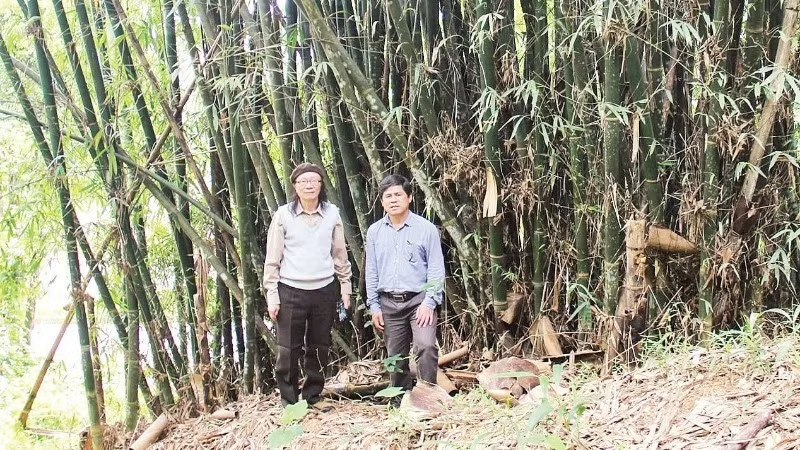
Sharing about the research process, Dr Nong Van Duy said that the research team combined field surveys with laboratory analysis. Survey routes were established across various high-altitude habitats; specimens were collected, GPS coordinates were recorded, morphological and ecological characteristics were described, then processed and observed using magnifying glasses and microscopes.
Identification was carried out by comparing morphological features with specialised literature and specimens stored in botanical museums both domestically and internationally. Simultaneously, several representative specimens underwent molecular biological analysis to increase accuracy. The usability of the species was assessed through literature review and local community surveys.
The research results recorded 32 bamboo species belonging to 16 genera distributed in the Central Highlands, demonstrating the significant biodiversity potential of the region. Bamboo is distributed across a wide altitude range, but is mainly concentrated below 1,000m and in tropical humid rainforest ecosystems. Altitude differentiation and vegetation type have clarified the ecological characteristics and adaptability of each species, providing a scientific basis for conservation planning and rational exploitation.
Notably, the project has built a morphological database for all 32 species, supplemented molecular biological data for 9 representative species, and completed a specimen collection of 96 specimens. This is a valuable source of scientific information that contributes to standardising information about bamboo in the Central Highlands as well as opening a direction for research and resource management using a more modern and sustainable approach in the future.
According to Professor, Doctor of Science Tran Van Sung, Chairman of the Scientific Research Project Acceptance Council of the Viet Nam Academy of Science and Technology, the results of the project are essential and contribute to building a scientific database on morphology, helping to identify the characteristics of the species. This will then guide the use of this valuable group of non-timber forest products.
The molecular biology database will be an important source of information to confirm the resource for Viet Nam in general and the Central Highlands region in particular, filling the scientific gaps left by previous researchers. Furthermore, establishing a database on bamboo resources in the Central Highlands will provide a foundation for further research on conservation, development, and strategic planning of these non-timber forest products, contributing to enhancing the value of bamboo species in the Central Highlands flora.