For Viet Nam, this requirement has become even more urgent as the Resolution of the 14th National Party Congress identifies science-technology, innovation and digital transformation as the main drivers of economic development in the new stage.
When students see a future path
Under the newly issued Decree No. 179/2026/ND-CP, from September 2026, students pursuing basic sciences, key engineering fields and strategic technologies will receive State scholarships of between 3.7 million and 5 million VND per month. Master’s students and doctoral candidates will also receive higher levels of support, in some cases up to 8.4 million VND per month.
The policy shows that the State is placing stronger priority on fields that will determine Viet Nam’s technological competitiveness in the years ahead.
Associate Professor Dr Nguyen Phong Dien, Vice President of Ha N]oi University of Science and Technology, said that for many years, basic sciences and high-tech engineering fields have often struggled to recruit talented students because the study pressure is heavy while starting incomes have not been truly attractive compared with those in economics and finance.
“There was a period when many students who were very good at Mathematics and Physics were no longer keen on engineering or basic research, but shifted to fields considered more likely to offer better incomes. This scholarship policy is not only financial support but also a signal that the State is changing its approach: regarding investment in talented people as investment in the nation’s future,” he said.
According to him, fields such as semiconductor microchips, artificial intelligence, big data, new materials and quantum technology all require highly qualified human resources who must be trained systematically over a long period. Without sufficiently strong policies to retain talented students from the undergraduate level, Viet Nam will find it very difficult to compete in the technology race.
Nguyen Hoang Anh, a 12th-grade Mathematics major at the Ha Noi National University of Education High School for Gifted Students, said the new scholarship policy has made him more confident in deciding to apply for microchip design.
“Previously, I was quite hesitant because this field is demanding, the training period is long, and my family is not well-off. When I learned that there would be a monthly scholarship, I felt more motivated to pursue it,” Hoang Anh said.
Not only at undergraduate level, investment policies for outstanding doctoral candidates are also creating high expectations. The VREF programme, implemented by the Ministry of Science and Technology for the 2026-2030 period, allows support of up to 1 billion VND per year for a doctoral candidate with an outstanding research topic. This marks a major change compared with the past, when many doctoral candidates had to find their own research funding or take on extra jobs to cover living costs.
Nguyen Le Thu Ha, a doctoral candidate in new materials at the University of Engineering and Technology under Viet Nam National University, Ha Noi, said many young researchers do not only lack funding, but also lack the sense that they are truly being given opportunities to pursue long-term research.
“Many talented people choose to go abroad because there they can focus full-time on research, gain access to modern laboratories and have long-term development opportunities. If Viet Nam can create such an environment, many people will want to stay,” Ha shared.
Helping young people choose science
According to the Ministry of Science and Technology, the government has recently issued a series of mechanisms to attract and make good use of science and technology talent, from digital technology talent and young talented engineers to digital transformation experts and chief engineers in strategic technologies.
Dao Ngoc Chien, Director of the National Foundation for Science and Technology Development, said the most notable point at present is that policy thinking has undergone a fundamental change.
“In the past, we mainly managed human resources through an administrative mechanism. Now, thinking is shifting towards competing to attract talent. In high technology, talented people can work anywhere in the world. Without a sufficiently attractive environment, we will lose human resources right at home,” Chien said.
Meanwhile, Professor Dr Nguyen Tien Thao, Director of the Higher Education Department under the Ministry of Education and Training, said the issue of high-quality human resources cannot be solved through short-term policies, but requires a long-term strategy from general education to higher education and postgraduate training.
Accordingly, prioritising scholarships for basic sciences and strategic technologies is a necessary step to adjust students’ career choices in the context of serious shortages of human resources in many core fields. However, financial support must go hand in hand with improving training quality and strengthening connections among universities, businesses and research institutes so that students can clearly see career opportunities.
According to many educators, scholarship and remuneration policies are only part of the “output” side. To develop high-tech human resources, what is more important is to nurture an interest in natural sciences from general education.
Vu Minh Uyen, a Physics teacher at Cau Giay Secondary School, said many students today are not truly interested in basic sciences, not because they lack ability, but because they have yet to see career opportunities.
“For many years, students have often had the mindset that studying economics, finance or communications would make it easier to succeed. Meanwhile, Mathematics, Physics and Chemistry are seen as difficult and stressful, requiring a lot of study but not necessarily leading to good incomes,” Uyen said.
According to her, to change this, teaching methods must also change, helping students see science as closely linked with daily life and modern technology, rather than merely dry formulas in textbooks.
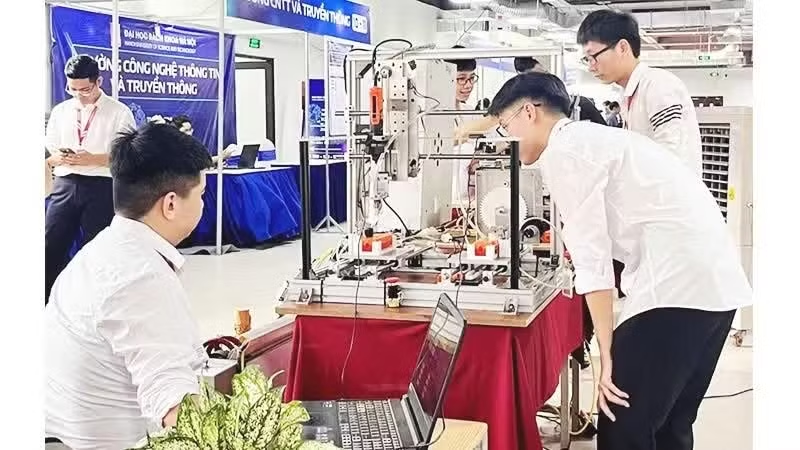
Nguyen Thi Mai Lan from the Faculty of Engineering and Technology at Ha Noi National University of Education said what students need is not only theoretical lessons but also practical creative experiences in laboratories, STEM competitions or small research projects.
“A student will love science more when they can conduct experiments themselves, create products or solve a real problem using the knowledge they have learned. If learning only revolves around exam practice and scores, it is very difficult to build a long-term passion for research,” Mai Lan said.
Attracting talent is not enough; retaining it is essential
Although the policy is considered a breakthrough, many experts said the biggest challenge remains in practical implementation.
Experience over many years shows that a number of talent training programmes have fallen into the situation of “investing first, then losing talent”. Many outstanding students, after graduation, have chosen to work for foreign companies or pursue research abroad because the domestic environment has not been attractive enough.
Nguyen Hoang Duong, a doctoral candidate in Computer Science at Aalto University in Finland, shared: “Talented people today do not only care about income. They also need a free research environment, career development opportunities and the ability to be properly recognised. If the mechanism for using human resources remains rigid, it will be very difficult to attract talent back to Viet Nam or retain them in the country to contribute.” This is also one of the notable counterpoints to current preferential policies.
In addition, many opinions suggest that scholarships and remuneration are only necessary conditions. Financial support alone is not enough. Many young scientists said what makes them hesitate is not the scholarship, but the research environment: financial procedures remain cumbersome, facilities are not synchronised, and career development opportunities are not truly clear. There are also concerns about the risk of chasing achievements or spreading resources too thinly. If scholarships are granted based only on entrance scores without a mechanism to assess real capacity during the learning process, the policy may not achieve the expected effectiveness.
However, giving priority to investment in basic sciences and strategic technologies is a necessary choice amid increasingly fierce technology competition. In today’s technology race, no country can spread its resources too thinly. To create an advantage, it is necessary to choose the right spearhead fields for long-term investment.
At present, many technical universities have begun changing towards linking training with research and businesses. Some universities are cooperating with technology enterprises to build semiconductor laboratories, AI centres and big data centres, while enabling students to participate in research projects at an early stage.
Reality shows that the current competition for high-tech human resources is no longer taking place only among individuals, but among countries and innovation ecosystems.
According to Professor Dr Chu Duc Trinh, Rector of the University of Engineering and Technology under Viet Nam National University, Ha Noi, what matters is giving students the feeling that they are taking part in solving real problems facing the country.
“When learners see that their research work has practical significance, they will have the motivation to stay and contribute,” Trinh said.