During a working visit to Austria from July 19-23, a VAST delegation led by Vice President Prof. Dr. Tran Tuan Anh held a series of meetings with leading research institutions and international organisations, including the International Institute for Applied Systems Analysis (IIASA), the Austrian Academy of Sciences, the Vienna University of Technology (TU Wien), and the International Atomic Energy Agency. The delegation also met representatives of the Vietnamese Embassy in Austria, friendship organisations and the Vietnamese intellectual community in the country.
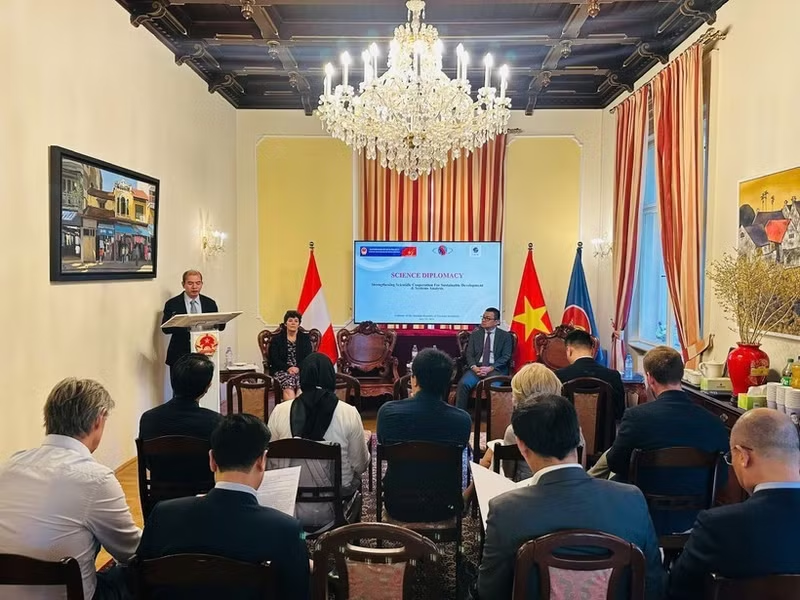
VAST, as Viet Nam's national member organisation at IIASA, co-hosted a seminar on science diplomacy with the Vietnamese Embassy and IIASA at the embassy in Vienna. The event brought together representatives of national and international research institutions and the diplomatic community.
Addressing the seminar, Tuan Anh said that as global challenges become increasingly complex and cross-border in nature, research institutions should do more than conduct scientific studies. They should also serve as platforms for knowledge exchange, connect scientists and strengthen dialogue between science and policymaking.
He said VAST aims to promote the application of systems analysis in policymaking through its role at IIASA while connecting Vietnamese researchers with international programmes on strategic technologies and sustainable development. The academy also hopes to expand scientific cooperation across Southeast Asia, a region facing significant development challenges.
Vietnamese Ambassador Vu Le Thai Hoang shared the view, describing science and technology as an increasingly important pillar of modern diplomacy. He noted that no country can address today's global challenges alone, making science diplomacy an essential bridge linking scientists, research institutions and policymakers on the basis of knowledge and mutual trust.
The ambassador said Austria, home to many international organisations including IIASA and the IAEA, is well positioned to connect Viet Nam with European and global scientific networks. In recent years, the embassy has organised a series of technology forums focusing on artificial intelligence, semiconductors, cybersecurity, humanoid robotics, nanotechnology and quantum technologies, bringing together scientists, businesses, investors and policymakers from Viet Nam, Austria and across Europe.
Karen Lips, representing IIASA, said the institute's core mission over the past five decades has been to create a space where science brings countries together through interdisciplinary research and international cooperation.
Susie Kitchens, IIASA's Director of Science Diplomacy, stressed that building trust between people is the foundation of science diplomacy, with academic exchanges and expert networks paving the way for long-term cooperation and evidence-based policymaking.
Alongside science diplomacy, VAST also promoted people-to-people exchanges during the visit through meetings with the Viet Nam-Austria Friendship Association, the Austria-Viet Nam Friendship Association and Vietnamese scholars and scientists living and working in Austria.
As President of the Viet Nam-Austria Friendship Association, Prof. Dr. Tran Tuan Anh said cooperation in science, technology and education not only generates research outcomes but also strengthens mutual understanding and trust between the peoples of the two countries. He highlighted discussions with Dr. Nguyen Duy Ha, a Vietnamese quantum physicist at TU Wien, and other overseas Vietnamese researchers on connecting research groups, jointly supervising doctoral students, expanding academic exchanges and participating in collaborative research projects.
VAST said it will continue combining science diplomacy with people-to-people diplomacy to deepen international cooperation, develop high-quality human resources, enhance research capacity and mobilise global resources for Viet Nam's development, contributing to the implementation of the Party's resolutions on breakthroughs in science, technology, innovation, digital transformation and international integration.