Building an integrated and modern scientific data ecosystem is not only a requirement of the digital transformation process but also a foundation for enhancing the competitiveness of Vietnamese science in the knowledge economy.
Scientific research in the current technological era is no longer based solely on individual knowledge but increasingly depends on the ability to organise and utilise data. When data is systematically stored, research findings can serve not only a single project but also become a resource for subsequent studies, across multiple disciplines. To enhance research capacity, a strong foundation of scientific data must be established. One of the biggest challenges today is that data remains fragmented, with limited interoperability and consistency.
Dr Pham Thi Xuan Nga, Deputy Director of the Central and Central Highlands Branch of the Viet Nam Academy of Social Sciences, said that universities, research institutes, laboratories, and businesses are currently developing their own data systems to meet their specific needs, using different formats, standards, and authentication methods, which makes it difficult to connect and exchange information.
Scientific datasets held by different organisations vary in both volume and degree of standardisation. For example, the same type of information may be described differently by different organisations. As a result, the full value of scientific data has yet to be realised. Some datasets are used within the scope of a single research project and then left unused, resulting in considerable waste, whereas linking them with other data sources could lead to new discoveries and reduce both the cost and time required to develop products.
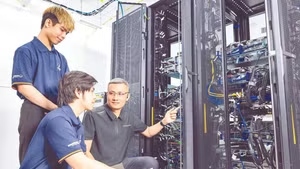
The Viet Nam Academy of Social Sciences recently worked with VNPT Group to assess the current state of its data. The report found that the overall level of digitisation at the academy remains low, while a vast volume of documents has yet to be digitised. Data is stored in a variety of formats, with no centralised management system or unified set of standards. This is considered a major bottleneck in the academy’s digital transformation process. In the natural sciences, meanwhile, the development of data systems is progressing rapidly with support from modern equipment, sensor systems, and high-performance computing technologies.
Several major universities, including Viet Nam National University, Ha Noi; Viet Nam National University, Ho Chi Minh City; and Ha Noi University of Science and Technology, have developed digital repositories for storing dissertations, theses, research papers, and scientific publications. However, these systems continue to operate largely independently. In essence, researchers seeking data must still access the databases of individual organisations, making the retrieval and reuse of data difficult.
Building an integrated and modern scientific data ecosystem requires coordination among the state, research institutes, universities, businesses, and the scientific community. This is not merely a technological issue but also involves institutions, standards, human resources, and responsibilities for data sharing. Such an ecosystem should function as a genuine network connecting data, people, technological infrastructure, research organisations, and governance mechanisms.
Assoc Prof, Dr Quach Thi Ngoc An of the National University of Art Education said the ultimate goal is not to create a “massive data repository” but a well-organised data system. In such a system, each research finding can become a starting point for further studies, scientists can easily find the resources they need, businesses can gain greater access to knowledge, and policymakers can have a scientific basis for policymaking. This is why a unified and synchronised national scientific data infrastructure needs to be developed.
The Ministry of Science and Technology has issued the Science and Technology Data Strategy to 2030, which views data as a new source of energy for the knowledge economy.
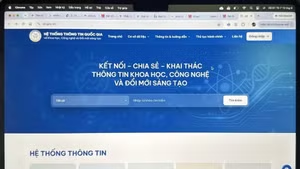
Under the strategy, all data on scientific research, technology transfer, intellectual property, standards and metrology, and innovation will be integrated, interconnected, and analysed in a coordinated manner within an open data system. The system will not only serve internal management purposes but also be shared and utilised as a resource for innovation.
The Viet Nam Academy of Social Sciences has issued a 100-day digital transformation plan with the aim of completing its data governance framework, developing a common data dictionary, and establishing regulations on data management, sharing, and utilisation. The academy’s leadership has identified this as an important foundation for building an integrated data ecosystem and improving the quality of scientific research and policy advice.