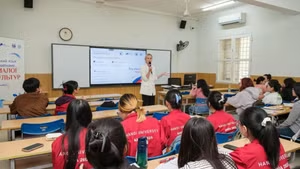
Shifting human resources in the digital age
The rapid advance of the Fourth Industrial Revolution is driving a shift in human resources from the social sciences towards technical and technological fields. This trend stems from the expanding digital occupational space. Digital transformation fosters interdisciplinarity between the social sciences and humanities on one hand, and technical sciences and technology on the other.
New job structures are emerging, particularly roles linked to artificial intelligence (AI) and big data, which highlight the importance of ethics in technology use. This transformation is creating a new labour market in which social science personnel can actively participate in the innovation and creativity ecosystem.
The rise in high-knowledge-content job opportunities in the private sector is attracting many social science and humanities experts, drawing them away from the public sector. This shift risks weakening policy analysis capacity and reducing the quality of social science and humanities research.
According to Dr Nguyen Thi To Ninh of the Central Council for Literature and Arts Theory and Criticism, the rise in high-knowledge-content job opportunities in the private sector is attracting many social science and humanities experts, drawing them away from the public sector. This shift risks weakening policy analysis capacity and reducing the quality of social science and humanities research.
Examining the competitive strategies of various countries, technical sciences and technology consistently serve as the foundation for technological autonomy and influence. To develop strategic technology sectors with distinctive identities, integrating local elements such as social data, cultural practices, habits, and ethical considerations is essential – all of which fall within the remit of social science research.
Private companies and major technology corporations increasingly recognise the indispensable role of social science experts. While technology can advance rapidly, humanistic thinking ensures sustainable development. Consequently, prioritising social science and humanities personnel to enhance product value has become inevitable. This trend requires social science professionals to acquire new competencies for roles such as data governance, user behaviour analysis, content moderation, technology impact assessment, and AI model training.
Building capacity for future training
In Viet Nam, training in the social sciences and humanities has long faced shortcomings. Programmes remain heavily academic, with limited practical application. Graduates often struggle to meet employer expectations, secure jobs, or access high-income positions with favourable working environments.
It is therefore vital to establish a new vision for training in these fields. Current circumstances demand a fusion of social knowledge with technological expertise.

Dr Ro Dam Thi Bich Ngoc, from the Institute of Psychology and Sociology under the Viet Nam Academy of Social Sciences, notes that changes in the scientific labour market – towards openness, flexibility, enhanced international cooperation, and interdisciplinary research – impose stringent requirements on personnel training. Institutions must innovate by accelerating digitalisation, developing data and technological skills, and expanding interdisciplinary thinking to meet contemporary demands.
Professor Dr Nguyen Van Khanh, former Rector of the University of Social Sciences and Humanities under the Viet Nam National University – Ha Noi, emphasises that research and training require fundamental reform. Training models must ensure interdisciplinarity and transdisciplinarity, incorporating new fields aligned with practical needs and emerging trends.
Educational methods should also evolve, flexibly combining in-person and online approaches, and shifting students from passive “being trained” to active “self-training”.
Lecturers must meet international standards, forming a globally oriented academic force capable of broad international exchange and cooperation. Investment in training infrastructure and a shift in mindset for research, learning, and teaching are equally essential.
Reforming the training of social science and humanities personnel must begin with the training and retraining of teaching staff. Lecturers must meet international standards, forming a globally oriented academic force capable of broad international exchange and cooperation. Investment in training infrastructure and a shift in mindset for research, learning, and teaching are equally essential.
The Ho Chi Minh City University of Social Sciences and Humanities, under the Viet Nam National University, is among the leading institutions innovating training. Its philosophy of comprehensive, liberal, and multicultural education aims to equip learners with broad general knowledge alongside deep specialised expertise.
Students develop synthetic and analytical thinking, specialised and general skills, as well as soft skills, preparing them to adapt to multicultural and digital work environments with a sense of service responsibility and respect for diversity. Mastering these essential skills enables graduates to secure employment, integrate into research and creative environments, and make practical contributions to the social sciences.
In its 2025–2030 development strategy, the Viet Nam Academy of Social Sciences highlights the importance of improving training quality. It aims to gradually transform the Academy into a higher education institution offering full training levels, oriented towards research and application, and aligned with international training trends.