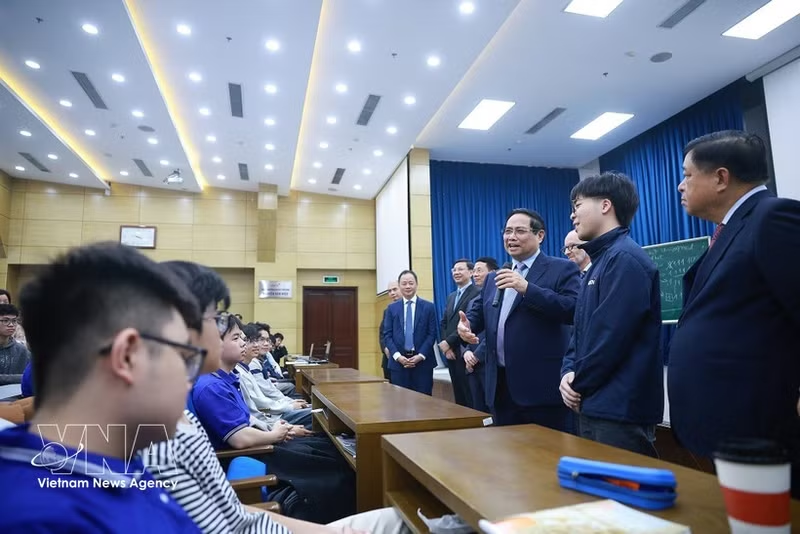
He also underscored the pivotal role of science and technology researchers in creating new knowledge, technologies, and value for the country, and contributing to national independence and self-reliance through intellect.
Important “fortress” of knowledge
Referring to the long-held view that national strength depends on the vitality of its talented people, and echoing President Ho Chi Minh’s emphasis on knowledge as a nation’s most valuable asset, PM Chinh said that in the era of science and technology, “talent” essentially refers to the country’s intellectuals and scientists.
He reviewed the contributions of intellectuals and scientists throughout the nation’s history, and affirmed that science and technology, innovation, and digital transformation are now inevitable trends, strategic choices, and top investment priorities, serving as the key to breakthrough development and a vital motivation of rapid and sustainable economic development for countries.
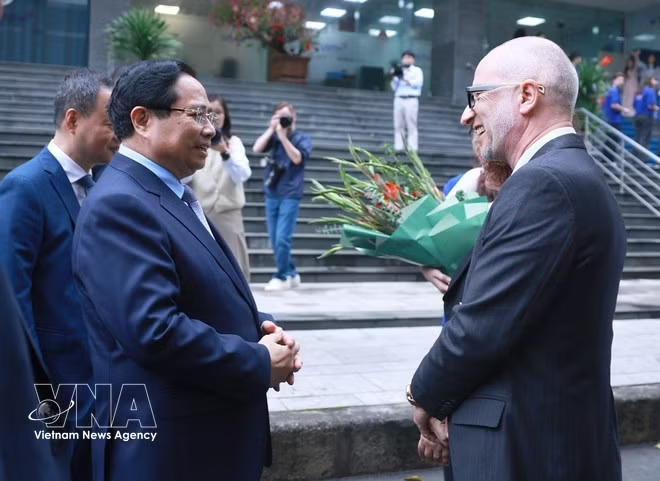
The Party, the State, and the Government identify science, technology, and innovation as both a fundamental pillar and a central engine of growth, as well as a direct productive force driving rapid and sustainable development, he said, stressing that VAST stands as a crucial “fortress” of knowledge that concentrates the intellectual resources and limitless creativity of the Vietnamese people.
Reflecting on the establishment and growth of the academy and its tangible contributions through generations of scientists to the nation’s construction and development, PM Chinh commended and highly valued the dedication and achievements of the agency’s scientific community over the past five decades.
Shifting decisively from “task-oriented” to “results-oriented" mindset
Highlighting the key orientations of the 14th National Party Congress, the Politburo’s Resolution No. 57 on breakthroughs in science and technology development, innovation and digital transformation; Resolution No. 68 on private economic sector development; and Resolution No. 79 on State economic development; and the role of VAST in advancing science and technology in the new era, the PM hoped that the academy will make breakthrough strides in the coming period.
He called on the academy to firmly establish itself as Viet Nam’s leading centre for science and technology, towards becoming a top-tier science and technology research organisation in Southeast Asia by 2030, with international competitiveness in several key fields.
He requested VAST to decisively implement digital transformation, green transformation, energy transition, and the restructuring and upgrading of human resources in a synchronised manner.
The leader stressed that the academy must take the lead in applying artificial intelligence and big data to scientific research, and in building a national database on science and technology to underpin policymaking.
The academy should focus on mastering core and foundational technologies to address the country’s real-world challenges, while elevating mathematics, physics, chemistry and biology to advanced regional and global standards by 2030, he noted.
VAST was tasked with promoting new economic models, such as the low-altitude economy, data economy, silver economy, circular economy, knowledge economy, sharing economy and night-time economy; strengthening linkages among the state-owned, private and foreign-invested sectors; and supporting the development of large, internationally competitive economic groups. It is encouraged to proactively “open up” its laboratories, intensify cooperation with private economic groups, and place enterprises at the centre of the innovation ecosystem.
The PM said VAST must have appropriate mechanisms to enable scientists to boldly engage in the commercialisation of research outcomes, turning inventions into tangible products that contribute directly to product value chains.
He directed the Ministry of Science and Technology to guide mechanisms and policies on granting greater autonomy to science and technology organisations, establishing oversight mechanisms, and developing cooperation models between public science institutions and enterprises, with a focus on transforming research outcomes into products and economic value.
He also requested the academy to formulate an action programme to implement the 14th National Party Congress’s Resolution and the Politburo’s strategic resolutions.
The PM instructed VAST to submit key proposals on mastering strategic technologies and strengthening its capacity in 2026, while proactively developing long-term strategies, programmes and major projects through 2030 with a vision to 2045. He also called for the establishment of mechanisms ensuring greater autonomy and accountability in operations, personnel, resources and finance, alongside focused investment in strategic infrastructure.
He stressed the need to reform governance and science management by shifting from a task-based to a results-oriented approach, prioritising concrete products and measurable national impact.
Taking into account market demand, coordination mechanisms and the commercialisation of research outcomes, PM Chinh called for stronger science and technology research that prioritises impact, academic value and practical application, rather than merely increasing publication numbers. He stressed a focus on basic sciences, core and strategic technologies, while fostering a culture of innovation that encourages bold thinking, breakthrough action and responsible risk-taking. The PM urged the creation of an open research environment that respects diversity, promotes international cooperation, strengthens the State–scientist–enterprise linkage, and delivers high–knowledge-content technologies with global competitiveness.
He affirmed that the academy will remain a cradle for nurturing and bringing together a new generation of pioneers—those who conquer not only fortresses but also technological frontiers, and who safeguard national sovereignty not only with determination, but with intellect and innovation.
He took the occasion to present the first-class Labour Order to VAST in recognition of its outstanding achievements and contributions to the national construction and defence.