The Resolution stipulates "attractive credit, scholarship, and tuition fee policies to incentivise outstanding pupils and students to undertake studies in mathematics, physics, biology, chemistry, engineering, and key technologies, particularly at the postgraduate level."
Alongside attracting talent, enhancing the capacity of academic staff, and modernising curricula are designated as key priorities. The Resolution emphasises the need to cultivate a contingent of lecturers and scientists with the expertise required to instruct fundamental scientific disciplines.
These breakthrough policies are designed to secure multiple measurable targets by 2030, including expanding the number of researchers in science, technology development, and innovation to 12 per 10,000 people, while elevating the annual growth rate of international scientific publications to an average of 10%. These objectives are anticipated to forge the foundation for Viet Nam to gradually master strategic technologies and fortify its technological self-reliance in the new era.
Prioritising the research workforce
International experience provides valuable lessons. Samsung's rise in the Republic of Korea (RoK) demonstrates that technological capability cannot be forged merely by expanding factories or purchasing advanced equipment. For decades, the company has consistently invested heavily in research and development (R&D), established a global R&D network, attracted highly qualified researchers, and synchronised scientific research with its core businesses, including semiconductors, display technologies, and mobile devices.
According to Samsung's 2025 Sustainability Report, the company injected approximately 35 trillion won in R&D and operated 40 research centres worldwide. Since the 1990s, Samsung has systematically embedded the recruitment, training, and deployment of doctoral-level researchers into its long-term development strategy. The number of employees holding doctoral degrees surged from 490 in 1995 to 5,771 in 2013, surpassing 6,000 in 2014. Although Samsung no longer discloses the total number of doctoral researchers on its payroll, it continues to invest heavily in cultivating advanced technological talent.
As of February 2026, two postgraduate engineering programmes jointly founded by Samsung and Sungkyunkwan University — Semiconductor and Display Engineering, and Digital Media Communications Engineering — had yielded 1,022 master's graduates and 116 doctoral graduates.
Samsung considers these programmes as its own postgraduate training system, designed to cultivate future technology leaders. This approach illustrates how enterprises can transcend merely recruiting highly qualified professionals from the labour market by actively engaging in postgraduate education in fields aligned with their long-term technological needs.
Doctoral education has therefore become an indispensable component of Samsung's research and development ecosystem, fortifying its research capability, technological innovation, and product development.

These achievements have substantially contributed to the broader development of the RoK's innovation ecosystem. In 2025, the country ranked fourth globally for innovation, leading the world in human capital, research capacity, and business-sector research performance. Large corporations such as Samsung have played a pivotal role in catalysing educational investment into industrial capability, intellectual property, and national technological competitiveness.
Samsung is far from alone. Other major RoK technology companies, including SK hynix and LG, also actively engage in postgraduate education by providing scholarships, jointly designing university programmes, and synchronising research with industrial demand.
At the Department of Semiconductor Engineering, founded jointly by SK hynix and Korea University, students receive full tuition support, monthly allowances, and internship opportunities at SK hynix. Graduates are also provided career prospects within the company.
In 2024, SK hynix injected 4.5 trillion won in research and development. In March 2026, LG further broadened this model by launching LG AI Graduate School, which cultivates master's and doctoral students in artificial intelligence while integrating research with the company's industrial challenges.
The experience of advanced economies such as the RoK demonstrates that leading enterprises generate not only products, revenue, and export capacity, but also serve as hubs for research, core technology development, and the cultivation of highly qualified talent.
Through sustained investment in R&D, close collaboration with universities, direct involvement in postgraduate education, and the employment of doctoral researchers, companies catalyse the transformation of knowledge into inventions, commercial products, and enhanced national competitiveness.

As artificial intelligence, semiconductors, cybersecurity, and quantum technologies emerge as key arenas of strategic competition among nations, Viet Nam demands not only a large pool of engineers capable of integrating and deploying advanced technologies, but also researchers with the ability to conduct independent research, spearhead new scientific directions, lead engineering teams, produce internationally recognised publications and patents, and develop solutions with practical applications.
Integrating postgraduate education in the national human resource strategy
Resolution No. 57-NQ/TW designates the development and effective deployment of high-quality human resources as one of its central priorities, including specific directions for postgraduate education. The key challenge is to cultivate specialists in fields that are strategically important to the nation, ensure education meets international standards, and synchronise research closely with real-world challenges. This is why the active participation of businesses, working alongside the State, universities, and research institutes, is essential.
Enterprises command practical advantages through their access to industrial challenges, data, research infrastructure, markets, and commercialisation pathways. Their involvement in doctoral education effectively bridges the gap between research and application while equipping doctoral candidates with opportunities to validate the practical value of their research.
As a global technology corporation committed to bringing Vietnamese innovation to the world, FPT has instituted a dedicated policy to bolster doctoral training in advanced technologies. Effective from May 2026, the programme focuses on strategic fields including artificial intelligence, quantum technologies, cybersecurity, and cloud computing.
The initiative strives to cultivate a highly specialised research workforce, strengthen the country's capacity to master core technologies, and deepen collaboration between enterprises and education and research institutions.
Under the policy, each doctoral candidate may secure financial support of up to 500 million VND over a maximum study period of four years. The package comprises up to 200 million VND for tuition fees, 150 million VND for participation in conferences and academic workshops, and 150 million VND to access GPU computing resources for research.
Beyond financial assistance, participants obtain research mentoring, guidance in developing research proposals, and support in connecting with suitable supervisors and universities. Applicants are evaluated through document screening and interviews conducted by the Expert Council of the Quantum AI & Cyber Security Institute, with priority given to candidates who already have research experience or have participated in major technology projects.
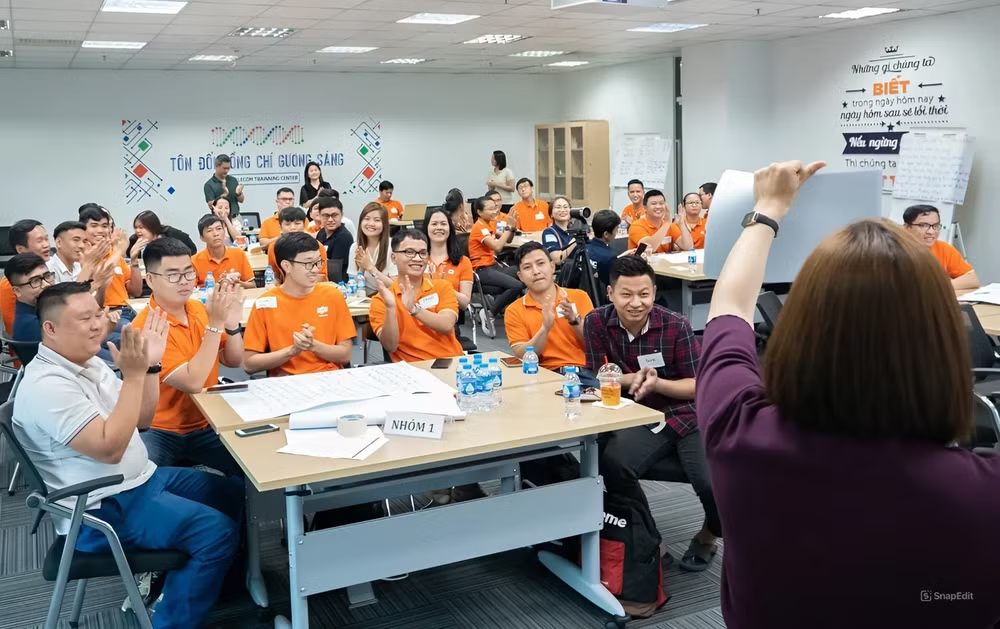
The Quantum AI & Cyber Security Institute, founded by FPT with a committed investment of 100 million USD, strives to cultivate 100 doctoral researchers, forge 2,000 technology experts, and yield 500 scientific publications, patents, and intellectual property assets. The initiative represents one example of how technology enterprises are actively actualising the spirit of Resolution No. 57-NQ/TW into concrete action.
Viet Nam requires many more enterprises and organisations that share the ambition of elevting the country's technological standing and forging genuine technological self-reliance. This process should begin as early as possible through the cultivation of a strong research, innovation, and technology development workforce. Such preparation will establish a solid foundation for achieving the objectives of Resolution No. 57-NQ/TW and steadily elevating the country's position in the emerging technological era.