From the first software contracts in Canada
More than two decades ago, on June 13, 1999, FPT signed a contract with Winsoft, a Canadian client, to implement the Lifeserve project. This was the group’s first software export contract in the North American market, at a time when Viet Nam’s software industry was beginning to reach out to international markets.
From those initial projects, FPT’s operations in Canada gradually expanded. In 2018, FPT Canada was established and, together with FPT Americas, assumed the role of an on-site market presence in the Americas, providing services related to software development, cloud computing, data and test automation for clients in many sectors.
Notably, cooperation later went beyond the provision of technology services. In 2020, FPT became the first strategic partner in Southeast Asia of Mila, the artificial intelligence research institute, expanding cooperation into research.
In 2024, FPT invested in First North Consulting and signed an agreement with Export Development Canada (EDC), aiming to support Canadian businesses in connecting with FPT member companies. On August 13, 2026, FPT and Mila continued to sign an agreement to expand cooperation.
These developments show a notable trend in Viet Nam-Canada economic relations: a shift from the exchange of goods and services to cooperation in research, technology development and human resource training.
Science and technology become new cooperation space
Viet Nam is currently Canada’s largest trading partner in ASEAN. According to the Ministry of Industry and Trade, two-way trade turnover reached nearly 8.6 billion USD in 2025. Alongside the trade foundation, bilateral cooperation is being expanded into new areas.
On the afternoon of September 24, at the Parliament of Canada, senior leaders of the two countries emphasised that science and technology should become an important pillar of the Viet Nam-Canada Strategic Partnership.
Under this orientation, the two sides are promoting connections among universities, research institutes and businesses, while prioritising human resource training and joint research in areas such as applied artificial intelligence, clean technology and marine technology.
On September 25, this orientation was reflected in the Joint Statement on the Viet Nam-Canada Strategic Partnership. Among the eight pillars of cooperation, the fourth is dedicated to digital transformation, artificial intelligence, advanced technology and innovation.
The leaders of the two countries welcomed the growing partnerships among universities, research institutes and businesses, and agreed to support research cooperation and talent mobility in strategic fields such as STEM, artificial intelligence (AI), quantum technology and semiconductors.
These are fields that require research resources, high-quality human resources and connectivity among the public sector, research institutions and businesses. Therefore, expanding cooperation into science and technology could create new channels of connection between the two economies.
From trade cooperation to joint technology development
The cooperation between FPT and Mila is an example of the shift from trade relations to research cooperation.
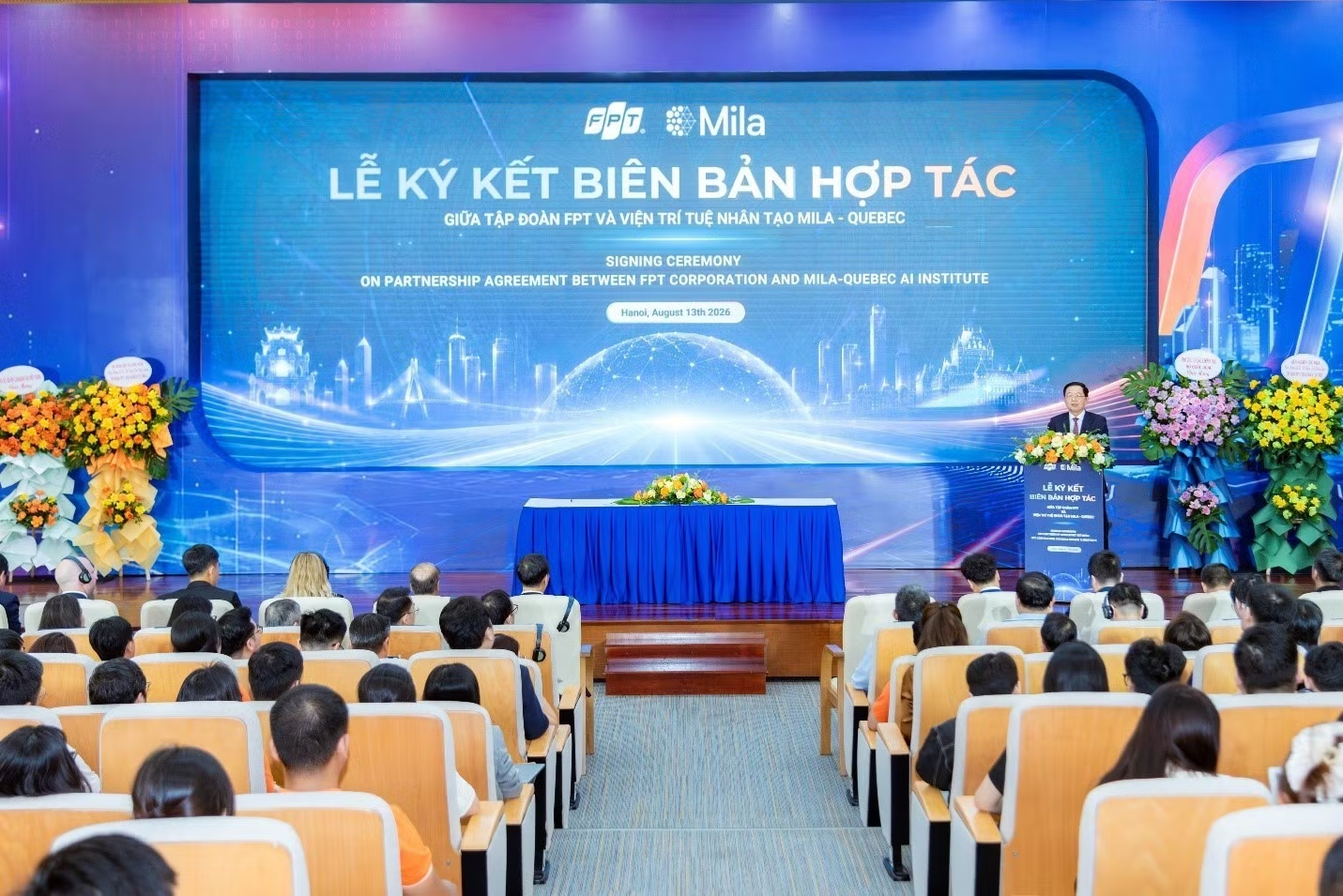
After six years of cooperation, the programme recorded 162 scientific works, including 126 published at leading international conferences and journals; five patents accepted; and 80 young researchers trained.
The cooperation agreement for the 2026-2029 period focuses on physical AI, responsible AI and cybersecurity in response to emerging risks from AI, while continuing to prioritise talent training.
Speaking to reporters, FPT Chief Executive Officer Nguyen Van Khoa said Viet Nam-Canada relations are entering a new stage, in which technology can become a driver of cooperation.
“If the past journey was nurtured mainly through diplomacy and trade, we believe the next stage will be shaped by technology: the two countries will not only exchange products, but also conduct research together, develop together and bring products to the global market together. FPT sees an opportunity to help open up that stage through artificial intelligence,” Nguyen Van Khoa said.
According to him, cooperation potential also lies in the complementarity between the two countries’ AI development orientations. Canada has a strong AI research foundation, while Viet Nam is promoting digital transformation, developing AI and building a technology workforce.
From the practical cooperation with Mila, Nguyen Van Khoa proposed establishing a joint Viet Nam-Canada laboratory, with the participation of the State, businesses, universities and research organisations.
Under this proposal, the State would ensure computing infrastructure and a testing mechanism; Vietnamese businesses and universities would put forward practical problems; and Mila would share research methods, aiming to develop models, source code and data under the “Make in Viet Nam” orientation.
He also proposed strengthening connectivity between agencies responsible for AI safety in the two countries, while studying the development of a testing framework for high-risk AI systems.
“We believe that the most sustainable value of cooperation lies not only in transferred technology, but in the capacity that the two countries build together,” Nguyen Van Khoa said.
From the foundation of trade relations formed over many years, the two countries’ upgrading of relations to a Strategic Partnership is creating an additional basis for expanding cooperation into knowledge-intensive fields. Science, technology and innovation could become new spaces of connection among regulatory agencies, businesses, universities and research institutes of Viet Nam and Canada.