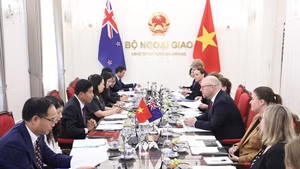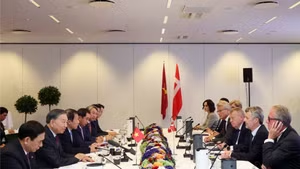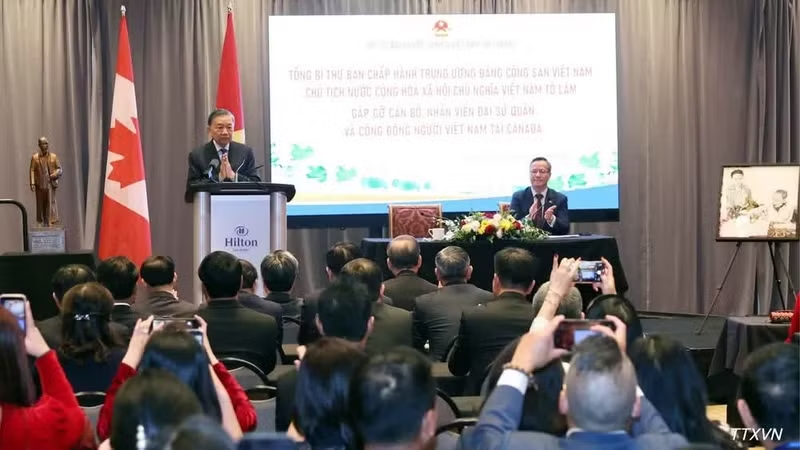
This marked the first official visit to Canada by the leader of the Communist Party of Viet Nam since the two countries established diplomatic relations in 1973. The visit took place at a time when conditions were ripe for Viet Nam-Canada relations to enter a phase of deeper and more substantive cooperation.
As anticipated, during the visit, Viet Nam and Canada officially established a strategic partnership, acknowledging over 50 years of enduring cooperation and committing to a shared journey toward a long-term, stable, and increasingly close future.
Presiding over the grand welcoming ceremony for General Secretary and President To Lam and the high-level Vietnamese delegation, Governor General Louise Arbour expressed her delight at receiving the delegation just as the beautiful autumn season was arriving. She likened the landscape’s transition into autumn to the Canada-Viet Nam relationship entering a new phase of maturity and deepening trust.
Governor General Arbour emphasised that nature is preparing for a season of renewal promising great things; she urged both nations to seize opportunities, continue nurturing their ties, and work together to build a more peaceful and prosperous future for their peoples, thereby further strengthening the friendship between the two nations.
General Secretary and President To Lam expressed his emotion at visiting this beautiful, vast, and vibrant country, noting that the sight of maple trees immediately evoked a sense of the Canadian people’s warmth, as well as their spirit of strength and freedom.
Since the establishment of diplomatic relations, Canada has stood by Viet Nam on its journey toward peace and reunification, providing support across various sectors — assistance that Viet Nam deeply values.
Viet Nam’s new phase of development will open further opportunities for cooperation with Canada. By combining Canada’s knowledge, technology, and resources with Viet Nam’s market, abundant high-quality human resources, and drive for progress, the two countries can jointly create quality products, services, and jobs. This forms a foundation of mutual benefit that will propel the relationship toward greater heights and stability.
Over the past five decades, the relationship between Viet Nam and Canada has seen significant development, characterised by growing friendship and mutually beneficial cooperation.
The entry into force of the CPTPP in January 2019 marked a new phase in economic, trade, and investment relations between the two countries, with two-way trade surging by 170%, becoming a highlight of bilateral trade cooperation among CPTPP members.
Viet Nam is currently Canada’s leading trade partner in ASEAN and its sixth-largest trade partner among the 40 Indo-Pacific nations. Canada is Viet Nam’s third-largest export partner in the Americas and its seventh-largest export market overall.
Recently, the number of specific cooperative activities has risen significantly; businesses from both sides have stepped up exchange visits and organised numerous events and connection activities involving ministries, sectors, localities, and enterprises to explore cooperation opportunities.
Both sides are promoting cooperation and linkages between localities with similar characteristics. Notably, Canada has implemented various Official Development Assistance (ODA) projects in several localities and is funding initiatives focused on climate-resilient coastal cities in Viet Nam.
During the visit, leaders from both nations assessed that there remains substantial room for the further development of bilateral relations. The two sides possess complementary strengths: Canada excels in energy, strategic minerals, artificial intelligence, clean technology, agriculture, and education, while Viet Nam has a growing demand for technology, capital, human resources, and enhanced production capacity.
Both countries need to continue fostering economic, trade, and investment cooperation, effectively leveraging the CPTPP, and facilitating market access for each other’s goods and businesses.
Breakthroughs are required in science and technology, innovation, digital transformation, clean energy, and high-quality human resource training, with the aim to expand educational cooperation, exchanges, and scholarships, particularly in strategic fields such as artificial intelligence and aerospace.
Leaders of both nations affirmed that energy security serves as a vital foundation for economic growth, industrial development, and long-term prosperity, emphasising the importance of ensuring a stable, reasonably priced, and sustainable energy supply.
Canada possesses strengths in traditional, renewable, and emerging energy technologies; deepening bilateral cooperation is essential to support Viet Nam’s energy security and sustainable development goals while creating opportunities for growth, investment, and exports within Canada’s energy sector.
For years, people-to-people diplomacy has served as a key pillar in fostering bilateral relations. Such activities have deepened mutual understanding and strengthened friendship and solidarity, yielding substantive and tangible cooperative results across various fields.
Currently, approximately 300,000 people of Vietnamese origin live and work in Canada, making significant contributions to the country’s economic development.
The community has steadily established its standing within Canadian society, boasting numerous scientists and PhD holders honoured in sectors such as electronics, telecommunications, satellite technology, energy, and nuclear chemistry, alongside many successful lawyers, physicians, and businesspeople.
According to Canadian Minister of Foreign Affairs Anita Anand, the Vietnamese community has contributed to the enduring vitality of the relationship between the two nations through its deep integration into society and its contributions to Canada’s cultural diversity.
To leverage the role and resources of the overseas Vietnamese community in Canada for the nation’s construction and development in this new era, it is essential to further strengthen people-to-people cooperation in education, training, science, technology, and research and development.
Such efforts aim to unlock the potential and capitalise on the strengths of both nations in strategic priority sectors. Particular emphasis should be placed on the role of Vietnamese students in Canada; fostering exchanges and mutual understanding between the youth of both countries will, in turn, drive economic and scientific-technological cooperation between Viet Nam and Canada.
During his visit, General Secretary and President To Lam attended a high-level Viet Nam-Canada business roundtable and met with representatives from leading Canadian enterprises and investment funds.
Sensing the positive energy and spirit of cooperation reflected in the discussions and proposed partnership models, the general secretary and president noted that the Viet Nam-Canada economic relationship rests on a solid foundation and is well-positioned to transition into a new phase characterised by deeper investment ties and stronger value chain integration.
Investment should not merely focus on increasing the number of projects but on enhancing their quality; capital inflow into Viet Nam must be accompanied by technology transfer, advanced management practices, high-quality human resources, linkages with Vietnamese enterprises, and enhanced competitiveness.
In this spirit, the general secretary and president urged the business communities of both nations to shift their focus from robust trade relations toward stronger investment ties, primarily by connecting Canada's long-term capital with high-quality projects in Viet Nam.
Canadian funds, financial institutions, and investors do not merely step in after a project’s preparatory phase is complete; they can engage much earlier to co-develop project proposals, structure financing plans, manage risks jointly, and create long-term value.
At the high-level Viet Nam-Canada business roundtable, enterprises from both nations exchanged memoranda of understanding regarding cooperation in the aviation sector, thereby supporting their respective corporate development strategies.
The state visit to Canada by General Secretary and President To Lam and the high-level Vietnamese delegation reflects a new level of political trust and increasingly deep alignment of interests, visions, and determination.
It underscores the commitment of both nations to building a long-term, stable, and substantive relationship, serving as a model of cooperation between countries on opposite shores of the Pacific.