The difficulty facing pharmaceutical research today lies not only in whether inventions can be created but also in the ability to turn protected inventions into successful commercial transactions.
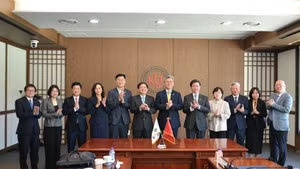
This was the issue raised by Nguyen Hoang Giang, Deputy Director of the Intellectual Property Office of Viet Nam, during his exchange with scientists, lecturers and management officials at the University of Medicine and Pharmacy at Ho Chi Minh City. According to Giang, new guidelines and policies have clearly shown the orientation of promoting intellectual property activities, especially the commercial exploitation of intellectual property rights. However, for these mechanisms to prove effective, universities, research institutes, and scientists must proactively identify, protect, and develop plans to exploit intellectual assets from the research process itself.
This requirement is even more significant in the pharmaceutical field, where a research result only truly demonstrates its value when it is transformed into a product, process or solution that can be applied to disease prevention, treatment, and people’s healthcare.
The gap after protection is granted
Nguyen Van Chinh, Vice Rector of the University of Medicine and Pharmacy at Ho Chi Minh City, said the ultimate goal of pharmaceutical research cannot stop at international publications or academic titles. Research results must enter life, create sustainable socio-economic value, and directly serve people’s healthcare.
To do so, scientists not only need professional capacity but also an understanding of intellectual property policies and laws and the ability to assess market potential, value intellectual assets, seek partners, and negotiate commercialisation.
In reality, being granted a protection title is only one step in the journey of bringing an invention to the market. Behind that protection title are a series of questions: What needs can the technology meet? Is the market ready to accept it? How is the value of intellectual property rights determined? Should the results be exploited through licensing, transfer, or the establishment of a business?
Nguyen Huu Can, Acting Director of the National Institute of Intellectual Property, said knowledge can be transformed into socio-economic value through various methods, such as licensing, transferring, or establishing enterprises based on research results, also known as spin-off enterprises.
Each method requires scientists and host organisations to have an appropriate strategy. Without determining ownership rights, technology value, and exploitation plans, an invention, even one with potential, will still struggle to find enterprises willing to invest in its completion and market launch.
Valuation is one of the particularly important stages, but it also causes much confusion. The value of intellectual property rights is determined not only by the professional quality of the research, but also by its legal status, technical feasibility, market demand, and revenue-generating capacity.
According to the valuation firm V-Link, to prepare for valuation and the search for commercial partners, scientists need to record and gather sufficient information related to legal, technical, market, and financial factors. Without such data, determining the value of an invention and negotiating with enterprises will face difficulties.
At the University of Medicine and Pharmacy at Ho Chi Minh City, experts from the Intellectual Property Office of Viet Nam, the Department of Science and Technology and valuation specialists have initially reviewed several inventions that have been granted protection titles and are planned for commercial exploitation. This approach helps directly identify gaps in technology dossiers, valuation capacity, and market access plans, instead of only providing general guidance.
Early protection to avoid losing advantages
The case of the Ho Chi Minh City Traditional Medicine Hospital highlights another challenge: while many research findings and new products have been developed, the hospital has yet to put in place an effective strategy to protect and manage its intellectual property.
Do Tan Khoa, Director of the Ho Chi Minh City Traditional Medicine Hospital, said intellectual property protection needs to receive greater attention in the coming period, especially when the hospital cooperates with partners and brings products to the market.
In traditional medicine, research outcomes often take the form of remedies, processes, formulation methods, or products developed from the professional experience of doctors and traditional medicine practitioners. If these assets are not properly identified and protected in time, research institutions may face difficulties in cooperating with enterprises or commercialising their products.
Therefore, the protection of inventions and trademarks should not be carried out only after products have been completed but should be considered from the research and development process itself. This is both a basis for establishing rights and a condition for scientists and research organisations to take the initiative in negotiations with partners.
Against this backdrop, patent specialists directly advised the Ho Chi Minh City Traditional Medicine Hospital on preparing patent applications for four of its research results. The consultation also highlighted the importance of protecting the distinctive intellectual assets created by the hospital’s doctors and traditional medicine practitioners.
Experts also analysed the commercial exploitation potential of the hospital’s research strengths, suggesting directions for developing an appropriate intellectual asset management plan. This is a necessary step to connect research results with enterprises, creating opportunities to complete technologies, develop products, and expand applications.
New mechanisms under Decree No. 267/2025/ND-CP are also expected to help remove some bottlenecks in this process, with regulations on protecting scientists from research risks, digitalising procedures, and sharing profits from research results.
However, the legal corridor can only prove effective when intellectual property activities are incorporated throughout the entire research process, instead of being treated as a final procedure. Universities, research institutes, and hospitals need to identify intellectual assets early, determine ownership rights, choose appropriate protection methods, and prepare suitable commercialisation plans.
The connection among state management agencies, research organisations, intellectual property experts, valuation units, and enterprises can help shorten the distance from the laboratory to the market. When scientists are supported in protecting their achievements and have clear benefit-sharing mechanisms, they will have more motivation to turn medical knowledge into valuable products.
That is also the way for pharmaceutical inventions not only to be recognised through protection titles or scientific publications but to truly serve people’s healthcare, improve domestic pharmaceutical technology capacity, and create value for the economy.