This compels higher education to prioritise training talent, promoting research, strengthening cooperation with businesses, and building an ecosystem for human resource development to meet the country’s development requirements.
Linking training with business needs
Recognising the key role of human resources in the development of the semiconductor industry, the Prime Minister issued Decision No. 1017/QD-TTg approving the programme for developing human resources for the semiconductor industry by 2030, with orientations to 2050.
Under the programme, by 2030, Viet Nam will train at least 50,000 workers with university degrees or higher to serve the semiconductor industry. It aims to train at least 15,000 workers for the design stage and at least 35,000 for production, packaging, testing, and related fields. Notably, the programme targets intensive training for around 1,300 lecturers teaching at higher education institutions, research institutes, training support facilities, and businesses.
The Government’s issuance of the semiconductor human resource development programme, with specific targets on training scale, lecturers, and highly qualified personnel, shows that the sector’s core challenge lies not in technology or investment capital, but primarily in people.
This view resonates with many experts. Professor Kuan-Neng Chen from National Yang Ming Chiao Tung University, Taiwan (China), emphasised that alongside advanced technology and modern infrastructure, the decisive factor in a country’s long-term competitiveness in semiconductors is its ecosystem for training and developing talent.
Drawing on the experience of Taiwan (China), Professor Kuan-Neng Chen said Viet Nam should prioritise a long-term strategy of investment in education and training high-quality human resources, especially in specialised technical fields. Building a contingent of engineers and researchers with comprehensive capacity will provide the foundation for Viet Nam to deepen its participation in global value chains.
These requirements also apply to many other strategic technology fields, such as artificial intelligence, big data, digital technology, and core technologies.
In these areas, the quality of human resources and the research capacity of higher education institutions play a decisive role. If investment in education and foundational conditions builds high-quality human resources, the connection between education and training institutions and businesses decisively ensures they meet the practical demands of the labour market and the pace of technological development.
According to Dr Le Quang Dam, General Director of Marvell Viet Nam, technologies such as three-dimensional integrated circuits, chiplets, advanced packaging, and silicon photonics are becoming strategic development directions for the global semiconductor industry, especially amid rising demand for artificial intelligence, data centres, and high-performance computing.
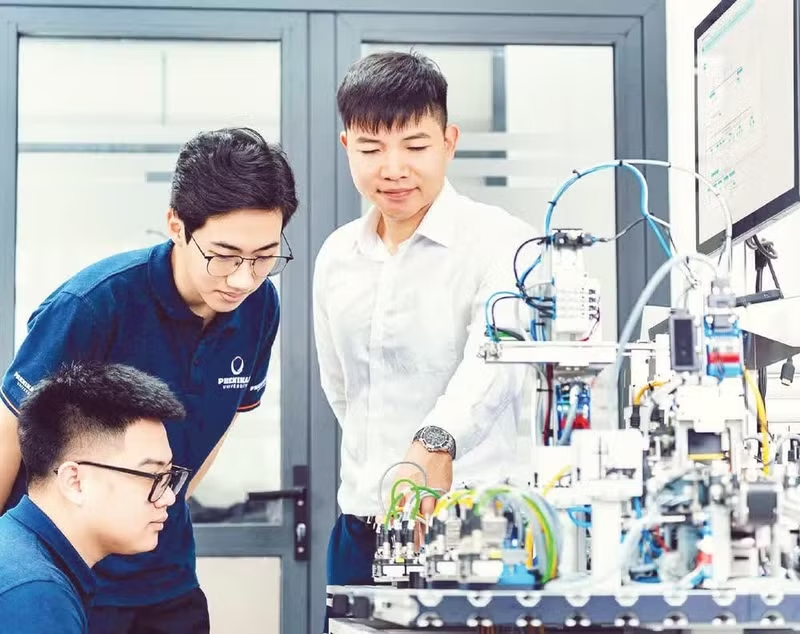
To meet these requirements, stakeholders must further strengthen links between businesses and higher education institutions. Cooperation in training, internships, joint research, and human resource development not only aligns training programmes with practical needs, but also creates opportunities for students to gain early access to advanced technologies and professional working environments.
Building an ecosystem for talent development
In practice, cooperation between businesses and universities has become a common trend in many countries with developed semiconductor industries. This is also a vital solution for narrowing the gap between training and labour market needs.
Speaking from an institutional perspective, Prof. Dr Chu Duc Trinh, Rector of the University of Engineering and Technology under Viet Nam National University, Ha Noi, said that as global technology supply chains undergo major restructuring, Viet Nam has an opportunity to become an important link in the high-tech ecosystem. However, to seize this opportunity, investment in infrastructure alone is not enough; the key factor remains people.
Experience from businesses and higher education institutions demonstrates that developing human resources for strategic technology sectors cannot rely solely on the efforts of individual universities or businesses, but requires a synchronous ecosystem spanning policy, training, research, and talent attraction and development.
New requirements for developing human resources for strategic technology sectors are driving positive changes in the higher education system. According to the Ministry of Education and Training, the training structure is adapting rapidly to develop human resources for strategic and key technology sectors.
Enrolment results in 2025 revealed that STEM disciplines attracted 220,319 students, representing 33.3% of total enrolment, an increase in both scale and proportion compared with 2024. The total scale of university training in STEM disciplines now stands at 777,475 students, representing 29.6% of the total training scale across the system.
Notably, disciplines in science and technology, engineering, and mathematics increasingly attract students with strong academic performance. More than 50 pedagogical disciplines and 17 key engineering and strategic technology disciplines, such as computer science, artificial intelligence, semiconductor microchips, control, and automation, recorded admission scores based on high school graduation exam results of 28 out of 30 points or higher.
In the current context, not only financial resources but also talent has emerged as a strategic competitive factor among countries. Scientific and technological capacity, economic strength, and the level of social development all rely heavily on the quality of human resources, especially talented personnel. The development of higher education institutions ultimately aims to train high-quality human resources and nurture and develop talent, directly contributing to socio-economic development and affirming Viet Nam’s position in the international arena. At the same time, higher education is also a pillar in promoting science and technology, innovation, and digital transformation. Therefore, along with improving training quality, stakeholders must build an ecosystem attractive enough for talented people to stay, find shared purpose, and engage in long-term cooperation for the country’s development.
Minister of Education and Training Hoang Minh Son
Minister of Education and Training Hoang Minh Son affirmed that in the current context, not only financial resources but also talent has emerged as a strategic competitive factor among countries. Scientific and technological capacity, economic strength, and the level of social development all rely heavily on the quality of human resources, especially talented personnel. The development of higher education institutions ultimately aims to train high-quality human resources and nurture and develop talent, directly contributing to socio-economic development and affirming Viet Nam’s position in the international arena. At the same time, higher education is also a pillar in promoting science and technology, innovation, and digital transformation. Therefore, along with improving training quality, stakeholders must build an ecosystem attractive enough for talented people to stay, find shared purpose, and engage in long-term cooperation for the country’s development.