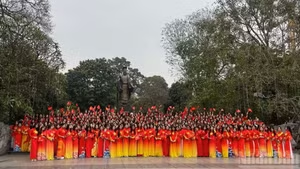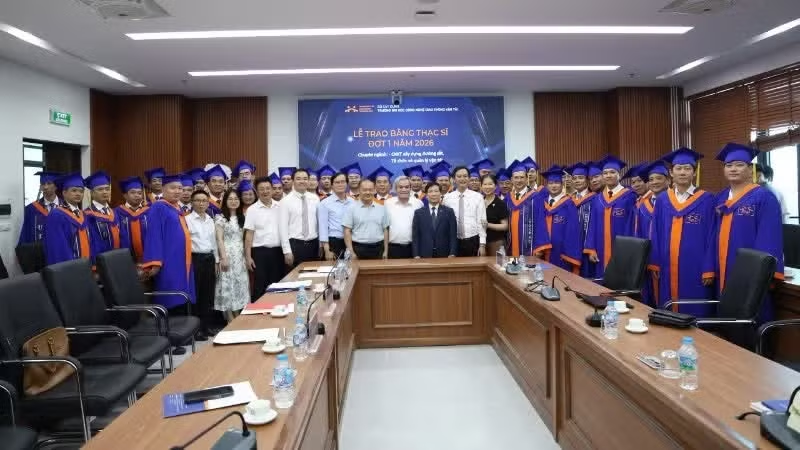
Recently, 45 postgraduate students specialising in Railway Engineering earned master's degrees after completing their academic and research programmes. The event not only marked the completion of a postgraduate training course but also demonstrated the railway sector's firm commitment to implement the principle that "human resources must go one step ahead." They are regarded as the first cohort of highly qualified professionals to receive systematic training, preparing for a new phase of development within Viet Nam's railway sector, in line with Conclusion No. 49 of the Politburo and the Government's Railway Human Resources Development Project.
Human resources must come first
According to Cam Anh Tuan, Deputy General Director of Viet Nam Railways Corporation, the railway sector has never received as much attention and expectations as it does today.
Conclusion No. 49 of the Politburo clearly sets out the direction for developing the railway sector in a synchronised, modern, and sustainable manner, gradually building a national railway industry capable of mastering core technologies and integrating with regional and global levels of development.
Based on this direction, developing human resources has been identified as a task that must be prioritised.
Tuan noted that, in implementing the Government’s Decision No. 2230 on the Railway Human Resources Development Project, the railway sector is focusing on building a highly qualified workforce of technical staff, specialists, and managers to meet the requirements of upcoming key projects, including the Lao Cai–Ha Noi–Hai Phong railway, the North-South high-speed railway, and urban railway lines in Ha Noi and Ho Chi Minh City.
The Viet Nam Railways Corporation leader emphasised that these 45 new master's graduates represent an important first step in building a highly skilled workforce for the sector.
"Our objective is not limited to master's training. We will continue training doctoral graduates and leading experts in core technological fields such as signalling, control systems, operational technology, and other key engineering disciplines," Tuan stated.
This approach aligns with international experience. Countries that have successfully developed high-speed railway systems all began preparing their human resources early on, alongside planning and investment in infrastructure.
Building a team of specialists for a new railway sector
Prof. Dr. and Meritorious Teacher Tu Sy Sua stated that human capital always plays the central role in any development strategy, particularly in high-technology sectors such as modern railways.
He noted that master's-level education marks the transition from basic workforce training to developing professionals capable of conducting research, providing policy advice, proposing solutions, and tackling complex technical challenges.
As Viet Nam prepares to implement next-generation railway projects, master's graduates specialising in railway studies will play an important role in researching and proposing technical solutions, transport operations, management, and the adoption and mastery of new technologies.
"This is a workforce capable of contributing to planning, building, and developing the railway sector in the future, particularly for high-speed railway and urban railway projects," Prof. Tu Sy Sua said.
Both experts and the graduates fully recognise their responsibilities in meeting the sector's new development requirements.
Nguyen Tien Trung, a new master's graduate in Railway Transport Organisation and Management, said the knowledge gained during the programme will help strengthen his professional expertise in transport organisation and management while preparing him to participate in adopting and mastering technology when new railway projects are launched.
"I hope to contribute to building a modern, safe, and efficient operating system, helping Viet Nam's railway sector develop in line with the country's requirements in the new era," Trung said.
According to experts, if infrastructure forms the "body" of a project, human resources are its "soul." Modern railway systems can only operate efficiently with well-trained engineers, specialists, and managers capable of adopting and mastering advanced technologies.
Preparing today for high-speed railways
As the unit directly responsible for training railway human resources, Railway College is actively preparing to meet workforce demands in the new development phase.
According to Dr. Truong Trong Vuong, Principal of Railway College, demand among railway workers for advanced qualifications has risen sharply. While students historically progressed from intermediate to college and university education, an increasing number are now pursuing master's degrees to deepen their expertise.
The college is working with universities to provide articulation programmes in key disciplines such as bridge and road engineering, transport management and operations, signalling and communications, and locomotive and rolling stock engineering. At the same time, it is developing new training programmes to support high-speed railway development.
According to Dr. Truong Trong Vuong, one of Viet Nam's first specialists to receive advanced training in high-speed railway, many research projects completed during the recent master's programme directly addressed issues related to modern railways, including rail welding technology, infrastructure engineering, transport organisation, and solutions for high-speed railway systems.
However, Vuong noted that demand for skilled personnel for upcoming railway projects will be enormous. To meet this requirement, Viet Nam needs to combine domestic training with international cooperation, drawing on the experience of countries that have successfully developed high-speed railway systems.
"High-speed rail is an entirely new field for Viet Nam. Therefore, combining domestic specialists with international experts is essential to rapidly build a workforce capable of adopting and mastering the technology," Vuong said.
The foundation for mastering technology
Under the Railway Human Resources Development Project approved by the Prime Minister in Decision No. 2230/QD-TTg, Viet Nam aims to train around 35,000 personnel between 2025 and 2030 to serve new railway projects, including the North-South high-speed railway, the Lao Cai–Ha Noi–Hai Phong railway, and urban railway lines in Ha Noi and Ho Chi Minh City.
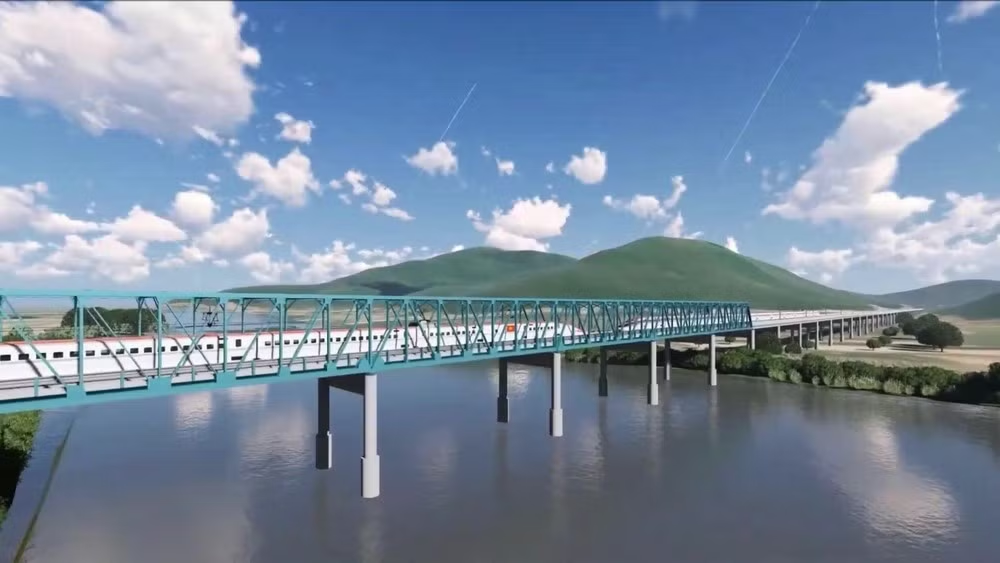
that is creating an urgent need for high-quality human resources
This figure is unprecedented in the history of Viet Nam's railway sector, reflecting both the scale and the exceptional demands of this new phase of development. In addition to requiring a large number of skilled technical workers, the railway sector also needs highly qualified specialists, engineers, managers, and researchers capable of adopting, mastering, and gradually developing core technologies.
According to Cam Anh Tuan, the consistent principle underpinning the Party's and the State's guidelines is that human resources must be developed one step ahead. This is also a prerequisite for achieving the goal of building a national railway industry capable of mastering technology, reducing dependence on external sources, and gradually participating more deeply in the regional railway value chain.
In particular, the North-South high-speed railway project — a strategic infrastructure project involving exceptionally large investment scale and some of the world's most advanced technologies — has created an urgent need to prepare human resources from today. Without early and proactive training, Viet Nam will face considerable challenges in technology transfer, system operation, maintenance, and future network management.
From this perspective, the master's programmes in railway studies being conducted today are intended not only to meet the sector's immediate needs but also to form the core forces of Viet Nam's next generation of railway specialists. They will become the key personnel responsible for research, consultancy, management, operations, and the gradual mastery of modern railway technologies over the coming decades.
The journey from 45 new master's graduates to the goal of training 35,000 railway professionals in the coming years will be long and challenging. However, it is also an essential step towards realising the ambition of building a modern, synchronous, and sustainable railway system in line with the spirit of Conclusion No. 49 of the Politburo.
As the country's key railway projects gradually become a reality, a highly skilled workforce is not only an immediate requirement but will also be the decisive factor in determining the sector's competitiveness for decades to come.