On 18 July, the Viet Nam Real World Asset Summit 2026 officially opened in Ha Noi, attracting more than 3,000 delegates from legislative bodies and state management agencies, including the National Assembly, the Ministry of Public Security, the Ministry of Finance, the State Bank of Viet Nam, the Ministry of Justice, the Ministry of Science and Technology, and the Ministry of Home Affairs, as well as representatives of major technology companies and financial institutions from Viet Nam and abroad.
The two-day event is jointly held by the State Securities Commission of Viet Nam, the Viet Nam Blockchain and Digital Assets Association (VBA), the National Cybersecurity Association (NCA), and the Viet Nam National Real Estate Association (VNREA).
Shifting the regulatory mindset and building a trust infrastructure for the digital asset market
Speaking at the opening ceremony, Bui Hoang Hai, Vice Chairman of the State Securities Commission of Viet Nam, observed that the tokenisation of real-world assets is emerging as one of the most influential trends in global finance, helping to unlock resources that have remained "dormant" within the economy.
For Viet Nam, with the growing demand for capital for infrastructure, production, innovation, and digital transformation, this represents a highly promising area that deserves serious study and prudent implementation with a long-term vision. However, he also stressed that the digital asset market in general, and especially the tokenisation of real-world assets, can only develop sustainably if built upon a clear legal framework, transparent capital flows, secure infrastructure, and effective investor protection.
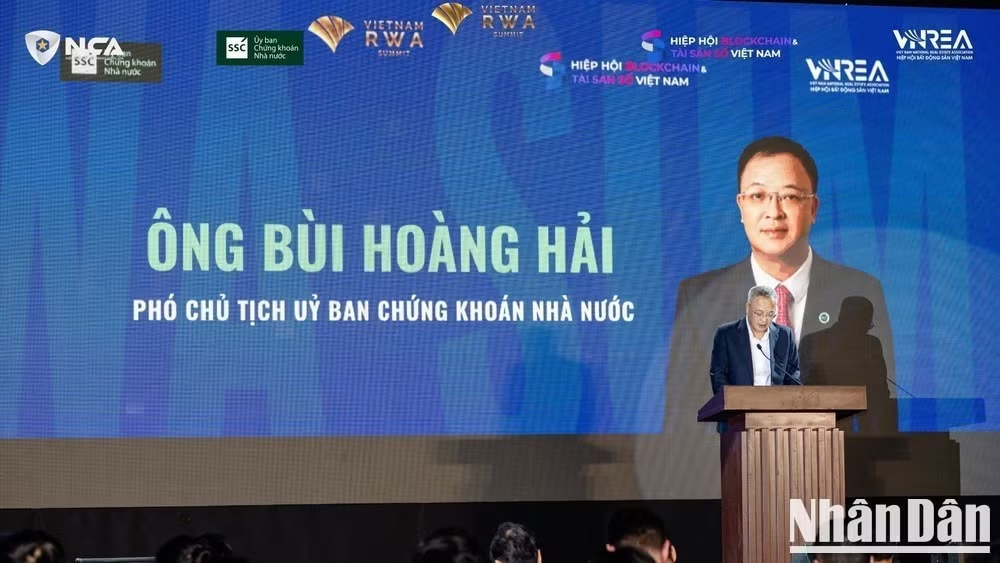
Regarding cybersecurity, Senior Colonel, Dr Nguyen Hong Quan, Deputy Director of the Department of Cybersecurity and High-Tech Crime Prevention (A05) under the Ministry of Public Security, stated that a digital asset ecosystem can only achieve sustainable development when it is built upon secure technology, protected data, transparent transactions, clearly accountable stakeholders, and the safeguarding of the lawful rights and interests of both citizens and businesses.
"The Ministry of Public Security in general, and the cybersecurity and high-tech crime prevention force in particular, believe that cybersecurity is not a barrier to innovation. On the contrary, cybersecurity is the very condition that enables innovation to develop sustainably and builds trust in the market," Senior Colonel Quan emphasised.
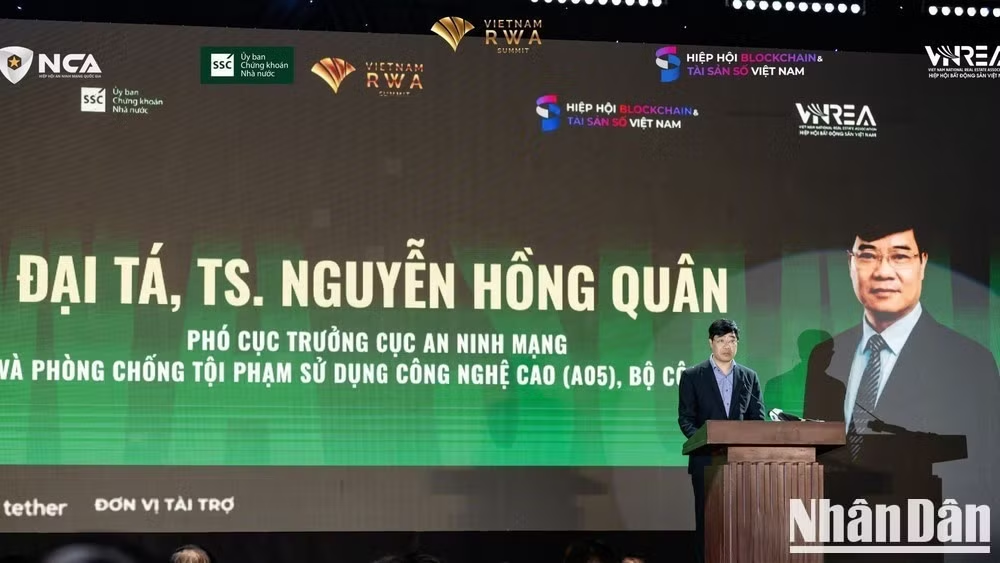
Addressing technical risks, Lieutenant Colonel Dr Nguyen Thanh Chung of the Department of Cybersecurity and High-Tech Crime Prevention (A05), Ministry of Public Security, noted that from 2020 to early 2025, more than 660 cyberattacks targeting the digital asset sector were recorded worldwide, causing losses of nearly 13 billion USD. In the first months of 2026 alone, losses have already reached approximately 800 million USD. The main risks stem from the novel technical characteristics of blockchain, insufficient investment in cybersecurity, human vulnerabilities, and the market's growing attractiveness to cybercriminals. Attacks have primarily targeted wallets, exchanges, bridges, and blockchain applications, underscoring the need to strengthen assessment, monitoring, and incident response capabilities for pilot systems.

Viet Nam possesses advantages in retail demand and the digitalisation of the capital market
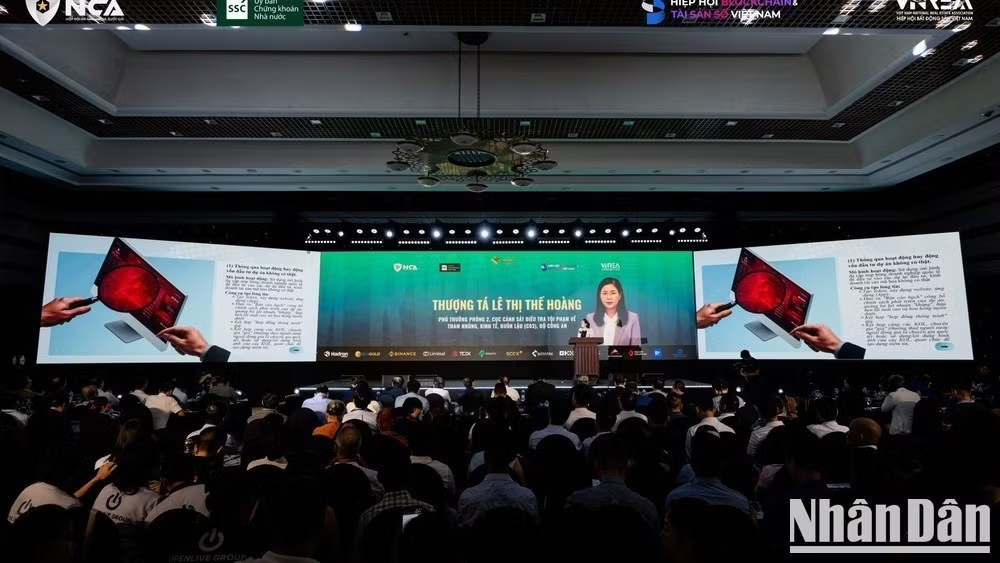
Lieutenant Colonel Le Thi The Hoang, Deputy Head of Division 2 under the Department for Investigation of Corruption, Economic Crimes and Smuggling (C03), Ministry of Public Security, warned of schemes involving the creation of token projects, with artificial liquidity generated through bots and fake accounts to attract investors.
Digital assets have also been exploited for money laundering through multiple intermediaries, blockchain platforms, and international exchanges in order to obstruct tracing efforts. According to her, the challenge is not merely to deal with violations, but also to enhance the capacity for early detection, monitoring of capital flows, and coordination among regulators, law enforcement agencies, and organisations across the ecosystem.
If a legal framework is the necessary condition, then a reliable data infrastructure will be the sufficient condition for the market to develop and achieve its expected outcomes. Mr Phan Duc Trung, Chairman of the Viet Nam Blockchain and Digital Assets Association, said that investment in the tokenisation of real-world assets increased by approximately 300% in 2025, significantly outperforming other asset classes. However, the primary obstacle preventing the market from reaching its full potential does not lie in tokenisation technology itself, but in the failure to establish sufficient trust within the capital market.
According to Trung, blockchain can facilitate the distribution, transfer, and settlement of assets, but it cannot create trust on its own or transform poor-quality assets into good ones. Trust in tokens must begin with reliable data on the underlying real-world assets, verifiable identities of all parties involved, and authenticated information regarding assets and cash flows, together with mechanisms for disclosure, continuous monitoring, and supervision.

Therefore, the market structure should be developed in sequence: starting with real-world assets, followed by a reliable data infrastructure, then digital assets built upon an appropriate legal framework, and only afterwards the creation of tokens and distribution channels. Within this structure, exchanges are merely one of many channels through which assets reach investors; the decisive factors remain the nature of the underlying assets, their quality, and the verifiability of the supporting data.
Regarding Viet Nam, Trung noted that within the past approximately ten months, the country has established six legal documents at various levels, ranging from laws and decrees to circulars, while continuing to prepare frameworks for digital identification and authentication. Viet Nam also enjoys advantages in terms of retail market demand, with around 200 billion USD in tokenised assets flowing through the market and approximately 17 million wallets or holders of digital assets. This could provide an important foundation for developing a digitised capital market, provided that the necessary layers of data infrastructure, digital assets, and distribution mechanisms are comprehensively established.