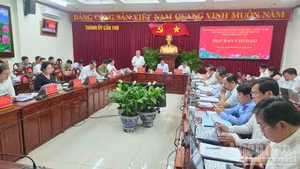
Recently, the Prime Minister issued a decision on the list of 10 strategic technologies and a list of two groups with 30 strategic technology products, demonstrating determination and efforts to build a strategic technology foundation, enhance self-reliance capacity and national competitiveness. The issuance of the list of strategic technologies and groups of strategic technology products is considered an important step in orienting the long-term development of national science and technology. This is not only a basis for concentrating investment resources but also helps identify priority areas that need to be promoted in order to create competitive advantages.
Researching, developing and mastering core technologies, strategic technologies and strategic technology products with high localisation rates and added value, capable of replacing imports and supporting exports, will help form several strategic industries with international competitiveness, making significant contributions to economic growth, ensuring national defence, security and national technological self-reliance.
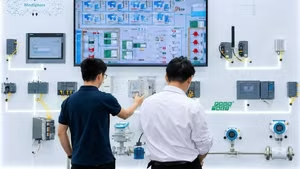
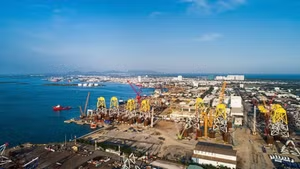
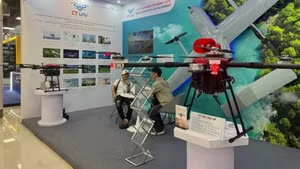
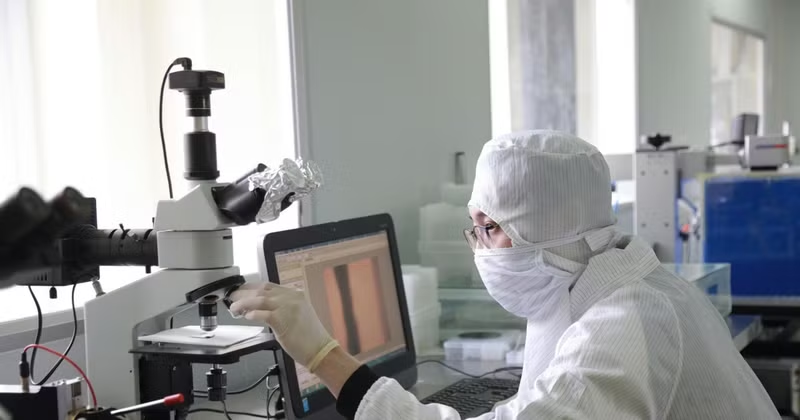
Reality shows that many research units and enterprises have also focused on directions for developing strategic technologies and strategic technology products such as: digital technology, robotics and automation, advanced biology and biomedicine, advanced energy and materials, semiconductor chips, seas, oceans and underground resources… Implementing solutions to improve research and application capacity, aiming to develop into world-class research centres; promoting the commercialisation of research results and making practical contributions to the knowledge-based economic growth model. However, developing and mastering strategic technologies in our country still remains a long journey from research, transfer and application to meeting market demands. Reality shows that the organisation and implementation of strategic technology and strategic technology product development remain confused, have yet to create substantial changes, and no strategic technology products have yet been systematically implemented in close association with the requirements of each sector, field, locality and enterprise, creating tangible value and making clear contributions to economic development.
The role of enterprises and the market in strategic technology development has not yet been fully promoted. Investment in science, technology and innovation remains scattered; links between research institutes, universities and enterprises are still loose; in most cases, universities, research institutes and scientists still produce research products first, lacking major problems ordered by enterprises under the model of “demand preceding supply”.
To turn the goal of mastering strategic technologies into reality, state management requires mechanisms and policies strongly encouraging enterprises to invest in science, technology and innovation; making enterprises truly become the centre of the technology ecosystem.
The State plays the role of creator and guide, building specific implementation mechanisms, selecting the right key projects and concentrating sufficiently strong resources for each priority area. Sectoral ministries need to closely coordinate with leading corporations, enterprises, research institutes and universities to form strategic technology value chains; from research-development and testing-application to production-commercialisation. At the same time, it is necessary to soon establish innovation centres that are sufficiently strong, open and flexible to effectively connect research with the market. Notably, the training, attraction and utilisation of human resources need to move one step ahead in order to soon form a leading workforce in science, technology and innovation capable of leading research and progressing towards mastering strategic technologies. Research institutions need to strongly innovate in the direction of taking enterprises and the market as the centre; research topics should aim towards applicability and commercialisation instead of merely serving scientific publication objectives.
For enterprises, it is necessary to identify themselves as the centre of the innovation ecosystem; not only as places applying technology but also becoming the centre of the process of research, development and technology commercialisation; innovating thinking to propose major problems for research orders; participating in the process of building research infrastructure, especially in strategic technology areas identified by the Government, in order to gradually realise the goal of breakthroughs in science, technology and innovation development, moving towards mastering strategic technologies.