The focus of reform must now shift decisively towards improving the way government functions, clearly defining responsibilities, strengthening coordination, and promptly addressing emerging bottlenecks so that every policy and decision is effectively translated into practical results.
After one year of operating under the two-tier local government model, the reform has begun to demonstrate the soundness of streamlining the administrative apparatus while promoting greater decentralisation and delegation of authority.
The abolition of the district level has not only removed an administrative layer but has also brought government closer to the people, enabling local authorities to respond more proactively and improve public service delivery.
Previously, district authorities served as an intermediary between provincial and commune-level governments, translating policies into action, supervising implementation, and advising on issues arising at the grassroots level. With the district tier removed, a direct relationship has been established between provincial and commune authorities.
This is more than an organisational adjustment; it represents a fundamental transformation in the way the entire system operates, requiring a governance framework suited to the new model.
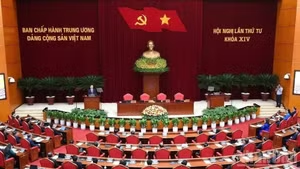
Speaking at the closing session of the third plenum of the 14th Party Central Committee, Party General Secretary and State President To Lam stressed that after one year of implementing the new political system and the two-tier local government model, the new organisational structure had proven to be effective, appropriate and well coordinated. However, he noted that operational quality remained uneven, particularly at the grassroots level.
Experience has shown that greater decentralisation inevitably creates new demands for local governance.
The responsibilities of provincial authorities and the autonomy of commune-level governments must be clearly defined. Delegation of authority must be accompanied by adequate resources, data, implementation capacity and appropriate oversight mechanisms. These are essential requirements during the transition.
Within this framework, authority must go hand in hand with accountability. Delegation must be supported by the conditions necessary for implementation, while problems arising at the grassroots level must be addressed promptly to continuously improve governance.
An institutional framework can function effectively only when the functions, duties and responsibilities of every level of government are clearly defined and implemented consistently.
Under the two-tier local government model, decentralisation is not merely about transferring additional powers. Rather, it establishes a new governance model in which each level performs its designated role and takes full responsibility for outcomes.
General Secretary and State President To Lam outlined the responsibilities of each level of government: "The three levels of government must operate smoothly, coordinate closely and interact effectively. The central government should focus on strategic orientation, institutional development, building shared platforms, allocating major resources and overseeing implementation. Provincial authorities must further reform and innovate their methods of leadership and administration, translate policies into concrete actions, organise development space, coordinate resources, create favourable conditions for commune-level governments and take responsibility for overall performance. Commune-level governments serve as the frontline of public governance, directly implementing policies, serving citizens, and addressing practical issues arising from the daily lives of people and businesses. Therefore, they must be equipped with sufficient governance capacity to lead local development."
This is also the key to overcoming the current "implementation bottlenecks". Provincial authorities need to shift from managing day-to-day administrative affairs to governing the system strategically.
Their primary responsibilities should include formulating policies, refining institutional mechanisms, coordinating resources, monitoring implementation and promptly resolving issues beyond the authority of commune-level governments.
If provincial governments continue operating under the mindset that every issue must be handled at the provincial level, they will remain occupied with routine administrative matters, limiting their strategic role in shaping development and improving institutions.
Conversely, commune-level governments must move beyond simply following instructions towards proactively organising implementation and directly serving citizens and businesses.
Matters that have been decentralised should be resolved at the grassroots level whenever possible. Only issues beyond local authority or involving broader institutional or policy questions should be escalated for consideration by higher authorities.
When every level performs its designated role effectively, policies can be implemented more smoothly and governance quality will improve.
No organisational model can be perfect from the outset. The true value of reform lies not in avoiding problems altogether, but in identifying operational shortcomings early and continuously refining the system through practical experience.
For the two-tier local government model, the objective is not merely to maintain a streamlined organisational structure or a clearly decentralised framework, but to establish a governance system capable of continuous self-improvement.
Within such a system, every policy is tested through practice; every challenge is identified, addressed and transformed into a basis for refining institutions, policies and governance methods.
Every issue that arises should not only be resolved but should also serve as valuable experience for improving institutional mechanisms and strengthening governance capacity.
This creates a continuous governance cycle in which strategic direction, implementation, supervision and practical evaluation are closely linked, allowing policies and mechanisms to be adjusted in a timely manner.
When authority, responsibility and support mechanisms are clearly defined, the system becomes capable of self-adjustment and rapid adaptation to new development requirements.
However, even the best institutional framework can succeed only if it is implemented by capable and responsible public officials. What is needed is not more administrative directives but a transparent and well-defined system that makes it clear which decisions can be made independently, which require coordination, which must be reported to higher authorities, and how officials can receive timely guidance when difficulties arise.
Only under such conditions can public officials carry out their duties with confidence, demonstrate initiative, take responsibility and embrace innovation in the public interest.
The success of the two-tier local government model should not be measured by the number of administrative units eliminated, but by the government's implementation capacity and the quality of services delivered to citizens and businesses.
When every policy is translated into tangible results, when grassroots challenges are resolved promptly, and when people can clearly perceive improvements in government performance, reform has truly taken root.
A modern governance system is not one that never encounters problems, but one that continually learns from experience, refines its institutions and strengthens its implementation capacity. Administrative reform can only be considered successful if the new model delivers better governance than the old one.
Ultimately, success depends not only on creating a more rational organisational structure, but also on establishing a governance model capable of continuous improvement and supported by a professional, responsible civil service committed to turning every policy and decision into concrete results in people's daily lives.