When site clearance began for the section of Ring Road 2.5 linking Nguy Nhu Kon Tum Street and Nguyen Trai Street in Thanh Xuan Ward, many voiced concern over the scale of the challenge. The ward needed to acquire more than four hectares of land involving around 700 households in a long-established neighbourhood with complex land records.
Nguyen Huy Cuong, Secretary of the Thanh Xuan Ward Party Committee, noted that the ward had adopted the principle of "say it, do it", ensuring work was carried out swiftly but prudently, decisively yet in full compliance with the law, while safeguarding the lawful rights and interests of residents.
Practical experience has enabled the locality to draw valuable lessons, including identifying and addressing bottlenecks early, ensuring direct leadership by Party committees, holding leaders fully accountable, and organising the administrative apparatus with clear responsibilities, tasks, timelines, and expected outcomes.
The ward has also revamped its public engagement approach by working alongside residents rather than merely conducting information campaigns. In addition to compensation, support, and resettlement policies prescribed by law, it introduced tailored social welfare packages for different circumstances, while sending letters of appreciation and erecting gratitude boards to acknowledge households that handed over land, cementing its philosophy that residents are partners throughout the process.
As a result, in just over four months, by May 20, 2026, Thanh Xuan Ward successfully finalised 100% of site clearance for the Ring Road 2.5 project without resorting to compulsory land acquisition, preventing protracted disputes, and while maintaining social stability.
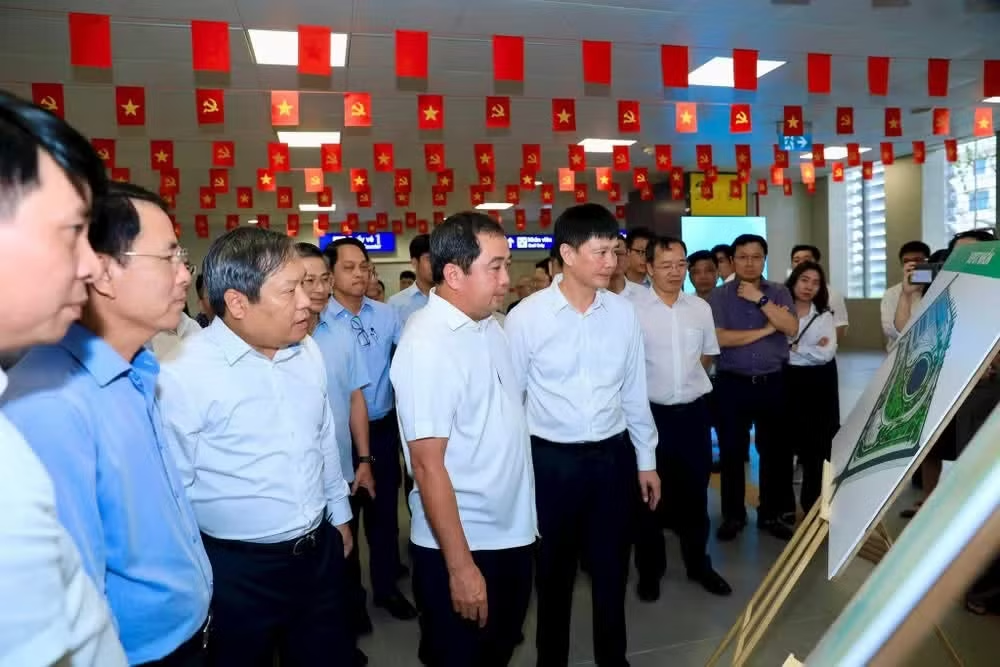
This is a clear example of the effectiveness of Ha Noi's two-tier local government model, empowering local authorities to resolve new and difficult tasks, particularly in site clearance.
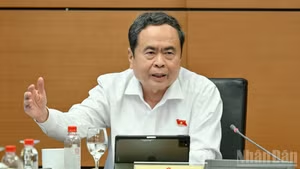
Ha Noi Party Secretary Tran Duc Thang asserted that the achievements of the past year had confirmed that the city's two-tier political and local government system was a sound policy perfectly tailoured to practical conditions. The city has initially established a more effective governance model that is closer to the people and more responsive to their needs.
The political system is gradually shifting from administrative management to modern governance; from a management-oriented administration to a service-oriented one; from administrative decision-making to data-driven governance; and from multi-layer coordination to direct interaction between the city and communes and wards.
The objective of bringing government closer to the people and shifting from management to governance has yielded remarkable outcomes. Under this new approach, Ha Noi has acted decisively, delivering work quickly, correctly, effectively, and through to completion. Initial economic and public administration indicators all point to encouraging progress.
Following one year of operating the two-tier local government model, the city has reduced the number of commune-level administrative units by 76%. The current 126 communes and wards now directly administer more than 5,463 villages and residential groups while serving nearly 8.9 million residents.
The restructuring of commune-level administrative units was not executed merely to slash the number of units but was closely linked to reorganising development space and restructuring the city's governance model.
Despite juggling numerous urgent and complex tasks, the city has maintained political stability, unity, and cohesion across the entire system without disrupting leadership, direction, administration, or public services. The political system, from the city level down to the grassroots, has operated smoothly under four pillars — the Party, the People's Council, the People's Committee, and the Viet Nam Fatherland Front.
Administrative thinking has transitioned from governance based on administrative tiers to governance focused on localities and serving residents and businesses, with greater accountability placed on leaders. State management has gradually become more effective, while commune- and ward-level administrations have become more proactive, more people-centred, and better able to serve residents.
City leaders noted that decentralisation, delegation of authority, and clarification of responsibilities had been implemented comprehensively and decisively. The principle of "localities decide, localities implement, and localities take responsibility" has shortened processing times and improved the responsiveness of local administrations to the needs of residents and businesses.
In less than one year, communes and wards have received and processed more than 2.26 million dossiers pertaining to responsibilities delegated from the former district level and the city.

The city has publicly disclosed 100% of administrative procedures under the jurisdiction of all levels of government. It has implemented 2,077 administrative procedures, including 1,118 that are fully eligible for end-to-end online public services. It has also completed the restructuring of 1,172 administrative procedures and standardised more than 2,000 internal and electronic workflows.
In 2025, the city received more than 3.5 million administrative applications, including over 2.1 million submitted online. More than 619,000 applications were processed regardless of administrative boundaries, curbing travel time and administrative costs while making public services more accessible to residents and businesses across the city.
The milestones achieved during the first year of implementation have helped maintain political stability, public order, and social security, while creating favourable conditions for socio-economic development.
In 2025, the city's gross regional domestic product (GRDP) grew by 8.16%, while total State budget revenue exceeded 711 trillion VND, up 38.4% compared with 2024.
During the first six months of 2026, total State budget revenue reached 404.418 trillion VND, fulfilling 62.2% of the annual target and increasing 2.9% year on year.
"We can affirm that the two-tier political and local government model is the right policy, well suited to the realities of the Capital, creating new drivers for socio-economic development while enhancing the capacity to serve residents and businesses," Tran Duc Thang emphasised.
Drawing on the achievements and valuable lessons from the first year of implementation, Tran Duc Thang affirmed that Ha Noi would continue to strengthen unity in awareness, thinking, and action to further elevate leadership and governance capacity, and build a modern public administration and digital government capable of meeting the Capital's development requirements in the new period, with the ultimate goal of enhancing the happiness and quality of life of its people.