Border areas command a profoundly critical strategic position, serving both as spaces for development and integration and as the frontline in safeguarding the Fatherland. Therefore, building strong border areas, in association with socio-economic development and the consolidation of national defence and security, represents an imperative strategic prerequisite in the cause of national construction and defence.
Thoroughly grasping the guidelines of the Party and State and the leadership and direction of the Central Military Commission and the Ministry of National Defence, during the 2015–2025 period, the Border Guard force implemented numerous models, programmes, and movements in border and island areas. These contributed to catalysing tangible transformations in socio-economic development, consolidating grassroots political systems, strengthening the great national unity bloc, building a strong all-people border defence, and a solid “people’s hearts and minds posture” in border areas.
One of the defining hallmarks in building strong border areas is the advisory role and participation of the Border Guard force in building and consolidating grassroots political systems. The force has focused on strengthening personnel for border and island communes, assigning Party members to attend activities at hamlet and village Party cells, participate in local Party committees, and coordinate in training grassroots officials. During 2015–2025, 10 officers joined provincial and municipal Party committees; 435 joined commune-level Party committees; 2,626 Party members attended activities at 2,375 hamlet and village Party cells in border areas; and nine officers were transferred to hold positions as secretaries, chairpersons, and deputy secretaries of commune Party Committees, the Fatherland Front, and Party commissions in border communes. At the same time, the force regularly provided training in national defence and security knowledge, border management and protection; trained militia and self-defence forces and reserve forces; and detected and developed local personnel sources, especially officials from ethnic minority groups.
Consolidating grassroots political systems has always been closely linked with socio-economic development and improving people’s lives. Therefore, the Border Guard force has coordinated in effectively implementing many social welfare, hunger eradication and poverty reduction, new-style rural area building programmes, and projects on preserving and developing particularly small ethnic minority communities. These efforts have helped 112 communes reach the average level and 195 communes rise from average to fairly good level in socio-economic development.
In the two tenures of 2015–2020 and 2020–2025, 9,661 Party members from border guard stations were assigned to assume responsibility for 42,247 households, directly guiding people in production development, livelihood transformation, and sustainable poverty reduction.
The movement “Border Guards join hands to build new-style rural areas” supported 189 communes in meeting criteria, including 71 communes recognised as meeting new-style rural standards. In education and health care, the programme “Helping children go to school — adopted children of border guard stations” and the combined military-civilian medical station system have been steadfastly sustained, contributing to improving the living standards, education, and health care of people in border areas. These programmes, models, and movements not only provide immediate support, but also create livelihoods and elevate the long-term autonomous development capacity of border communities.
Reflecting upon the past 10 years, it is evident that the most sustainable value created by the Border Guard force’s models, programmes, and movements lies not only in socio-economic development results or the consolidation of grassroots political systems, but more importantly in firmly building the “people’s hearts and minds posture” in border areas, promoting the strength of the great national unity bloc, and creating a solid political and social foundation for the cause of building, managing, and protecting territorial sovereignty and national border security.
Experience dictates that border protection must begin with protecting and caring for people’s lives, and that maintaining territorial sovereignty must begin with consolidating people’s trust. When people trust the Party and State, remain attached to the Border Guard force, and actively participate in local movements, the strength to protect the border will be multiplied and sustained.
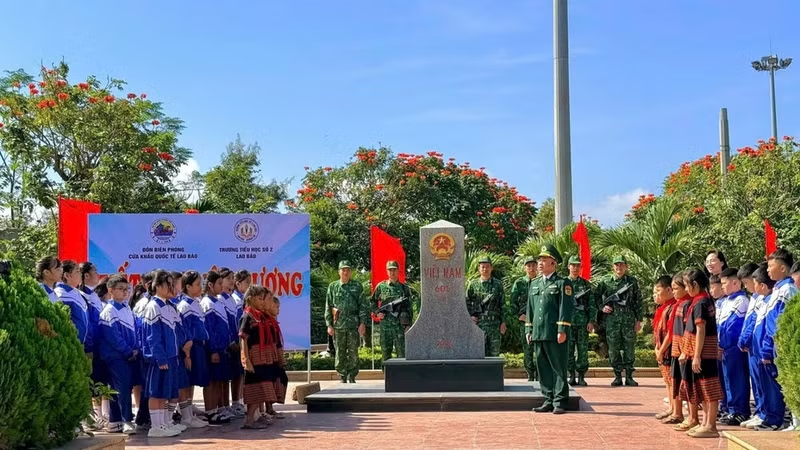
Guided by the motto “The station is home, the border is homeland, and ethnic communities are brothers and sisters”, Border Guard officers and soldiers consistently practise the “three attachments and four togethers”, staying close to their areas and standing alongside the people with respect, understanding, and care. This close bond has strengthened people’s trust in the Party, the State, the army, and the Border Guard force. From recipients of support, local residents have evolved into proactive stakeholders in managing and protecting borderlines and markers, and maintaining security and order in border areas. This is the core value that generates the combined strength needed to firmly safeguard the Fatherland’s frontiers.
As the country enters a new stage of development, the global and regional situation undergoes rapid tranformation, with complex and unpredictable developments. Traditional and non-traditional security challenges, cross-border crime, natural disasters, and climate change continue to directly affect all aspects of social life.
Meanwhile, the development gap between delta and urban areas and border and island areas remains large, and the lives of part of the population remain fraught with hardship. This reality demands the persistent rejuvenation of the contents and methods of implementing models, programmes, and movements in a practical, effective, and sustainable direction.
The focus should be on continuing to thoroughly grasp and effectively implement the Party’s guidelines and policies on building strong border areas; proactively proposing improvements to mechanisms and policies for the development of border and island areas; and mobilising the entire political system and resources for infrastructure investment, sustainable poverty reduction, and enhanced material and spiritual well-being for the people.
At the same time, efforts must persistently elevate the effectiveness of personnel assigned to support communes, officers participating in local Party committees, Party members attending hamlet and village Party cells, and those in charge of households. It is also necessary to promote the role of village elders, hamlet heads, and reputable people; maintain and replicate models proven effective in practice; and link these efforts with stronger digital transformation and closer coordination among all levels, sectors, localities, and society as a whole.
Practice has affirmed that wherever the grassroots political system is strong, people’s lives are improved, and the great national unity bloc is consolidated, territorial sovereignty and national border security are firmly maintained.
Maximising the impact of these models, programmes, and movements is therefore not only an immediate task, but also a long-term strategic requirement, contributing to building borders of peace, stability, cooperation, and development, and firmly safeguarding the Fatherland early and from afar.