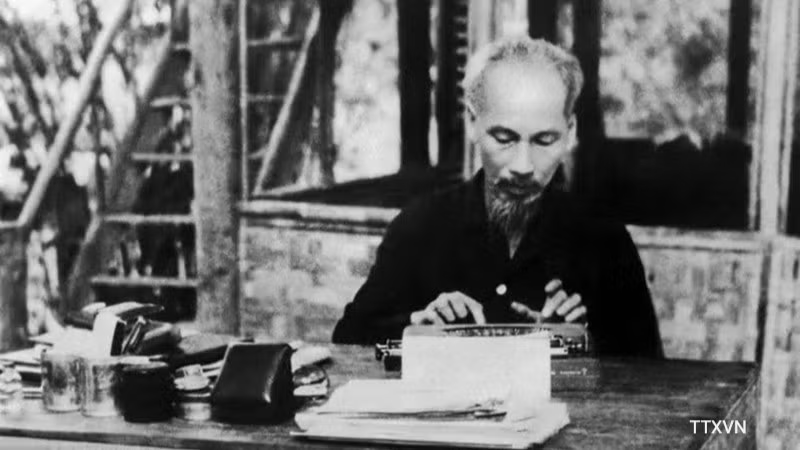
In the years that followed, every May, President Ho Chi Minh reread the document, revising and supplementing it. The Testament was completed on May 10, 1969.
President Ho Chi Minh wrote his Testament at a historic moment when the Vietnamese revolution and nation were confronting extremely grave challenges. The US imperialists massively deployed troops to the South and waged a brutal “local war”, while using their air and naval forces to launch fierce attacks against the North in a war of destruction.
The Party and President Ho Chi Minh continued to lead the building of socialism while the entire country was at war, with the North concentrating its efforts on providing manpower and material support to the southern battlefield. In March 1965, the Party Central Committee convened its 11th Plenum of the thirrd tenure, followed by the 12th Plenum in December 1965, affirming its determination to lead the fight against the US with a creative revolutionary line and methods. On July 17, 1966, President Ho Chi Minh issued an appeal to the people and soldiers nationwide to resolve to defeat the US aggressors, affirming the truth: “Nothing is more precious than independence and freedom.” Once victory was achieved, he said, Viet Nam would be rebuilt to become more dignified and beautiful.
President Ho Chi Minh’s Testament has become an invaluable historic document addressing the great tasks of the Party, the revolution, the country and the people. At the same time, it expressed his hope that many specific tasks would be carried out even better. The Testament embodies the profound love for the people and humanity of a great leader who devoted his entire life to the country and its people. One of the most urgent tasks at the time was to secure victory in the resistance war against the US for national salvation, liberate the South and reunify the country.
President Ho Chi Minh wrote: “Our people’s resistance war against the US for national salvation may have to endure greater hardships and sacrifices, but it will certainly achieve complete victory. That is an absolute certainty.” “Our Fatherland will certainly be reunified. Our compatriots in the North and South will certainly be reunited under one roof.” More than half a century ago, the Party, the entire people and armed forces fulfilled that arduous, sacred and glorious mission. That strategic determination continues to carry profound educational significance, embodying patriotism and the aspiration for independence, freedom and national reunification. The foreign aggressors have been driven out, but “we must together safeguard the country” and firmly defend our beloved Vietnamese Fatherland. That is the solemn pledge of our Party and people before the spirit of President Ho Chi Minh.
Other major tasks entrusted by President Ho Chi Minh in his Testament have been successfully carried out by generations of the Party and people—achievements of which we can be proud when reporting to him. We will continue to strive steadfastly over the long term, remaining faithful to the teachings of our beloved President Ho Chi Minh.
Writing about the Party, President Ho Chi Minh affirmed that our Party had united, organised and led the people in their vigorous struggle, advancing from one victory to another. He attached particular importance to Party building and rectification: “In my opinion, the first thing that must be done is to rectify the Party, so that every Party member, every Youth Union member and every Party cell strives to fulfil the tasks assigned by the Party and wholeheartedly serves the people.” “The Party is a ruling Party. Every Party member and cadre must be truly imbued with revolutionary morality, and must truly practise diligence, thrift, integrity, uprightness, complete selflessness and impartiality. We must preserve the absolute purity of our Party and prove worthy of our role as the leader and truly loyal servant of the people.”
Regarding national reconstruction after victory, President Ho Chi Minh expressed his wish that “we shall rebuild our country more splendidly than ever before”, rebuilding “the cities and villages to make them more beautiful and dignified than before the war” and “restoring and expanding economic sectors”. He called for improvements in sanitation and healthcare, reforms to the education system to suit the people’s new circumstances, and proper care for people with meritorious service and all sections and strata of society. The ultimate goal was to build a strong and prosperous country for the people.
President Ho Chi Minh stressed that working people in both the lowlands and mountainous areas had endured hardship for generations, suffered oppression and exploitation under feudalism and colonialism, and experienced many years of war. Yet the Vietnamese people remained heroic, courageous, enthusiastic and industrious. Since the founding of the Party, the people had always followed the Party and remained deeply loyal to it. “The Party must have a truly sound plan for developing the economy and culture in order to continuously improve the people’s living standards.”
President Ho Chi Minh also instructed the Party to train young people, educate them in revolutionary morality, and cultivate them as successors in the building of socialism who were both “red” and “expert”. “Fostering the revolutionary generation for the future is a very important and necessary task.”
He left his “boundless affection” to the entire people, the entire Party, all members of the armed forces, young people and children, while extending his cordial greetings to international friends. “My final wish is that our entire Party and people, united in their efforts, will build a peaceful, reunified, independent, democratic and prosperous Viet Nam, and make a worthy contribution to the world revolutionary cause.”
A great many tasks of national reconstruction and the organisation of social life confronted the Party and the people. President Ho Chi Minh observed: “The work described above is immense, arduous and complex, but also most glorious. It is a struggle against what is old and corrupt in order to create what is new and good. To achieve victory in this gigantic struggle, it is necessary to mobilise, organise and educate the entire people, relying on the great strength of the entire people.”
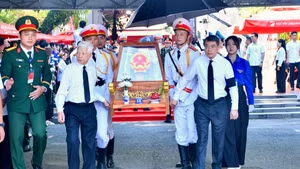
Successive generations of Party and State leaders have led the Vietnamese nation in carrying out President Ho Chi Minh’s Testament to the fullest extent possible, as well as fulfilling the five solemn pledges contained in the funeral oration delivered by Le Duan, First Secretary of the Party Central Committee, before President Ho Chi Minh’s spirit at the memorial ceremony on September 9, 1969. They led the cause of national liberation and reunification to complete victory and firmly safeguarded the Fatherland’s independence and sovereignty; successfully led the cause of Doi Moi (Renewal) and national development along the socialist path; and remained steadfast on the revolutionary path decisively chosen by the Party and President Ho Chi Minh in 1930, when the Communist Party of Viet Nam was founded.
In carrying out President Ho Chi Minh’s teachings and aspirations, the Party, State and entire Vietnamese people are making every effort to build and develop a civilised and modern country.
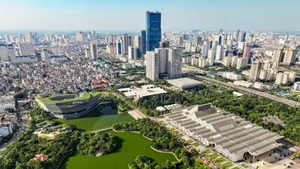
In carrying out President Ho Chi Minh’s teachings and aspirations, the Party, State and entire Vietnamese people have made concerted efforts to build and develop a civilised and modern country. Before the launch of Doi Moi (Renewal) in 1986, Viet Nam was still an underdeveloped, poor and backward country, with per capita income of less than 200 USD and people facing many difficulties in their daily lives. After 40 years of Doi Moi, Viet Nam has become a developing country with upper-middle income, with per capita income exceeding 5,000 USD a year. Its economy has reached 514 billion USD in size, ranking 32nd in the world.
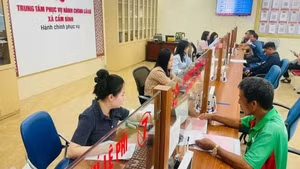
Thanks to accelerated industrialisation, modernisation and urbanisation, the development of modern infrastructure and the building of new-style rural areas, the face of the country has undergone rapid and comprehensive transformation. The material and cultural lives of the people have steadily improved. The poverty rate, which stood at more than 58% in 1993, had fallen to 1.3% under the multidimensional poverty standard by 2025. Viet Nam has achieved universal lower secondary education, while more than 95% of the population is covered by health insurance. The social security system is increasingly geared towards providing better support for people in education, healthcare, housing and mobility, towards a civilised and progressive society that places people at its centre.
Party building and rectification, in accordance with President Ho Chi Minh’s teachings, have been strengthened to enhance the Party’s leadership and governing capacity and combativeness. The Party attaches importance to renewing its thinking, strengthening theoretical research, reviewing practical experience, further developing and perfecting its guidelines and Platform, fostering ethical standards, and building strong organisations and a capable contingent of officials. The 14th National Congress of the Communist Party of Viet Nam in January 2026 emphasised the need of strengthening Party building and rectification and self-renewal so that the Party is truly ‘moral and civilised’; elevating and improving the effectiveness and efficiency of the Party’s leadership and governance and enhancing its combativeness.
The Congress affirmed four steadfast commitments: remaining steadfast in, creatively applying and developing Marxism-Leninism, President Ho Chi Minh’s Thought and the theory underpinning the Doi Moi line; remaining steadfast in the goals of national independence and socialism; remaining steadfast in comprehensively and synchronously advancing the Party-led Doi Moi process; and remaining steadfast in the Party’s organisational and operational principles.
These are also fundamental orientations for the country as it enters a new era and strives to successfully achieve its two centenary strategic goals. The entire Party, people and armed forces are making every effort for a peaceful, independent, democratic, strong, prosperous, civilised and happy Viet Nam, firmly advancing towards socialism. This requires the effective implementation of the Politburo’s Directive No. 07-CT/TW, dated July 13, 2026, on “Promoting the Study and Practice of President Ho Chi Minh’s Thought, Morality, Methods and Style in the New Stage of Development”—studying to gain a profound understanding and putting those teachings into practice in a serious, substantive and effective manner.