More than five centuries ago, scholar Than Nhan Trung famously inscribed a timeless maxim on a doctoral stele at the Van Mieu - Quoc Tu Giam (Temple of Literature): “Talented and virtuous people are the vital essence of a nation. When this essence flourishes, the country grows strong and prospers; when it declines, the country weakens and falls.”
This philosophy embodies the wisdom of previous generations in valuing talent and statecraft. Looking back through history, its enduring relevance to personnel work in the new era resonates with profound contemporary significance.
In today's personnel work, nurturing this vital national resource requires special attention at every stage — from talent identification, planning, and training to evaluation and merit-based utilisation.
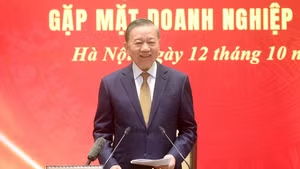
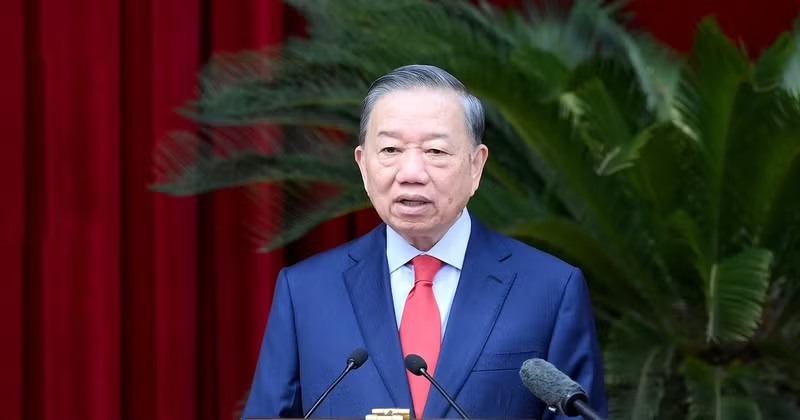
Speaking at the opening of the fourth meeting of the Party Central Committee, Party General Secretary and President To Lam emphasised that the National Strategy for Attracting, Utilising, and Developing Talent in Key Sectors to Serve the Country's Rapid and Sustainable Development must stem directly from the country's strategic tasks and critical capability deficits. He questioned how Viet Nam should train, attract, and connect talent to master technology, improve productivity, and strengthen national self-reliance. Valuing and utilising talent is the decisive factor, while developing a sustainable talent pipeline is a fundamental and enduring endeavor.
The Party leader called for mechanisms to entrust major responsibilities, delegate genuine authority, ensure adequate resources, and evaluate individuals based on their actual contributions. He also emphasised the need to foster an environment that champions innovation while tolerating controlled risks in scientific research.
He urged connecting domestic talent, overseas Vietnamese intellectuals, and international experts, while strengthening linkages among universities, research institutes, businesses, and the public and private sectors.
Attracting top talent must go hand in hand with effective utilisation, the cultivation of succession pipelines, and the transfer of knowledge.
Associate Professor Dr Lam Quoc Tuan, Director of the Institute of Party Building under the Ho Chi Minh National Academy of Politics, affirmed that practical experience has proven that leadership cadre quality is paramount.
The soundness of strategic lines, their timely and accurate operationalisation, and the successful implementation of Party and State directives all depend on the calibre of the leadership contingent.
These officials are responsible for crafting and steering the policy agenda of the Party, the State, and socio-political organisations. Their spheres of influence, responsibilities, and methods of operation are extensive, diverse, and complex.
The ethics, working styles, and exemplary conduct of strategic-level cadres therefore exert a profound impact on institutional decision-making and operational effectiveness, as well as on the nation as a whole.
During the Doi Moi (Renewal) period, however, Viet Nam's strategic leadership contigent has displayed persistent shortcomings in both professional capacity and personal integrity, when measured against the country's political tasks and development imperatives.
These limitations stem partly from the absence of a comprehensive strategy for personnel and talent development, compounded by fragmented personnel policies. Continuously reforming the Party's personnel work to build a leadership contingent that is sufficient in quantity, high in quality, and capable of ensuring stable, unbroken succession is therefore a vital prerequisite for development in the new era.
The National Strategy for Attracting, Utilising, and Developing Talent in Key Sectors to Serve the Country's Rapid and Sustainable Development centres on key pillars, including mechanisms to identify and attract talent from outside the state sector and among overseas Vietnamese, alongside developing both leadership cadres and specialists according to merit-based, substantive standards.
A central priority is to maximise talent utilisation by entrusting major responsibilities, delegating genuine authority, assessing their actual contributions, and creating an environment conducive to innovation. The strategy also seeks to establish diverse talent networks, strengthen connections among research institutions, educational establishments, and businesses, and facilitate effective knowledge transfer. Evaluating talent by testing candidates through “novel and challenging assignments” marks a breakthrough. This approach aims to dismantle converntional reliance on formal qualifications or rigid administrative routines.
Mechanisms for task-based commissioning and outcome-based contracting are also expected to drive performance, under which the State commissions projects, allocates commensurate funding, and evaluates outcomes. Such mechanisms will help mobilise a wider pool of top-tier talent across society, enabling it to contribute more effectively to economic growth and the transformation of Viet Nam's development model.