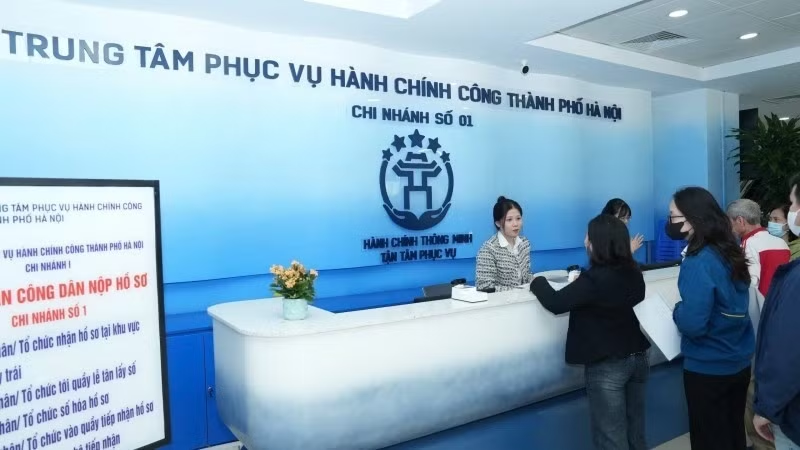
According to the Department of Administrative Reform under the Ministry of Home Affairs, the positive growth in the Satisfaction Index of Public Administrative Services (Sipas) and the Public Administration Reform (PAR) indicators in recent years points to a rising trend in public satisfaction and, more importantly, is forcing cadres and civil servants to change their awareness and actions towards putting citizens’ interests at the heart of service delivery.
Provinces and cities have proactively used these indicators as standard yardsticks and transparent reference points to identify the causes behind rises and falls in scores, and, on that basis, to design and implement tasks that are closer to practical realities.
Commune-level public service operations in Nghe An Province are closely tied to digital transformation, cutting the time and costs of administrative procedures through a comprehensive restructuring of processing workflows in the electronic environment, using population data and sectoral databases; and accelerating the provision of end-to-end online public services, online payments, and the digitisation of dossiers and settlement results.
A representative of the provincial Department of Home Affairs said this is not merely a technology task, but a fundamental solution that changes management and service methods, while reducing dependence on paperwork and manual certifications. Accordingly, the province has focused on upgrading the quality of operations at public administrative service centres at all levels, following the spirit of “one focal point–one process–one service standard”.
At present, 100% of provincial-level people’s committees have issued PAR Index indicators to assess and rank annual administrative reform results of subordinate agencies and units. The evaluation and classification of the quality of cadres, civil servants, and public employees based on these indicators serve as a basis for staffing arrangements, deployment, training, professional upgrading, planning, appointments, and commendation. As a result, duty accountability has been strengthened across many fields and on many fronts.
At present, 100% of provincial-level people’s committees have issued PAR Index indicators to assess and rank annual administrative reform results of subordinate agencies and units.
The Department of Home Affairs of Da Nang City is a pioneering unit in building and operating an internal affairs management information system, conducting management, consolidation, and data reporting on a software-based platform.
In practice, provinces and cities that have recorded positive Sipas and PAR Index results over many years have consistently been model examples of comprehensive and synchronised reform implementation. These indicators, grounded in realities on the ground, have deepened thinking on local governance, helping authorities at all levels clearly identify bottlenecks, promptly adjust targets and content, and renew leadership and direction methods — serving as a driving force for innovation and creativity in carrying out assigned tasks.
In many places, the application of Sipas and the PAR Index is not simply an administrative reform tool but has been expanded into a comprehensive multi-dimensional instrument capable of providing detailed information in real time, leveraging predictive analysis, and creating space not only for state agencies but also for citizens to become active participants in local governance.
At present, the commune level is where work effectiveness is “measured and counted” most clearly. Staffing, utilisation, and personnel management are no longer a matter of “arrangement” in the old way, but must follow functions, tasks and output results.
In Hai Phong City, Director of the Hai Phong City Department of Home Affairs Sai Thi Yen said that after the administrative merger, the city is not short of personnel in terms of headcount, but the imbalance is clear, creating a “gap” in service capacity. The shortfall is concentrated in fields requiring deep expertise such as planning, construction, architecture, transport, health, science and technology, and digital transformation.
In many places, civil servants hold degrees that meet formal requirements but lack hands-on experience and the capacity to handle “hot” issues at grassroots level; or they are capable but not in the right specialisation, resulting in less incisive advice, weaker case files, and uneven processing progress for residents and businesses. If these problems are not identified early, they can easily lead to prolonged processing times, a higher risk of complaints and petitions, and even breaches.
Hai Phong has chosen the solution of targeted secondments and reinforcements with clear objectives, time limits, and requirements for capability transfer. The key point of this approach is not reinforcement on a mass scale, but reinforcement to the right positions and the right localities, with very specific requirements on timelines and transfer; the goal is not “enough people” but “the right positions. To date, Hai Phong has basically addressed the situation of having “enough people but not the right work”, work being done without clear accountability, or procedures being correct but progress being slow.